At the JointLab "IP3" Scientists Develop Integrated Processes for the Production of Nanomaterials - Transfer of Scientific Know-how to Products
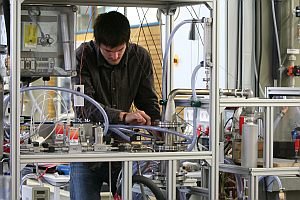 Construction of equipment at the JointLab IP3: Transfer of nanoparticles into the liquid phase. (Photo by: Gabi Zachmann)
"IP3" - innovative products, intelligent particles, integrated processes - is a joint laboratory for process technology at Karlsruhe, which has been founded by KIT and BASF SE. The JointLab has been established for five years for the time being. Both partners are represented equally. Activities will focus on the development of nanostructured functional materials for use in organic electronics, as pigments, agrochemicals, medicine, or catalysts.
The JointLab was opened on Friday, December 18, 15 hrs, at the assembly hall of the Center for Advanced Technological and Envi-ronmental Training (FTU), KIT Campus North, Hermann-von-Helmholtz-Platz 1, Eggenstein-Leopoldshafen.
The funding volume of the joint laboratory amounts to about 8 million euros for the contractual period of five years. These funds are pro-vided by BASF, KIT, and the state of Baden-Württemberg.
State Minister of Science, Professor Dr. Peter Frankenberg, con-gratulates on the start of "this highly promising model" of a close cooperation of science and industry. "Two global players have come to cooperate in IP3 and to mutually extend and complement their competences. They are active in a highly relevant field of research. The findings of IP3 will be used by both BASF and KIT as a basis for further directly application-oriented projects."
In the first phase, the IP3 team will include 20 scientists, of these, eleven Ph. D. students. Five KIT institutes will be involved with their know-how and their infrastructure. IP3 is designed decentrally in order to effectively and efficiently use the competences of the part-ners and to grow in a need-oriented manner in the future.
"With the establishment of the JointLab at KIT, we wish to further intensify the long excellent cooperation between Universität Karlsruhe and the research departments of BASF", underlines Pro-fessor Rainer Diercks, President of the BASF Competence Center for Chemicals Research and Engineering." New approaches to the development of integrated processes from raw materials to finished products require a high degree of competence in the field of particle technology and close cooperation of an interdisciplinary group of researchers. These conditions are fulfilled excellently by the Joint-Lab."
Professor Gerhard Kasper, Head of the Department of Gas Particle Systems of the KIT Institute for Mechanical Process Technology and Mechanics, considers the combination of fundamental research with application-oriented development in these projects to be highly promising: "Only processes that are well understood can be opti-mized specifically and transferred to new applications" says the scientist.
At the JointLab, the researchers will study individual process mod-ules by means of modern methods for later upscaling and combina-tion for use. It is aimed at producing particulate materials with ex-tremely small structures that can be controlled precisely by the proc-ess conduct. Precision, reproducibility, and modularity of the proc-ess steps on the nanometer scale are the keys to an optimally adapted functionality and, hence, implementation of many innovative product ideas. At the same time, the scientists involved also see better chances for a sustainable production of known materials. Precisely controllable processes consume less valuable raw materi-als and guarantee safe handling of nanoparticles and customized products.
Further information on the project at the joint laboratory IP3 and the scientists involved can be obtained at: www.ip3.de.