While attempting to solve one mystery about iron oxide-based nanoparticles, a research team working at the National Institute of Standards and Technology (NIST) stumbled upon another one. But once its implications are understood, their discovery* may give nanotechnologists a new and useful tool.
The nanoparticles in question are spheres of magnetite so tiny that a few thousand of them lined up would stretch a hair’s width, and they have potential uses both as the basis of better data storage systems and in biological applications such as hyperthermia treatment for cancer. A key to all these applications is a full understanding of how large numbers of the particles interact magnetically with one another across relatively large distances so that scientists can manipulate them with magnetism.
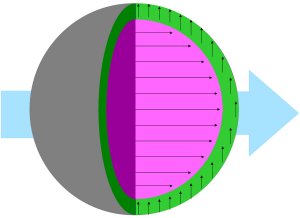 Schematic of a spherical magnetite nanoparticle shows the unexpected variation in magnetic moment between the particle's interior and exterior when subjected to a strong magnetic field. The core's moment (black lines in magenta region) lines up with the field's (light blue arrow), while the exterior's moment (black arrows in green region) forms at right angles to it. Credit: NIST
“It’s been known for a long time that a big chunk of magnetite has greater magnetic ‘moment’—think of it as magnetic strength—than an equivalent mass of nanoparticles,” says Kathryn Krycka, a researcher at the NIST Center for Neutron Research. “No one really knows why, though. We decided to probe the particles with beams of low-energy neutrons, which can tell you a great deal about a material’s internal structure.”
The team applied a magnetic field to nanocrystals composed of 9 nm-wide particles, made by collaborators at Carnegie Mellon University. The field caused the particles to line up like iron filings on a piece of paper held above a bar magnet. But when the team looked closer using the neutron beam, what they saw revealed a level of complexity never seen before.
“When the field is applied, the inner 7 nm-wide ‘core’ orients itself along the field’s north and south poles, just like large iron filings would,” Krycka says. “But the outer 1 nm ‘shell’ of each nanoparticle behaves differently. It also develops a moment, but pointed at right angles to that of the core.”
In a word, bizarre. But potentially useful.
The shells are not physically different than the interiors; without the magnetic field, the distinction vanishes. But once formed, the shells of nearby particles seem to heed one another: A local group of them will have their shells’ moments all lined up one way, but then another group’s shells will point elsewhere. This finding leads Krycka and her team to believe that there is more to be learned about the role that particle interaction has on determining internal, magnetic nanoparticle structure—perhaps something nanotechnologists can harness.
“The effect fundamentally changes how the particles would talk to each other in a data storage setting,” Krycka says. “If we can control it—by varying their temperature, for example, as our findings suggest we can—we might be able to turn the effect on and off, which could be useful in real-world applications.”
The research team, which also included scientists from Oberlin College and Los Alamos National Laboratory, used neutron instrumentation supported in part by the National Science Foundation (NSF). Research at Carnegie Mellon and Oberlin also received support from NSF.
* K.L. Krycka, R.A. Booth, C. Hogg, Y. Ijiri, J.A. Borchers, W.C. Chen, S.M. Watson, M. Laver, T.R. Gentile, L.R. Dedon, S. Harris, J.J. Rhyne and S.A. Majetich. Core-shell magnetic morphology of structurally uniform magnetite nanoparticles. Physical Review Letters, 104, 207203 (2010), DOI 10.1103/PhysRevLett.104.207203