The Terminator. The Borg. The Six Million Dollar Man. Science fiction is ripe with biological beings armed with artificial capabilities. In reality, however, the clunky connections between living and non-living worlds often lack a clear channel for communication.
Now, scientists with the Lawrence Berkeley National Laboratory (Berkeley Lab) have designed an electrical link to living cells engineered to shuttle electrons across a cell’s membrane to an external acceptor along a well-defined path. This direct channel could yield cells that can read and respond to electronic signals, electronics capable of self-replication and repair, or efficiently transfer sunlight into electricity.
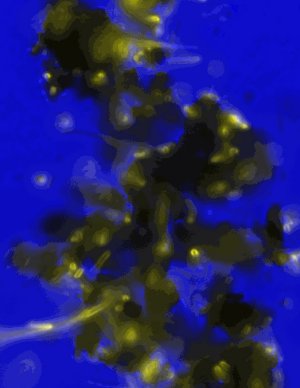 An engineered Escherichia coli strain (yellow) attaching to solid iron oxide (black). Scientists at the Molecular Foundry took the first step toward electronically interfacing microbes with inorganic materials, without disrupting cell viability. (Image courtesy of Heather Jensen)
“Melding the living and non-living worlds is a canonical image in science fiction,” said Caroline Ajo-Franklin, a staff scientist in the Biological Nanostructures Facility at the Molecular Foundry. “However, in most attempts to interface living and non-living systems, you poke cells with a sharp hard object, and the cells respond in a predictable way – they die. Yet, in Nature many organisms have evolved to interact with the rocks and minerals that are part of their environment. Here, we took inspiration from Nature’s approach and actually grew the connections out of the cell.”
Coaxing electrons across a cellular membrane is not trivial: attempts to pull an electron from a cell may disrupt its function, or kill the entire cell in the process. What’s more, current techniques to transfer cellular electrons to an external source lack a molecular roadmap, which means even if electrons do turn up outside a cell, there is no way to direct their behavior, see where they stopped along the way, or send a signal back to the cell’s interior.
“We were interested in finding a pathway that wouldn’t kill the living systems we were studying,” said Heather Jensen, a graduate student at University of California, Berkeley whose thesis work is part of this publication. “By using a living system in electronics, we can one day create biotechnologies that can repair and self-replicate.” In their approach, Jensen, Ajo-Franklin and colleagues first cloned a part of the extracellular electron transfer chain of Shewanella oneidensis MR-1, marine and soil bacteria capable of reducing heavy metals in oxygen-free environments. This chain or “genetic cassette,” Ajo-Franklin notes, is essentially a stretch of DNA that contains the instructions for making the electron conduit. Additionally, because all life as we know it uses DNA, the genetic cassette can be plugged into any organism. The team showed this natural electron pathway could be popped into a (harmless) strain of E. coli—a versatile model bacteria in biotechnology— to precisely channel electrons inside a living cell to an inorganic mineral: iron oxide, also known as rust.
Bacteria in environments without oxygen, such as Shewanella, use iron oxide from their surroundings to breathe. As a result, these bacteria have evolved mechanisms for direct charge transfer to inorganic minerals found deep in the sea or soil. The Berkeley Labs team showed their engineered E. coli could efficiently reduce iron and iron oxide nanoparticles—the latter five times faster than E. coli alone.
“This recent breakthrough is part of a larger Department of Energy project on domesticating life at the cellular and molecular level. By directly interfacing synthetic devices with living organisms, we can harness the vast capabilities of life in photo- and chemical energy conversion, chemical synthesis, and self-assembly and repair,” said Jay Groves, a faculty scientist at Berkeley Labs and professor of chemistry at University of California, Berkeley. “Cells have sophisticated ways of transferring electrons and electrical energy. However, just sticking an electrode into a cell is about as ineffective as sticking your finger into an electrical outlet when you are hungry. Instead, our strategy is based on tapping directly into the molecular electron transport chain used by cells to efficiently capture energy.”
The researchers plan to implement this genetic cassette in photosynthetic bacteria, as cellular electrons from these bacteria can be produced from sunlight—providing cheap, self-replicating solar batteries. These metal-reducing bacteria could also assist in producing pharmaceutical drugs, Ajo-Franklin adds, as the fermentation step in drug manufacturing requires energy-intensive pumping of oxygen. In contrast, these engineered bacteria breathe using rust, rather than oxygen, saving energy.
A paper reporting this research titled, “Engineering of a synthetic electron conduit in living cells,” appears in Proceedings of the National Academy of Sciences and is available to subscribers online. Co-authoring the paper with Jensen, Ajo-Franklin and Groves were Aaron Albers, Konstantin Malley, Yuri Londer, Bruce Cohen, Brett Helms and Peter Weigele.
Portions of this work at the Molecular Foundry were supported by DOE’s Office of Science.