Michael Creutz, a physicist at the U.S. Department of Energy's (DOE) Brookhaven National Laboratory, has been chosen by the World Federation of Scientists (WFS) as the recipient of the 2008 Gian Carlo Wick Gold Medal Award, which is given annually to a theoretical physicist for outstanding contributions to particle physics. Creutz will receive the award at a WFS meeting held in Erice, Italy, August 19 - 24.
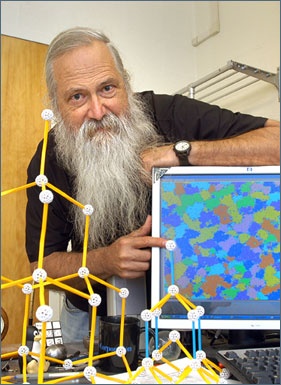 Michael Creutz
Founded in 1973, the WFS is an association of more than 10,000 scientists from 110 countries whose aim is to share knowledge among all nations so that everyone can experience the benefits of scientific progress. Gian Carlo Wick (1909-1992), a native of Italy, was an eminent theoretical physicist who led the theory group at Brookhaven Lab from 1958 to 1970.
“I am honored to have been chosen to receive this award and to be in the company of the esteemed scientists that received it previously,” Creutz said. “Also, I am proud to be the recipient of an award named after Gian Carlo Wick. I was not yet at the Laboratory when he worked here, but I met him when I was a child because my father, Ed Creutz, then head of the physics department at Carnegie Tech – now Carnegie Mellon University – hired him as a faculty member.”
Michael Creutz was cited for his work on lattice quantum chromodynamics (QCD), a theory that describes the interactions of subnuclear particles. Specifically, Creutz first demonstrated that properties of QCD could be computed numerically on a four-dimensional lattice through computer-based calculations known as Monte Carlo techniques.
In 1974, Nobel laureate Kenneth Wilson of Cornell University first proposed using a lattice in a regular geometric arrangement of discrete points of space and time to simplify making the advanced calculations required for QCD. Coined in the 1940s by physicists working at DOE’s Los Alamos National Laboratory, the Monte Carlo method derives its name from the random numbers used in this computational technique to explore the vast space of possible values for the fields that bind quarks. Such calculations are now routinely made by theoretical physicists around the world and require the most powerful computers available.
Using Monte Carlo techniques on the lattice, Creutz provided strong numerical evidence that quarks cannot be isolated, thus confirming this conjectured property of QCD. He found that the force between widely separated quarks, which is equal to 14 tons, did not decrease as the quarks moved farther apart. Creutz published his findings in the journal Physical Review in 1980. His paper became among the most cited from that year.
These computational methods have since been applied to numerous theoretical problems in physics, including the physics of Brookhaven’s world-class accelerator, the Relativistic Heavy Ion Collider, and may be relevant for interpreting new physics findings at the Large Hadron Collider at CERN, the European Organization for Nuclear Research, near Geneva, Switzerland. Currently, Creutz is investigating including neutrinos on the lattice, which is difficult because, unlike other subatomic particles, they only spin in one direction. Over the last several years, physicists have been able to improve the control of both the size and accuracy of the lattice with the aid of powerful new supercomputers at Brookhaven.
Michael Creutz earned a B.S. in physics from the California Institute of Technology in 1966, and a Ph.D. in physics from Stanford University in 1970. He was a postdoctoral fellow at the Center for Theoretical Physics at the University of Maryland before he joined Brookhaven Lab in 1972 as an assistant physicist. He became an associate physicist in 1974, a physicist in 1976, and a senior physicist in 1980.
A Fellow of the American Physical Society (APS), Creutz received the APS’s Aneesur Rahman Prize for Computational Physics in 2000. He also received the Brookhaven Research & Development Award in 1991 and the Andrew Sobczk Memorial Lectureship from Clemson University in 1997.