May 21 2009
SANYO Electric Co., Ltd. (SANYO) announced today it has broken its own record for the world’s highest energy conversion efficiency in practical size (100 cm2 or more) crystalline silicon-type solar cells, achieving a efficiency of 23.0% (until now 22.3%) at a research level for its proprietary HIT solar photovoltaic cells.
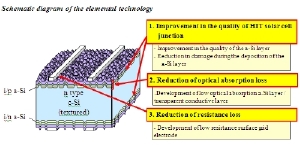 Schematic diagram of the elemental technology
Improving the quality of heterojunction of HIT solar cell
The structure of the HIT solar cell allows a possible reduction in recombination loss of the electrical element (charged carrier) by surrounding the energy generation layer of single thin crystalline silicon (c-Si) with high quality ultra-thin amorphous silicon (a-Si) layers. SANYO has recently managed to improve the quality of the HIT solar cell junction through developing a technology for depositing a higher quality a-Si layer over the c-Si substrate while protecting the c-Si surface from being damaged.
The result was an increase in the open circuit voltage (Voc) from 0.725V to 0.729V.
Reduction of optical absorption loss
In the solar cell, sunlight hitting the surface needs guidance to the c-Si, the energy generation layer, with the smallest possible absorption loss. For the HIT solar cell, reducing optical absorption loss in the a-Si layer, which covers the front and rear surfaces of the c-Si, and the transparent conductive layer was a challenge. Absorption of short-wavelength solar radiation by the a-Si layer and that of long-wavelength solar radiation by the transparent conductive layer were the causes of the optical absorption loss. SANYO has recently developed know-how to reduce optical absorption loss in both the a-Si and transparent conductive layers. As a result, the short circuit current (Isc) improved from 39.2mA/cm2 to 39.5mA/cm2.
Reduction of resistance loss
In the solar cell, generated electric current is collected and taken out through the surface grid electrode. SANYO recently realized lower-resistance electrode material for use in the grid electrode and a higher-aspect ratio through improving printing technology, leading to a success in reduction of resistance loss when an electric current flows through the grid electrode. As a result, the fill factor (FF) was improved from 0.791 to 0.80.
For the full release and all detailed information, click here