In excess of seven million barrels of gasoline are consumed by vehicles in the United States every day. As scientists race to find environmentally sound solutions to fuel the world's ever-growing transportation needs, battery researchers are exploring the promise of lithium-air battery technology.
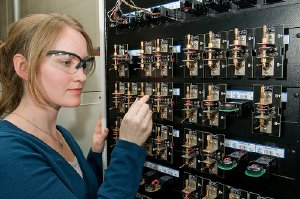 Argonne researcher Lynn Trahey loads a coin-sized cell on a testing unit used to evaluate electrochemical cycling performance in batteries. (Larger hi-rez version.) Photo by Wes Agresta.
Li-air batteries use a catalytic air cathode that supplies oxygen, an electrolyte and a lithium anode. The technology has the potential to store almost as much energy as a tank of gasoline, and will have a capacity for energy storage that is five to 10 times greater than that of Li-ion batteries, a bridge technology. That potential, however, will not be realized until critical scientific challenges have been solved.
Researchers at the U. S. Department of Energy's (DOE) Argonne National Laboratory are leveraging their broad and deep understanding of safe, high-energy and long-life Li-ion battery development to leap the high hurdles required for the development of commercially viable Li-air batteries.
"The obstacles to Li-air batteries becoming a viable technology are formidable and will require innovations in materials science, chemistry and engineering," said Argonne Director Eric Isaacs. "We have a history of taking on scientific challenges and overcoming them. Argonne is committed to developing Li-air battery technologies. In fact, we've made it a ‘grand research challenge' at the laboratory."
Argonne has researched a variety of battery technologies during the last four decades, and in the process has built a deep well of scientific and engineering expertise. As a result, the lab has become a leader in the development of new materials for advanced batteries, including Li-ion batteries.
"This is not a near-term technology," added Jeff Chamberlain, Senior Account Manager in Argonne's Office of Technology Transfer. "It is going to take time and collaborations across several scientific disciplines to address the four main challenges of this battery development effort: safety, cost, life and performance."
To accomplish this task, Argonne's research will continue to span basic, applied and theoretical sciences and will leverage the lab's world-class research facilities - the Advanced Photon Source, the Center for Nanoscale Materials and Argonne's Leadership Computing Facility.
While the potential of Li-air batteries is great, the research to get there will take time and involve working with industry, which will eventually adopt the technology for commercial application.
Argonne has worked with several industrial partners on the commercialization of Li-ion batteries and battery materials, including companies such as EnerDel, Envia, BASF and Toda America. The lab is working with the Commonwealth of Kentucky to develop the Kentucky-Argonne National Battery Manufacturing Center, which will support the development of a viable U.S. battery manufacturing industry. And more recently, DOE awarded the lab $8.8 million to build out and outfit three battery research facilities that will be used for battery prototyping, materials production scale-up and post-test analysis.