Recent analyses from the Relativistic Heavy Ion Collider (RHIC), a 2.4-mile-circumference "atom smasher" at the U.S. Department of Energy's (DOE) Brookhaven National Laboratory, establish that collisions of gold ions traveling at nearly the speed of light have created matter at a temperature of about 4 trillion degrees Celsius - the hottest temperature ever reached in a laboratory, about 250,000* times hotter than the center of the Sun.
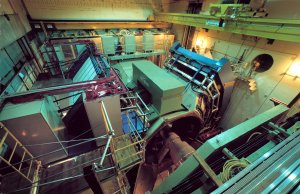 PHENIX detector
This temperature, based upon measurements by the PHENIX collaboration at RHIC, is higher than the temperature needed to melt protons and neutrons into a plasma of quarks and gluons. Details of the findings will be published in Physical Review Letters.
These new temperature measurements, combined with other observations analyzed over nine years of operations by RHIC's four experimental collaborations - BRAHMS, PHENIX, PHOBOS, and STAR - indicate that RHIC's gold-gold collisions produce a freely flowing liquid composed of quarks and gluons. Such a substance, often referred to as quark-gluon plasma, or QGP, filled the universe a few microseconds after it came into existence 13.7 billion years ago. At RHIC, this liquid appears, and the quoted temperature is reached, in less time than it takes light to travel across a single proton.
"This research offers significant insight into the fundamental structure of matter and the early universe, highlighting the merits of long-term investment in large-scale, basic research programs at our national laboratories," said Dr. William F. Brinkman, Director of the DOE Office of Science. "I commend the careful approach RHIC scientists have used to gather detailed evidence for their claim of creating a truly remarkable new form of matter."
According to Steven Vigdor, Brookhaven's Associate Laboratory Director for Nuclear and Particle Physics, who oversees the RHIC research program, "These data provide the first measurement of the temperature of the quark-gluon plasma at RHIC."
Scientists measure the temperature of hot matter by looking at the color, or energy distribution, of light emitted from it - similar to the way one can tell that an iron rod is hot by looking at its glow. Because light interacts very little with the hot liquid produced at RHIC, it bears accurate witness to the early cauldron-like conditions created within.
Said Vigdor, "The temperature inferred from these new measurements at RHIC is considerably higher than the long-established maximum possible temperature attainable without the liberation of quarks and gluons from their normal confinement inside individual protons and neutrons.
"However," he added, "the quarks and gluons in the matter we see at RHIC behave much more cooperatively than the independent particles initially predicted for QGP."
Hot gas vs. hot liquid
Scientists believe that a plasma of quarks and gluons existed a few microseconds after the birth of the universe, before cooling and condensing to form the protons and neutrons that make up all the matter around us - from individual atoms to stars, planets, and people. Although the matter produced at RHIC survives for much less than a billionth of a trillionth of a second, its properties can be determined using RHIC's highly sophisticated detectors to look at the thousands of particles emitted during its brief lifetime. The measurements provide new insights into Nature's strongest force - in essence, what holds all the protons and neutrons of the universe together.
Predictions made prior to RHIC's initial operations in 2000 expected that the quark-gluon plasma would exist as a gas. But surprising and definitive data from RHIC's first three years of operation, presented by RHIC scientists in April 2005, showed that the matter produced at RHIC behaves as a liquid, whose constituent particles interact very strongly among themselves. This liquid matter has been described as nearly "perfect" in the sense that it flows with almost no frictional resistance, or viscosity. Such a "perfect" liquid doesn't fit with the picture of "free" quarks and gluons physicists had previously used to describe QGP.
In the papers published in 2005, RHIC physicists laid out a plan of crucial measurements to clarify the nature and constituents of the "perfect" liquid. Measuring the temperature early in the collisions was one of those goals. Models of the evolution of the matter produced in RHIC collisions had suggested that the initial temperature might be high enough to melt protons, but a more direct measurement of the temperature required detecting photons - particles of light - emitted near the beginning of the collision, which travel outward undisturbed by their surroundings.
"This was an extraordinarily challenging measurement," explained Barbara Jacak, a professor of physics at Stony Brook University and spokesperson for the PHENIX collaboration. "There are many ways that photons can be produced in these violent collisions. We were able to 'eliminate' the contribution from these other sources by exploiting RHIC's flexibility to measure them directly and to make the same measurement in collisions of protons, rather than of gold nuclei. Thus we could pin down excess production in the gold-gold collisions, and determine the temperature of the matter that radiated the excess photons. By matching theoretical models of the expanding plasma to the data, we can determine that the initial temperature of the 'perfect' liquid has reached about four trillion degrees Celsius."
Moving forward
The discoveries at RHIC have led to compelling new questions in the field of quantum chromodynamics (QCD), the theory that describes the interactions of the smallest known components of the atomic nucleus. To probe these and other questions and conduct detailed studies of the plasma, Brookhaven physicists are planning to upgrade RHIC over the next few years to increase its collision rate and detector capabilities.
"These technical improvements will facilitate studies of rare signals providing measurements of even better precision on temperature, viscosity, and other basic properties of the nearly perfect liquid quark-gluon plasma created at RHIC," Vigdor said.