What is nanotechnology? How will it affect our lives? And, why should we care? These are just a few of the questions addressed in Talking Nano, a wide-ranging 6-DVD set that includes presentations by noted researchers, a museum educator, and, remarkably, two very talented jugglers.
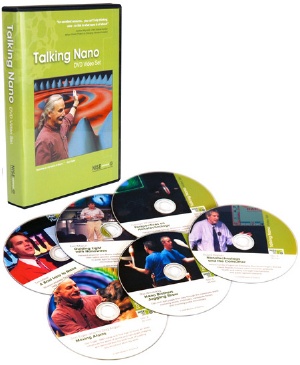
Taken as a whole, Talking Nano provides an excellent overview of where nanotechnology came from, what has been accomplished so far, and where it might eventually take us. Discs 1, 2, 3 and 6 are geared toward viewers with little or no prior knowledge about nanoscience, including younger science students. In Disc 1, A Brief Intro to Nano, Museum of Science educator Tim Miller provides a concise introduction to nanoscale science as framed by Richard Feynman's 1959 prediction that scientists would find "plenty of room at the bottom." Miller's presentation packs a lot of information into 20 minutes, and serves as a tasty appetizer for what's to come.
In Disc 2, Don Eigler and his Dog Argon: Moving Atoms, IBM Fellow Don Eigler introduces the atom and its basic structure before delving into his own groundbreaking research in nanoscale imaging and atom manipulation. A surprisingly down-to-earth presence-sporting a ponytail and joined onstage by his dog Argon-Eigler wraps complex ideas into a folksy and accessible delivery. He easily explains how data from scanning probe microscopes are used to produce visualizations of individual atoms, and shows some of his own iconic colorized "atomic landscapes." Leaving Powerpoint slides behind, and contacting his colleagues in California via Skype, Eigler logs into their scanning probe microscope and with a few clicks of the mouse, moves an actual atom in front of a cheering audience. As the video ends, Eigler takes things a step further, inviting kids onstage to do a little atomic manipulation of their own. Their enthusiasm reveals the power of a master of the art of science communication, able to guide children as well as adults to an awe-inspiring awareness of a remote and typically inaccessible world.
Guiding Light with Nanowires on Disc 3 captures another youth-friendly presentation by another masterful science communicator, Harvard physicist Eric Mazur. Beginning with his own colorful underwater images, Mazur reveals the strange effects produced by the reflection and refraction of light moving through substances of different densities. He demonstrates "total internal reflection," first harnessed a hundred years ago to produce public art, and now used to move light over great distances in fiber optics, a technology which has revolutionized communications. Mazur is a skilled and energetic presenter who has a knack for breaking difficult concepts into bite-sized chunks. He keeps his science firmly grounded in everyday experience. He describes almost stumbling upon the discovery that glass fibers can be pulled to nanoscale thinness with a simple Bunsen burner, and shows how these remarkably thin wires could serve as rails for guiding light in future communication technologies. We get a sense of the excitement of discovery on the edge of this still wide-open frontier: one innovation leading to another, and basic research morphing into tools and systems that change our lives.
The Amazing Nano Brothers Juggling Show, the "bonus" Disc 6 of the series, is quite a departure from the presentation-based format of the other 5 Talking Nano DVDs - and probably unique in the world of science theater: a 40 minute comedic romp through atomic structure, size and scale, nanoscale properties, and scanning probe microscopy. The very talented Joel Harris and Dan Foley, keeping up a constant banter about nanoscale science, spiced with slapstick brotherly rivalry, perform some truly amazing juggling feats choreographed just for this show, bringing key concepts about the nanoscale to life through "juggling visualizations." Art literally embodies science, as, for example, strobing balls arc across a dark stage illustrating the atom's electron "cloud;" Joel and Dan "bond" by sharing electrons (passing balls back and forth in complex patterns); and a unicycle stands in for the tip of a scanning probe microscope, while the brothers pass data back and forth in the form of rings (0's) and clubs (1's). This unique presentation was conceived, written and directed by the Museum of Science's Carol Lynn Alpert, with help from Dan and Joel and based on their prodigious talents.
Discs 4 and 5 are more appropriate for older students or adults, and tackle some of the more controversial aspects of nanotechnology. On Disc 4, Nanotechnology and the Consumer, David Rejeski of the Wilson Center Project on Emerging Nanotechnologies discusses the complex interplay between science, regulatory policy, and public opinion. Rejeski points out that even while nano-engineered consumer products are rapidly filling store shelves, research into potential health and safety risks and the formulation and enforcement of appropriate regulatory policy has lagged. At the same time, public perceptions about nanotechnology vary widely across gender, education level, and even ideology, suggesting significant differences in the way information about new technologies is processed by different people. The most illuminating aspect of Rejeski's talk is his discussion probing the nature of current discourse between government, industry, and the public, and its impact on the future development of nanotechnology.
The fifth disc in the series, George Whitesides: Perspectives on Nanotechnology (and its longest, clocking in at 55 minutes), offers a provocative overview of the past, present, and future of nanotechnology, from the unique perspective of this pioneering Harvard researcher in chemistry, biology, and nanotechnology. Peppered with philosophical interjections and broad insights on everything from the nature of existence to the ineffability of the wave/particle duality, George Whitesides' talk feels like a fireside chat with an éminence grise. The tenor of Whitesides talk is undeniably pro-science, and by extension pro-nanotechnology. While critically questioning some of the more hyped-up claims for nanotechnology and acknowledging, somewhat sardonically, some of the less-exalted drivers of research and innovation, he makes the case, on balance, that investment in nanotechnology will bring positive outcomes for society. At the same time, he cautions his listeners to consider the ethical dimensions of certain veins of scientific inquiry, wondering, for example, whether we should bioengineer green-glowing mice or prettier pets just because we can, and questioning the quality of life in a future in which ubiquitous information capture and storage will radically alter notions of privacy. While some viewers may feel Whitesides is too dismissive of certain kinds of potential risks, few will find this talk lacking in terms of the breadth of topics covered, or for the insights it offers into the implications of nanotechnology for society.
Talking Nano was filmed at and produced by the Museum of Science, Boston in association with the NSF Center for High-rate Nanomanufacturing, the Harvard NSF Nanoscale Science and Engineering Center, the Wilson Center Project on Emerging Nanotechnologies, and the Nanoscale Informal Science Education Network. It is available at cost from the Museum of Science online store. For more information, see talkingnano.net."