Jan 4 2008
Mazda Motor Corporation has developed a world’s first catalyst for cars that uses single-nanotechnology to create a catalyst material structure which substantially reduces the amount of precious metals that are used, such as platinum and palladium.
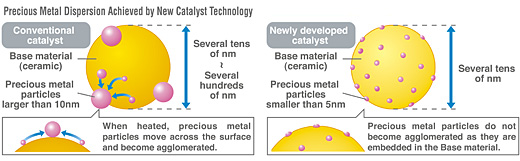 How the Mazda nanotechnology catalyst works
The new development enables Mazda to reduce the amount of platinum and palladium used in automotive catalysts by 70 to 90 percent. It does not result in any changes in the performance of purifying gas emissions and maintains the high durability of conventional catalysts. Single-nanotechnology is a technology that can control even smaller particles than nanotechnology.
In automotive catalysts, precious metals promote chemical reactions that purify exhaust gases on their surfaces. In conventional catalysts, the precious metals are adhered to a base material. Exposure to exhaust gas heat causes the precious metal to agglomerate into larger particles. This reduces the catalyst’s effective surface area and catalytic activity, which requires the use of a significant amount of precious metals to counter and maintain an efficient purification performance.
In order to increase the precious metal surface area, Mazda developed a new catalyst using its proprietary catalyst material structure and precious metal particles that are less than 5 nanometers (nm) in diameter. This is the first time that a catalyst material has been achieved that features single, nanosized precious metal particles embedded in fixed positions.
As a result, there is no agglomeration of the precious metal particles, and the amount of high-priced precious metals used in three-way catalytic converters - which purify gasoline-engine exhaust gases - can be reduced by 70 to 90 percent. Moreover, the new catalyst material will maintain the same level of purifying efficiency, with minimal deterioration over time even under the harshest operating conditions.