Swift and accurate identification of ultra fine structures, defects, scratches or dust particles in incident light demands a high-performance stereomicroscope, trained eyes and top quality illumination. At the SMT (Systems Integration in Microelectronics) fair in Nuremberg, Leica Microsystems is presenting its innovative LED illumination modules for stereomicroscopes, which offer optimum illumination even for difficult material samples. Thanks to modern LED technology, operating costs are significantly lower than for conventional halogen illumination.
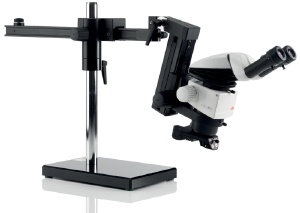
With its practically vertical illumination light path, the Leica LED3000 NVI solves even challenging illumination applications such as samples with indentations and drill holes not accessible using standard lighting components. The Leica LED5000 CXI (coaxial illumination) provides excellent detailed illumination of flat, highly reflecting surfaces such as wafers or polished metal samples, and substantially enhances contrast. Both illumination modules can be optimally combined with Leica stereomicroscopes for routine applications.
Extremely bright and homogenous illumination of the sample is offered by the Leica LED5000 RL ring light, an all-purpose solution for different types of applications. Due to conveniently switchable segments, extra information can be obtained from the sample without having to move it. The multi-contrast illumination Leica LED5000 MCI creates particularly high contrast on the sample: Due to the flat angle of the oblique incident light, the finest irregularities and defects such as scratches and dust particles are visualized. The ring light and the multi-contrast module are ideal illumination modules for high-end Leica stereomicroscopes, although the new LED modules can be used on most of the older models of the Leica M and MZ stereomicroscope series as well.
All the illumination settings of the Leica LED modules are reproducible. A constant color temperature is maintained during dimming. The LED modules offer ideal conditions for documenting results with a digital camera, either as still or moving images.
With a lifetime of up to 50,000 hours there is no need for lamp change and lamp failure is no longer an issue, either. Using up to 90 per cent less energy than a 150-watt halogen lamp, the LEDs cut operating costs and make a valuable contribution to the protection of the environment.