Researchers at the National Institute of Standards and Technology (NIST) have developed a new calibration technique that will improve the reliability and stability of one of NIST's most versatile technologies, the microhotplate. The novel NIST device is being developed as the foundation for miniature yet highly accurate gas sensors that can detect chemical and biological agents, industrial leaks and even signs of extraterrestrial life from aboard a planetary probe.
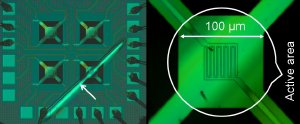 The NIST microhotplate uses its thermal efficiency in conjunction with a thermocouple to form a self-test temperature sensing system. Four microhotplates (left image) are seen with a strip of rhodium film (marked by an arrow) crossing the bottom right microhotplate. This strip makes contact with the platinum in the microhotplate structure (seen in the closeup image on the right) to form a stable thermocouple for measuring temperature. Credit: M. Afridi, NIST
The tiny microhotplates-no wider than a human hair-are programmed to cycle through a range of temperatures. They can be coated with metal oxide films tailored to detect specific gas species. Airborne chemicals attach to the surface of the detector depending on the type of film and the temperature of the surface, changing the flow of electricity through the device, which serves as the "signature" for identifying both the type and concentration of the gas in the ambient air.
Accurate microhotplate temperature measurements are crucial for the discrimination and quantification of gas species, while reliable, long-term operation demands that the microhotplate's temperature sensors be either highly stable or able to sense when they've drifted, a functionality known as a "built-in self test" (BIST). As demonstrated for the first time in a paper in an upcoming issue of IEEE Electron Device Letters,* the new calibration method satisfies both requirements.
A portion of the polysilicon heater making up the microhotplate originally served as the device's temperature sensor. However, this sensor would slowly drift over time from its initial calibration. Within three months, the temperature readings were off by as much as 25 degrees Celsius at high temperatures.
The NIST engineers overcame this shortcoming by using data from two additional temperature sensors-a highly stable, thin-film platinum/rhodium thermocouple integrated in the microhotplate structure for one sensor and the thermal efficiency of the structure itself for the other. Comparing the temperatures reported by these two sensors provides the microhotplate with its internal monitoring system. As long as the absolute value of the difference between the reported temperatures remains below a specified threshold value, the average of the two readings is considered reliable. Should the difference exceed the threshold, the system reports an error.
The original polysilicon sensor still provides the microhotplate's initial temperature measurement, which is used to calibrate the other two sensors. With the complete "check and balance" system in place, temperature measurements are accurate to within 1.5 degrees Celsius.
Having successfully demonstrated the new temperature calibration system for their microhotplate, the NIST researchers are working on additional advancements for the technology. Next in line is the development of a built-in system for sensing contamination of the metal oxide films critical to the microhotplate's use in gas detection.
* M. Afridi, C. Montgomery, E. Cooper-Balis, S. Semancik, K.G. Kreider and J. Geist. Analog BIST functionality for microhotplate temperature sensors. IEEE Electron Devices, Volume 30, No. 9 (September 2009).