Lawrence Livermore National Laboratory researchers are the recipients of six awards among the top 100 industrial innovations worldwide in 2009.
The six technologies honored by the trade journal R&D Magazine were developed by six teams of LLNL scientists and engineers. They worked with three universities, four industrial firms, one other national lab, the Stanford Linear Accelerator Center and the U.S. Department of Homeland Security’s Domestic Nuclear Detection Office.
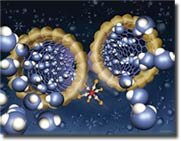 Artist's representation of water molecules going through a pair of carbon nanotubes. A large ion (center) is excluded.
The winning of an R&D 100 award provides a mark of excellence known to industry, government and academia and represents one of the most innovative ideas of the year.
This year’s R&D 100 awards will be presented Nov. 11 during a black-tie dinner at the SeaWorld Conference Center in Orlando, Fla.
With this year’s results, the Laboratory has now captured a total of 135 R&D awards since 1978.
“I am extraordinarily proud that the Laboratory has received this outstanding recognition through the R&D 100 awards this year,” said LLNL Director George Miller. “Once again, the Laboratory has succeeded in winning acclaim in a wide range of research areas. These LLNL teams are using their world-class capabilities and external partnerships to help solve difficult challenges in the global interest.”
Energy Secretary Steven Chu noted: “I want to congratulate all of this year’s winners on their awards and to thank them for their work. The large number of winners from the Department of Energy’s national labs every year is a clear sign that our labs are doing some of the most innovative research in the world. This work benefits us all by enhancing America’s competitiveness, ensuring our security, providing new energy solutions, and expanding the frontiers of our knowledge. Our national labs are truly national treasures, and it is wonderful to see their work recognized once again.”
This year’s Livermore R&D 100 awards could provide assistance in homeland security, help in improving sight for people, boost fusion energy research and permit major improvements in water purification, among other benefits.
Helping homeland security
A new material — strontium-iodide doped with europium — developed by LLNL researchers and their partners for use in radiation detectors enables high-resolution gamma-ray spectroscopy to identify nuclear materials for homeland security and other important applications.
The U.S. Department of Homeland Security (DHS) is supporting the development of this material and its use in devices. Several private companies are interested in obtaining licenses to deploy the material as a scintillator in hand-held detectors and portal monitors, as well as for medical, industrial and military uses.
The work to develop the material was performed in collaboration with Oak Ridge National Laboratory, Fisk University, Radiation Monitoring Devices Inc. of Watertown, Mass. and the DHS’ Domestic Nuclear Detection Office.
Improved water purification
Scientists from LLNL and a Hayward-based company, Porifera Inc., have developed a technology known as ultrapermeable carbon nanotube membranes, or simply nanotube membranes, that could play an important role in producing clean water.
Nanotube membranes can serve as an excellent filtration tool for separating salt and other ionic compounds from seawater or brackish water and for reclaiming waste water for use in crop irrigation and manufacturing processes.
Water flows about 1,000 times faster through nanotube membranes than through conventional filtration membranes of similar pore diameter and pore density. This capability could provide a more than 20 percent reduction in energy consumption in seawater desalination and more than 80 percent in brackish water desalination.
Seeing the retina at the cellular level
A new clinical instrument, a microelectromechanical systems-based Adaptive Optics Optical Coherence Tomography device, developed by researchers from LLNL and other institutions, permits ophthalmologists to see the eye’s retina at the individual cell level.
With this capability, doctors will be able to obtain early diagnoses and follow the progession of retinal diseases, as well as track the progress of genetic therapies that reverse such diseases. The instrument uses the same adaptive optics principles that allow astronomers to see distant stars and galaxies with the ground-based Keck Telescope in Hawaii with a higher resolution than the Hubble Space Telescope.
To date, the team has built and tested three prototype instruments with support from the National Eye Institute. The work has been performed in collaboration with the University of California, Davis, the Indiana University School of Optometry and Boston Micromachines Corp. of Watertown, Mass.
Detecting nuclear materials
LLNL researchers have developed the Statistical Radiation Detection System (SRaDS), a novel software system that nonexperts can use to rapidly and accurately distinguish nuclear materials, such as plutonium and uranium, from other radioactive substances for homeland security uses.
While traditional gamma-ray spectrometry techniques encounter problems with short screening periods, the SRaDS technology uses all the information available from each and every gamma ray screened. This approach ensures more accurate and timely detection and identification than can be achieved with conventional systems.
SRaDS is scalable and is easily integrated into any gamma detector system, including large stationary radiation portals used to search for contraband radioactive material in vehicles, cargo containers, or pedestrians moving through customs or border crossings. The work was performed in conjunction with ICx Technologies Inc. of Arlington, Va.
Capturing images of a tiny star
A new diagnostic system, the Grating Actuated Transient Optical Recorder (GATOR), developed by LLNL scientists and engineers can acquire sequential images of X-rays or optical light in a trillionth of a second or faster from experiments on the National Ignition Facility.
This diagnostic tool enables detailed measurements to be taken under ignition conditions to study the high energy density physics of thermonuclear burn – the condition in which stars and nuclear weapons operate. It will enable new studies to advance the scientific understanding of stars as well as stockpile stewardship.
The GATOR system improves upon the time resolution achievable with existing instruments by more than fifty-fold and can image events created using high-power lasers, as well as other high-energy-density objects.
Measuring a photon beam
LLNL researchers have developed an instrument, or energy monitor, that measures the pulse-by-pulse energy of an X-ray free electron laser (XFEL) photon beam without being damaged by the beam or affecting beam quality.
Obtaining a continuous understanding of the XFEL photon beam with minimal intrusion is important because beam characteristics determine the interaction of the beam with the experimental sample.
XFELs are tunable, high-power sources of photons, and these new machines offer significant promise for scientific and medical breakthroughs by capturing molecules and atoms in motion. This work was done in collaboration with a researcher from the Stanford Linear Accelerator Center.