Enable IPC Corporation's (Pink Sheets: EIPC) subsidiary, SolRayo LLC, has unveiled the design of the Company's new ultracapacitor using nanotechnology coatings for use in a number of applications, including smart grid, grid stability, power quality, and renewable energy. The new design is aimed at lowering costs and delivering more energy and power than similar devices currently on the market for the same price, opening up huge, untapped markets for ultracapacitors.
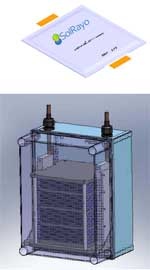
Flexible design
The new design is extremely flexible and is based on cells that can be used individually, or stacked in assemblies to attain the desired voltage and power.
"We have designed individual 300 farad units (a farad is a unit of capacitance) that can be stacked in series or parallel in a larger framework," explained Kevin Leonard, SolRayo's Chief Technology Officer. "The slim design should allow 300 farad units to be produced at considerably less expense than a similar unit available today. That's quite an achievement."
"Our goal is to fundamentally change the market by opening up the use of nanotechnology in ultracapacitors in a wide range of applications," said Dr. Mark Daugherty, SolRayo's CEO. "The idea is to use our cost-cutting technology in a simple design that will address a myriad of applications, beginning with smart grid, grid stability, power quality and renewable energy."
Addresses renewable energy issues
The State of Wisconsin awarded a grant to SolRayo in late 2008 to develop their technology for renewable energy applications in the state. One of the issues with solar and wind sources is the cost of storing excess energy so it can be used later as needed.
"The key is to keep costs low while significantly improving performance," Dr. Daugherty said.
"Our technology and this design will help achieve those goals."
Using ultracapacitors should cost significantly less than other storage methods for many applications when you look at total life cycle cost. Due to their simpler design, and significantly longer life, ultracapacitors require less upfront, maintenance and replacement costs than batteries and other storage mediums. Standard ultracapacitors use carbon electrodes. The Enable IPC / SolRayo device starts with carbon electrodes and adds a proprietary nanotechnology coating which has been shown to improve storage capacity of ultracapacitors by many times while lowering the storage cost per energy unit.
Design completed; alpha unit in process
The state grant requires Enable IPC's SolRayo subsidiary to develop, design and build a prototype ultracapacitor for renewable energy storage. Earlier this year, the Company completed phase I of the program, resulting in the designs pictured here. The Company is actively building these units and is on schedule to unveil its alpha unit product in January 2010.
Production units are scheduled to follow beta testing in early 2010.
Other applications
While the Company's focus has been on grid stability, power quality and renewable energy, the use of ultracapacitors in other areas is gaining momentum. Third party market researchers report large annual growth in consumer, industrial and transportation applications.
"Ultracapacitors take some of the load off batteries when large bursts of power are needed," explained Mr. Leonard. "An example is in your digital cell phone - the cell phone is powered by a battery, but the burst of power needed for transmitting is often supplied by an ultracapacitor."
Estimates vary widely between market research reports, but Enable IPC personnel believe a conservative estimate of the worldwide ultracapacitor market could reach $600 million in 2012. This represents an average annual growth rate of 15% to 17%.
"Ultracapacitors are coming into their own," said Dr. Daugherty. "Our goal is to have our technology lead the way to their widespread use throughout the world."