LayTec is proud to report that its EpiTT system is successfully applied at Kopin Corporation (MA, US) on AIXTRON 2600/IC system for temperature and reflectance monitoring of Heterojunction Bipolar Transistor (HBT) epi wafer production.
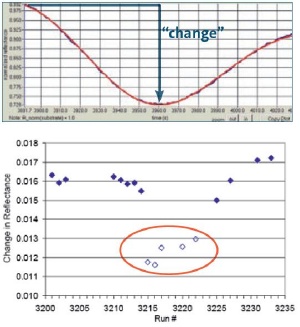 (top) Even partial reflectance oscillation of thin HBT layer can be fitted accurately. (bottom) Reflectance during the HBT base layer. The open datapoints identify the runs with the source problem.
At the CS Mantech in May, Eric Rehder from Kopin presented the measurement results and emphasized the following:
"...it is highly desirable to directly measure key epi layer parameters on each product wafer in order to continue pushing toward the goals of perfect quality and yields. Therefore, we have been working with the LayTec EpiTT in-situ optical reflectance monitoring system. These data allow for immediate detection of shifts in the epi layers. Therefore, problems can be detected and corrective actions taken before failed wafers are grown."
The figure (top) shows how accurately the oscillations are measured and fitted by EpiTT. It provides information on the run-to-run or wafer-to-wafer temperature variations in real time making visible the changes that cannot be detected by traditional metrology. The period of the oscillation yields the growth rate, the "change" amplitude - the refractive index change; the damping indicates the absorption of the film. The red line is the LayTec fit that nearly perfectly overlays the experimental data of the blue line.
The example in the figure (bottom) demonstrates how the "change" amplitude indicates a source doping problem during the base layer deposition. The reflectance change amplitude during the base layer deposition is plotted for several runs. The points show the depth of the oscillations for each run. The depth is normally near 0.016, corresponding to a certain doping level of the base layer, but for several runs it became shallower (0.013 - the points in the red circle). During this time there was a source problem causing the doping to decreas, and after fixing the problem the reflectance turned back to normal values.
In this way time reflectance measurements are used for insitu doping level reproducibility control. For further information please see the paper*.
*E. M. Rehder et. al. In Situ Monitoring of HBT Epi Wafer Production: The Continuing Push Towards Perfect Quality and Yields. Published in: www.gaasmantech.org/Digests/2009/2009%20Papers/045.pdf