The Carl Zeiss Research Award has been presented every two years since 1990. This year's prize goes to renowned scientists Professor Rainer Blatt from the University of Innsbruck and Professor Ignacio Cirac from the Max Planck Institute for Quantum Optics in Garching, Germany.
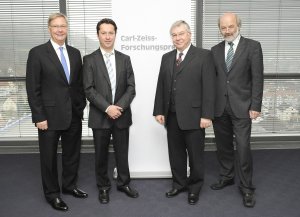 The winners of the Carl Zeiss Research Award: Professor Ignacio Cirac (2nd from left) and Professor Rainer Blatt (2nd from right). Professor Gerd Leuchs (right) emphasized the “excellent and extraordinary” work of the two scientists during his speech. President and CEO of Carl Zeiss AG, Dr. Dieter Kurz (left) presented the certificates. [Photo: Carl Zeiss]
Blatt and Cirac were honored for their revolutionary experimental and theoretical work in the field of quantum information and for the concepts and ideas that they have developed in quantum optics. “With this work, they have taken a leading role in quantum information science, one of the most active research fields today,” commented Dr. Dieter Kurz, President and CEO of Carl Zeiss AG. Both scientists have not only laid the foundation for future quantum technology, but have also actively worked in this direction.
Blatt and his group were among the first to conduct experiments on processing quantum information with ion traps—ideas initiated from Ignacio Cirac and Peter Zoller. The outstanding results transformed Innsbruck, Austria, into one of the global centers for quantum information processing.
Cirac contributed groundbreaking theories, including how quantum information science can be used in quantum optical systems. His remarkable work paved the way for the development of quantum information research.
During his speech, Professor Gerd Leuchs, founding Director of the Max Planck Institute for the Physics of Light in Erlangen, emphasized how much attention the work of the award winners has drawn to this field.
Every two years, Carl Zeiss honors extraordinary performances in international optical research with the Carl Zeiss Research Award. It is one of the most renowned honors in the world in the field of optics. It carries a cash prize of EUR 25,000.
Presented for the first time in 1990, the Carl Zeiss Research Award honors scientific excellence and lays the foundation for successful developments in the future. The significance of this award is emphasized by past winners Eric A. Cornell and Ahmed Zewail who went on to win the Nobel Prize after receiving the Carl Zeiss Research Award.
Professor Thomas Naumann from the DESY particle accelerator in Hamburg and guest researcher at CERN in Geneva provided the numerous guests from industry, science and politics with an insight into the creation of the cosmos using information gained from the LHC in CERN, the world's largest particle accelerator which has just resumed operations.