Oct 15 2008
Researchers at the National Institute of Standards and Technology (NIST) and JILA, a joint institute of NIST and the University of Colorado (CU) at Boulder, have made the first tunable "noiseless" amplifier. By significantly reducing the uncertainty in delicate measurements of microwave signals, the new amplifier could boost the speed and precision of quantum computing and communications systems.
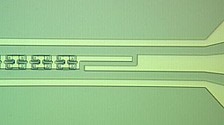 In the JILA/NIST “noiseless” amplifier, a long line of superconducting magnetic sensors (beginning on the right in this colorized micrograph) made of sandwiches of two layers of superconducting niobium with aluminum oxide in between, creates a 'metamaterial' that selectively amplifies microwaves based on their amplitude rather than frequency or phase. Credit: M. Castellanos-Beltran/JILA
Conventional amplifiers add unwanted “noise,” or random fluctuations, when they measure and boost electromagnetic signals. Amplifiers that theoretically add no noise have been demonstrated before, but the JILA/NIST technology, described in an Oct. 5, 2008, advance online publication of Nature Physics,* offers better performance and is the first to be tunable, operating between 4 and 8 gigahertz, according to JILA group leader Konrad Lehnert. It is also the first amplifier of any type ever to boost signals sufficiently to overcome noise generated by the next amplifier in a series along a signal path, Lehnert says, a valuable feature for building practical systems.
Noisy amplifiers force researchers to make repeated measurements of, for example, the delicate quantum states of microwave fields—that is, the shape of the waves as measured in amplitude (or power) and phase (or point in time when each wave begins). The rules of quantum mechanics say that the noise in amplitude and phase can’t both be zero, but the JILA/NIST amplifier exploits a loophole stipulating that if you work with only one—phase—and ignore amplitude, then the amplifier is theoretically capable of adding no noise. In reality, the JILA/NIST amplifier adds about half the noise that would be expected from measuring both amplitude and phase.
The JILA/NIST amplifier could enable faster, more precise measurements in certain types of quantum computers—which, if they can be built, could solve some problems considered intractable today—or quantum communications systems providing “unbreakable” encryption. It also offers the related and useful capability to “squeeze” microwave fields, trading reduced noise in the signal phase for increased noise in the signal amplitude. By combining two squeezed entities, scientists can “entangle” them, linking their properties in predictable ways that are useful in quantum computing and communications. Entanglement of microwave signals, as opposed to optical signals, offer some practical advantages in computing and communication such as relatively simple equipment requirements, Lehnert says.
The new amplifier is a 5-millimeter-long niobium cavity lined with 480 magnetic sensors called SQUIDs (superconducting quantum interference devices). The line of SQUIDs acts like a “metamaterial,” a structure not found in nature that has strange effects on electromagnetic energy. Microwaves ricochet back and forth inside the cavity like a skateboarder on a ramp. Scientists tune the wave velocity by manipulating the magnetic fields in the SQUIDs and the intensity of the microwaves. An injection of an intense pump tone at a particular frequency, like a skateboarder jumping at particular times to boost speed and height on a ramp, causes the microwave power to oscillate at twice the pump frequency. Only the portion of the signal which is synchronous with the pump is amplified.
Funding for the research was provided by NIST, the National Science Foundation, and a NIST-CU seed grant.
* M.A. Castellanos-Beltran, K.D. Irwin, G.C. Hilton, L.R. Vale and K.W. Lehnert. Amplification and squeezing of quantum noise with a tunable Josephson metamaterial. Nature Physics advance online publication.