Aug 19 2009
The Southampton Nanofabrication Centre, which opens on 9 September will make smaller, more powerful nano- and bio-nanotechnologies possible and save industry time and money.
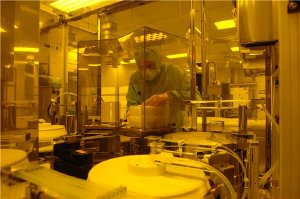 New clean rooms at the University of Southampton's Mountbatten Building
A key feature of the Centre, which is housed in the University of Southampton’s new Mountbatten Building and is one of Europe's leading multidisciplinary and state-of-the-art clean room complexes, is the new Focused Ion Beam (FIB) system from Zeiss which will make it possible to repair faulty chip circuits.
According to Dr Harold Chong from the Nano Group at the University's School of Electronics & Computer Science, the FIB will make it possible for researchers to view cross sections of materials in fine detail, thus enabling repair of chip circuits in microscopic dimensions.
'This will save a great deal of project management time,' said Dr Chong. 'There is great potential to work with universities and industry to fabricate micro-nano device and possibly salvage damaged circuits. One potential use of the FIB is to carry out fast prototyping and to develop smaller, faster and more powerful single electron devices.’
The Centre which will hold its first open day in September is a key element in maintaining the University's global reputation for world-leading research in nanotechnology and photonics. The new building and clean room facility will also provide a venue for industrial partners to have training on the research and fabrication equipment.
'We now have the capacity to work with materials 100,000 times smaller than the diameter of a human hair,' said Professor Harvey Rutt, Head of the School of Electronics and Computer Science. ‘Not only can the FIB cut extremely fine lines, it can analyse atom by atom the material removed. ‘We have an outstanding building in the Mountbatten Building and our clean rooms are now fitted out with around £50M of equipment which gives us unique capabilities for the future. We look forward to welcoming our guests, including research collaborators from universities and industry around the world, to see what we can offer them as research partners in the future.’