The tiny, nanoscale materials - quantum dots - Mathew Maye and his research team create in his Syracuse University chemistry laboratory could potentially make an important contribution to the nation's ongoing quest to become energy independent.
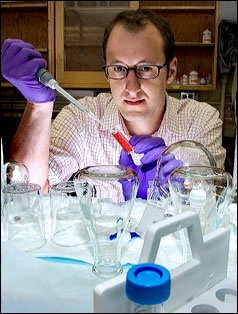 Mathew Maye
Detailed analyses of quantum dots require expensive, sophisticated instruments that are not available at most universities, including SU. However, a new agreement between Syracuse University and Brookhaven National Laboratory (BNL) will enable Maye and other SU faculty and students to use Brookhaven’s state-of-the-art research facilities. The agreement also encourages SU and Brookhaven scientists and engineers to explore opportunities for collaborative research in the fields of energy technology development, environmental sciences, biomaterials, forensic science, engineering and computer science, the biological sciences, and policy.
“The agreement with Brookhaven—the first such collaborative relationship in Central New York—will open up new opportunities for interdisciplinary research for our faculty as well as expanded educational and research opportunities for both graduate and undergraduate students,” says Vice Chancellor and Provost Eric Spina. “We are excited about the possibilities and look forward to a long and fruitful relationship with Brookhaven scientists and engineers.”
One of ten national laboratories overseen and primarily funded by the Office of Science of the U.S. Department of Energy (DOE), Brookhaven National Laboratory, located on Long Island in Upton, N.Y., conducts research in the physical, biomedical, and environmental sciences, as well as in energy technologies and national security. Brookhaven also builds and operates major scientific facilities, which are made available to university, industry, and government researchers.
“This agreement will enable researchers from both institutions to work together on important scientific challenges using state-of-the-art facilities at Brookhaven,” said Doon Gibbs, Brookhaven Lab’s Deputy Director for Science and Technology. “Also, the laboratory has a long legacy of training future scientists, and we are glad to help educate students at all levels.”
The agreement also calls for SU and Brookhaven officials to explore options for opening a satellite location of BNL at the Syracuse Center of Excellence for research in alternative biofuels. In July, Dacheng Ren, assistant professor of biomedical and chemical engineering in the L.C. Smith College of Engineering and Computer Science (LCS), will travel to BNL to explore collaborative opportunities in biofuel research.
“This is an exciting opportunity for us,” says Mark Glauser, LCS associate dean for research and doctoral programs. “BNL engineers and scientists are especially interested in the potential for working with our researchers due, in a large part, to the extensive biomass that is available in Upstate New York. We are already developing a faculty cluster with expertise in this area.”
In addition to exploring research opportunities, Brookhaven scientists and SU faculty will develop joint educational initiatives for graduate training and mentoring and expand opportunities for undergraduate, graduate, and post-doctoral educational experiences at BNL, including participation in research projects, internships, and summer or cooperative employment. Finally, the agreement calls for collaborative efforts to develop long-term, outreach programs designed to improve academic performance of K-12 schools to significantly increase the number of students qualified to attend college in New York State.
“The College of Arts and Sciences has a legacy of training bright graduate and undergraduate students who go on to become top scientists in their fields,” says Dean George Langford. “The agreement with Brookhaven will expand our ability to train new scientists in such emerging fields as neuroscience, biomaterials, and biotechnology, and in the development of alternative sources of energy. We are pleased to be part of this new collaboration.”
Maye, an assistant professor of chemistry in the College of Arts and Sciences, explores new ways to synthesize photovoltaic materials—materials that convert the sun’s energy into electricity. His goal is to build materials for devices that are more efficient than current solar cells, weigh less, cost less, and can be produced in a more eco-friendly manner.
In August, Maye will travel to Brookhaven with student members of his research team to conduct experiments on his photovoltaic quantum dots at BNL’s Center for Functional Nanomaterials and, in the future, plans to use BNL’s sophisticated National Synchrotron Light Source (NSLS). In the Center for Functional Nanomaterials, researchers take advantage of high-precision electron and optical microscopes to visualize materials, and of advanced lithography equipment to make nanomaterials. The NSLS enables scientists to use intense, focused x-rays to perform experiments not otherwise possible at their own laboratories.
“This exciting opportunity will open the door for us to examine our quantum dots at the level of the individual particle,” Maye says. “We will work with BNL scientists, who have the experimental expertise and equipment to help us better understand nanoscale properties. Additionally, our goal is to train students in my lab to use these instruments and to have them experience the advanced scientific techniques and great scientific culture at Brookhaven.”