Imec and ASML collaborated to qualify ASML’s Tachyon Source Mask Optimization and programmable illuminator system FlexRay™, proving its potential with the demonstration of a 22nm SRAM memory cell. In October 2010, the ASML XT:1900i lithography scanner at imec will be equipped with FlexRay™, enabling imec to step ahead and further explore the ultimate frontiers of immersion lithography.
A key part of any optical lithography system is the illuminator. It creates the pupil shape, i.e. the condition and shape of the light beam before it hits the mask. By tailoring the pupil shape to the specific layout to be printed, the resolution and process margins can be improved. Optimizing the pupil shape is thus critical, especially with process tolerances reaching the limits of manufacturability.
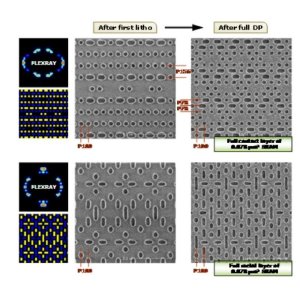 Double patterning of the contact and metal layer for a 22nm node SRAM of 0.078µm² bit cell area using freeform illumination.
The use of a customized freeform illumination source shape – optimized for a particular critical chip layout – leads to enhanced imaging results. Early joint development work between imec and ASML compared the use of traditional and freeform illumination modes, and demonstrated convincing improvement in all imaging quality metrics (process latitudes: exposure latitude, depth of focus, mask error factor), and with that also proved clear enhancement in the CD uniformity control over the entire chip and wafer area. Consequently, optimized freeform illumination helps bringing the limits of immersion lithography to areas where traditional illumination modes cannot get, and in that respect enables continued chip feature shrink and faster ramp to volume production, resulting in higher production yields.
Freeform illumination has become fully available through ASML’s FlexRayTM, allowing for virtually unconstrained intensity distribution within the source pupil. FlexRayTM uses a programmable array of thousands of individually adjustable micro-mirrors to create any pupil shape in a matter of minutes. This is a major advantage over traditional illuminators, which require individual optical elements designed and fabricated specifically for each mask pattern. During FlexRayTM’s development, imec provided ASML with experimental wafer data that allowed comparing freeform and traditional illumination on a customer test pattern. FlexRayTM showed excellent performance in terms of pupil control and stability, as well as operational speed, and ability to match to existing illumination modes and other scanners.
Finally, imec proved the potential of freeform illumination with a demonstration of double patterning into a hard mask of the contact and metal layer for a 22nm node SRAM of 0.078µm² bit cell area, with the application of simultaneous source & mask optimization (ASML Brion Tachyon SMOTM) and imaging using FlexRayTM illumination. Already from the images, but in particular from the metrics, it is very clear how freeform illumination leads to a pattern quality that cannot be realized using standard illumination. In this particular case, the XY asymmetric position of the freeform poles cannot be mimicked in a standard source.
Kurt Ronse, Director Lithography Program at imec says: “Imec has demonstrated that optimized freeform illumination will help push the limits of immersion lithography. It will create margin that will allow further scaling. To explore this path, and to bring this technology to our partners, we will equip our XT:1900i litho tool with FlexRayTM.”
Imec performs world-leading research in nanoelectronics. Imec leverages its scientific knowledge with the innovative power of its global partnerships in ICT, healthcare and energy. Imec delivers industry-relevant technology solutions. In a unique high-tech environment, its international top talent is committed to providing the building blocks for a better life in a sustainable society. Imec is headquartered in Leuven, Belgium, and has offices in Belgium, the Netherlands, Taiwan, US, China and Japan. Its staff of more than 1,750 people includes over 550 industrial residents and guest researchers. In 2009, imec's revenue (P&L) was 275 million euro.
Imec is a registered trademark for the activities of IMEC International (a legal entity set up under Belgian law as a "stichting van openbaar nut”), imec Belgium (IMEC vzw supported by the Flemish Government), imec the Netherlands (Stichting IMEC Nederland, part of Holst Centre which is supported by the Dutch Government), imec Taiwan (IMEC Taiwan Co.) and imec China (IMEC Microelectronics (Shangai) Co. Ltd.).