IMEC's associated laboratory IMOMEC, located on the campus of the Hasselt University, developed a method to stabilize the nanomorphology of organic solar cells resulting in a lifetime improvement of at least a factor 10. With these stabilized solar cells, efficiencies were achieved comparable to state-of-the-art organic solar cells. This breakthrough paves the way to commercial organic solar cells with an operational lifetime of over 5 years and efficiencies of over 10%.
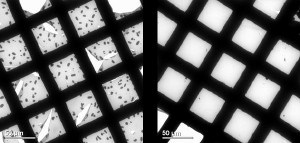 Transmission Electron Microscopy results for polymer/PCBM 1:1 active layers after degradation at 100åm for 2 h, showing phase segregation for the Rieke P3HT polymer (left), but a stable morphology for the novel conjugated polymer (right)
The efficiency and operation of organic solar cells strongly depends on the nanomorphology of the active layer, i.e. on a stable mix of organic compounds that can trap the light's energy and transport it to an electric contact. IMEC already reported such cells based on P3HT:PCBM with efficiencies near 5%. But to date, the lifetime of these cells is far too short for commercial applications, for which 5 years is seen as a minimum. Under long term operation, all solar cells based on an intimate mixing of organic semiconductors deteriorate. This is due to segregation of the mixture whereby the compounds tend to separate into different phases and consequently reduce the efficient conversion of light into electricity. IMEC has shown before that this phase segregation is related to the mobility of the organic polymer and that fixation of the nanomorphology of the polymers could result in a prolonged operational lifetime.
IMEC/IMOMEC has now introduced a new method and new conjugated polymers to stabilize the nanomorphology of the active layer making it far more robust to phase segregation under prolonged operation. Experiments on bulk heterojunction organic solar cells based on this new material showed no degradation of the efficiency after more than 100 hours whereas reference cells degraded already after a few hours. This means that a lifetime improvement of at least a factor 10 can be obtained. And the cells achieved efficiencies near 4% which is comparable to state-of-the-art.
Future research targets further refinement of the method by optimizing the chemical structures of the conjugated polymers.