Sandia National Laboratories researchers may have developed the key to making hydrogen cars a commercial reality.
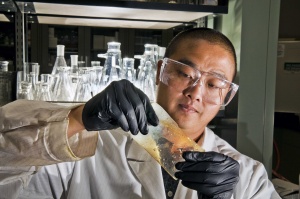 Sandia researcher Cy Fujimoto demonstrates his new flexible hydrocarbon polymer electrolyte membrane, which could be a key factor in realizing a hydrogen car. (Photo by Randy Montoya)
A major roadblock in the development of hydrogen cars has been the lack of a reliable hydrogen fuel cell that works well in both dry and humid environments. Hydrogen fuel cells are electrochemical engines that come in several different varieties with the most common being the polymer electrolyte membrane (PEM) fuel cell. PEM fuel cells use oxygen from the air and pressurized hydrogen to create electricity, heat and water (steam) as byproducts. The electricity powers the electric motor that turns the wheels of the car.
Sandia researcher Cy Fujimoto has developed a PEM using a different material that appears to be as durable as current PEMs but which also operates well in both dry and humid environments, unlike current PEMs.
“The findings have been quite intriguing and may impact the future of hydrogen cars,” Fujimoto said.
In recent tests, the Sandia polymer outperformed current state-of-the-art fuel cells in two categories. The new Sandia PEM material evolved from an earlier generation Fujimoto and former Sandian Chris Cornelius developed five years ago that operate at elevated temperatures.
The early Sandia fuel cell material, however, was not specifically designed for automotive applications. Fujimoto is making adjustments so that it will suit automakers’ needs, which include high proton conductivity at high temperature and at low water content.
Fujimoto anticipates that the new materials he developed over the past year and a half will make the Sandia PEM perform better at low relative humidity. The chemistry allows him to control where and how much acid is deposited on the polymer backbone, which enables fine-tuning of the size of the ion conducting channels. With larger pathways for proton movement the membranes will work better in low humidity environments.
Other acid-containing PEMS, such as Nafion, maintain a path for protons to pass through when the membranes are hydrated. As they dehydrate, the path shrinks and becomes disconnected, restricting proton movement. The result is diminished function of fuel cells in dry desert climates like the Southwest.
Fujimoto compares the current state of PEMs to a path in a park.
“You can be moving right along and then come to a place where the path breaks. A person walking the path can maneuver around the break and move on. Not so with protons. They come to a dead end,” he says. “Automobile manufacturers want a membrane that is reliable in all environments. They can’t have one that functions well in a humid climate like Miami, for example, and not work well in dry Albuquerque.”
Working through Sandia’s Intellectual Project Management, Alliances & Licensing Department, Fujimoto is collaborating with a consortium of automobile manufacturers to build the better PEM. He says a cooperative research and development agreement (CRADA) and possible licensing of the technology are forthcoming.
Before the collaboration can proceed much further, he says, he needs to come up with a way to “scale up the chemistry” so the membrane can be mass-produced at a low cost.
“We have to get the cost of manufacturing the membrane below $25 per square meter for the method to be practical for cars,” Fujimoto says. “This is one of the biggest challenges yet.”