What can you do with x-rays that are 10 billion times brighter than those from your doctor's x-ray machine? A lot! Scientists using the powerful beam lines at Berkeley Lab's Advanced Light Source in recent years have conducted breakthrough research on platinum-nickel alloys as a catalyst for fuel cells, made a discovery about the Ebola virus structure that could lead to a vaccine, and crafted a new technique for guiding self-assembly of nanostructures that should open up vistas for entirely new applications.
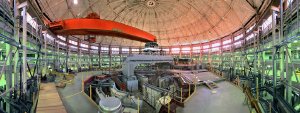 Interior of the Advanced Light Source.
Now, with $11.3 million in funding through the American Recovery and Reinvestment Act, scientists will be able to accomplish even more. The funding will allow the ALS—one of the world's brightest sources of ultraviolet and soft x-ray beams—to upgrade its facilities and maintain its position at the cutting edge of soft x-ray science. The money was allocated to the ALS through the Office of Basic Energy Sciences within the Department of Energy's Office of Science.
"This funding will help us reach our long-term goal of renewing the ALS, on an accelerated schedule," said ALS director Roger Falcone. "To accommodate our users, we need to provide a state-of-the-art x-ray beam for each of our instruments. Users come here because of our excellent science and facilities, and it needs to remain the best place for them to do their research."
Every year, more than 1,900 scientists from around the world come to Berkeley Lab to use the light sources to examine structure of materials on the atomic and molecular level, resulting in more than 500 publications annually in scholarly journals. However, as the number of submitted research proposals has more than doubled in the last six years, the ALS, which has 40 beam lines, was struggling to keep pace with the demand while also maintaining leadership in scientific capability among all light sources. Newer facilities around the world, including in Europe, Asia, Australia and Canada, are attracting high-impact scientific investigations.
The new funding will enable the ALS to make the transition to a new era of science, from one that emphasized observation and understanding of materials, to one with the promise of controlling energy and matter down to the atomic level. For example, the urgent need for renewable sources of energy demands new solutions; finding novel ways to control atomic and electronic structure may yield new materials and processes that will result in technology breakthroughs.
Specifically, the $11.3 million in Recovery Act funds will provide for four upgrades at the ALS:
- $5.8 million will go towards acquiring sextupole magnets to increase the x-ray brightness by up to a factor of three, allowing microscopes to see finer detail. This upgrade will be useful in, for example, protein crystallography, in which scientists examine the atom-by-atom structure of proteins, including proteins that play a role in the production of biofuels or in the causes or cures of disease.
- $2 million will be spent to construct and install an elliptically polarizing undulator to provide a new source of femtosecond x-ray pulses for studying dynamics. A femtosecond is one millionth of a billionth of a second, and is the timescale at which chemical bonds are formed or broken or materials transition from one phase to another. This upgrade will effectively double the capacity of an existing ultrafast measurement facility by enabling both soft and hard x-ray beams to operate simultaneously. This will allow new research on complex materials, such as superconductors and other exotic electronic materials, as well as nanostructures. The upgrade will also enable the study of magnetism at an ultrafast time scale, which could lead to advances in magnetic storage technology, such as hard drives.
- $2 million will be spent to equip beam lines with advanced CCD-based detectors developed at Berkeley Lab to enhance the reach and productivity of our x-ray facility. These new detectors will allow scientists to do more complex experiments, get results back much faster, and examine more types of samples than had previously been possible.
- $1.5 million will go towards developing a unique superconducting magnet for an x-ray scattering beam line, allowing experiments that should lead to novel insights into the structure of engineered magnetic nanostructures and other materials. Such experiments could lead to breakthroughs in spintronics, an emerging semiconductor technology based on the magnetic properties of electrons.
When it began operations in 1993, the ALS was one of the first of its generation of high-brightness synchrotrons, and it has pioneered a number of innovative technologies, including ultrafast x-ray science and nanoscale studies. Renewal of the ALS will be enabled not only by the $11.3 million for instrumentation upgrades, but also by several other Recovery Act allocations.
As part of the first tranche of Recovery Act funding for Berkeley Lab, a number of construction and infrastructure projects benefiting the Advanced Light Source are being funded. Building 6, which houses the ALS experiment floor as well as offices, labs, and conference rooms, has received $1.5 million to replace three aging air-handling units that had vibration issues, negatively impacting scientific studies. Building 2, which provides office and laboratory space adjacent to the ALS, has received $2.9 million for upgrades to its cooling system, necessary to handle the demands of new equipment. Finally, $14.7 million in Recovery Act funds will go towards accelerating construction of the new $35-million ALS User Support Building, which will include office and lab space for about 80 researchers.
"This funding for capital investment will allow us to make much more efficient use of our operational funding from the Department of Energy," said Falcone, who is also Associate Lab Director for Photon Sciences. "We will be able to serve a larger number of scientists and create new scientific and technological capabilities. Those capabilities will enable science and technology, extending from energy research, to advanced microprocessor development using extreme ultraviolet lithography, to helping pharmaceutical companies unravel complex protein structures, which is very important to the healthcare industry, much more quickly. "
Berkeley Lab is a U.S. Department of Energy national laboratory located in Berkeley, California. It conducts unclassified scientific research and is managed by the University of California for the DOE Office of Science. Visit our website at http://www.lbl.gov.