Romania's National Institute of Materials Physics (NIMP) has ordered an advanced sputtering tool from Surrey NanoSystems, to support fundamental research into oxide materials including piezoelectric and pyroelectric thin films, and photoelectrochemical cells to support the hydrogen economy.
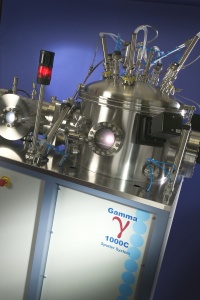 A Gamma sputtering system from Surrey NanoSystems has been ordered by NIMP, to support research into oxide materials including piezoelectric and pyroelectric thin films, and photoelectrochemical cells to support the hydrogen economy
NIMP chose a configuration of Surrey NanoSystems' Gamma tool, an advanced PVD (plasma vapour deposition) sputtering system. The technical decision was made primarily because of the tool's very high quality of thin film deposition and flexibility of application.
The tool will be used by researchers in NIMP's Laboratory of Ceramic Oxidic Materials. Among the applications being researched by the laboratory are piezoelectric and pyroelectric thin films, temperature sensors and photoelectrochemical (PEC) cells to support hydrogen production by means of water splitting. The latter application is a promising technique to accelerate the development of a hydrogen economy, and NIMP is exploring a number of ideas related to the manufacture of electrodes for PEC cells that can split water with high efficiency, yet be manufactured from low-cost materials and offer the durability required for consumer applications.
Among the key specifications for NIMP is the Gamma tool's very high vacuum capability of 5 x 10⁻⁹ Torr, which is as much as two orders of magnitude higher than some other commercially available sputtering systems, as this provides an exceptionally pure environment to aid uniform film deposition. This is supported by an optical heating facility to pre-treat substrates by driving off moisture.
Surrey NanoSystems is additionally fitting the tool with a brand new reactive gas control system. Instead of a conventional DC pulse controlled process, the Gamma tool will use optical emission spectroscopy to control a high performance gas injection system, providing NIMP researchers with additional fine control over the characteristics and quality of film deposition.
Features included to support flexibility of application include the ability to configure the system to support up to four sputtering target materials. This makes it possible to deposit a very broad variety of thin films including metallic films (platinum, titanium and aluminium), ceramic oxides (PZT, BaTiO3), oxide films (TiO2, Al2O3, Fe2O3), as well as seeding layers to obtain highly textured surfaces. The Gamma tool is also able to deposit films at high temperatures - up to 800 degrees C - and anneal materials without breaking the vacuum.
"The Gamma tool is highly configurable, and it allowed us to install all the key facilities we need to support our laboratory's work," says Marius-Cristian Cioangher of NIMP. "Flexibility of set up and control is another important aspect of the tool, and Gamma's graphical MIMIC-style display makes it easy to create and refine application-specific processing recipes."