Sandia National Laboratories researchers scored big in the $777 million, five-year DOE Energy Frontier Research Centers (EFRCs) announced last week by the White House.
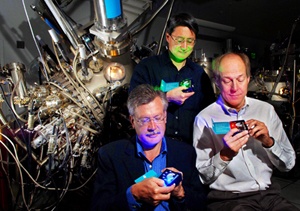 Sandia researchers Jerry Simmons (far left), Michael Coltrin, and Jeff Tsao (standing behind) check out solid-state lighting technologies
Sandia expects to become home to one of 46 new multimillion-dollar centers, be a significant partner in three others, and may be involved in another four.
The winners, selected from a pool of 260 applicants by DOE’s Office of Science, are expected to pursue advanced scientific research on energy.
The overall announcement was made in conjunction with a speech by President Barack Obama at the annual meeting of the National Academy of Sciences.
According to a DOE news release, center selections and plans for funding "were based on a rigorous merit review process utilizing outside panels composed of scientific experts."
The centers will be situated at universities, national laboratories, nonprofit organizations, and private firms across the nation.
Sandia's Solid-State Lighting Science center, under the direction of Jerry Simmons, is expected to receive $18 million in funding over the course of five years.
"More than 20 percent of our country’s electrical energy is consumed in lighting. Solid-state lighting, a new technology that will be the focus of our research, has the potential to cut that energy consumption in half — or even more," says Simmons.
Center researchers expect to investigate three areas: the conversion of electrical energy to light through radical designs involving luminescent nanowires, quantum dots, and hybrid structures; energy conversion processes in photonic structures smaller than the wavelength of the light they create; and understanding and eliminating defects in the semiconductor materials that presently limit solid-state lighting efficiency.
The work is projected to include collaborations with scientists at Rensselaer Polytechnic Institute, the University of New Mexico, California Institute of Technology, Los Alamos National Laboratory, Yale University, Northwestern University, the University of Massachusetts-Lowell, and Philips Lumileds Lighting.
Sandia also expects to receive $7.75 million as a significant partner in an EFRC led by the University of Texas at Austin to understand, over multiple length scales, the potential for capturing and geologically storing carbon dioxide within the Earth.
Sandia expects to play a further major role in a third center established at the University of Maryland that focuses on improving electrical energy storage in batteries, capacitors, and other technologies. Nanostructured electrode components are expected to provide greater surface areas to store charge, as well as smaller path lengths for the motion of electrons and ions, thereby increasing the rate at which charges can be moved and stored. Sandia’s research budget under Bob Hwang is tentatively set at $6 million.
In a fourth major effort, Sandia will aid Princeton University on its “Energy Frontier Research Center for Combustion Science,” overseeing $3.75 million in funding. The center intends to develop a suite of predictive computing modeling capabilities for the chemical design and utilization of nonpetroleum-based fuels in transportation.
Another $8.25 million in total is expected to aid research in collaboration with Notre Dame for “Materials Science of Actinides,” the University of Arizona’s Center for Interface Science on “Solar Electric Materials and Devices;” Washington University at St. Louis’ Photosynthetic Antenna Research Center “to understand the basic scientific principles that underpin the efficient functioning of the natural photosynthetic antenna system as a basis for manmade systems to convert sunlight to fuels,” and the University of Texas at Austin for “understanding charge separation and transfer at interfaces in energy materials and devices.”
Still other projects are expected to make use of nanoscience-related capabilities of the Center for Integrated Nanotechnologies, jointly operated by Los Alamos National Laboratory and Sandia.
In general, EFRC researchers are expected to take advantage of new capabilities in nanotechnology, high-intensity light sources, neutron-scattering sources, supercomputing, and other advanced instrumentation to lay the scientific groundwork for fundamental advances in solar energy, biofuels, transportation, energy efficiency, electricity storage and transmission, clean coal and carbon capture and sequestration, and nuclear energy.
Said Secretary of Energy Steven Chu, “These centers will mobilize the enormous talents and skills of our nation’s scientific workforce in pursuit of the breakthroughs that are essential to make alternative and renewable energy truly viable as large-scale replacements for fossil fuels.”