Researchers of Nanoplasmonics Develop Self-Assembling Nanocubes
Researchers from the San Diego Jacobs School of Engineering at the University of California engineered a method to facilitate metallic nanocrystals to self-assemble into bigger structures that could find applications in future generations of lenses and antennas.
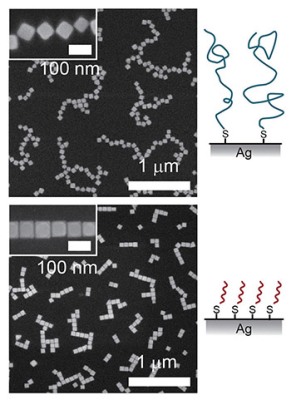 Self assembling nanocubes
The cubic metal nanocrystals can be likened to Tetris blocks that are capable of arranging themselves into bigger structures with relative orientation. This particular field of research which is known as Nanoplasmonics involves the development of materials with structures smaller than the wavelength of light and using these materials to manipulate light.
The researchers employed nanocubes that are smaller than 0.1µ. By means of accurate orientation, the nanocubes can either focus light at various wavelengths if they are meant to serve as a lens or can confine light if they are meant to function as a nanoscale antenna. The findings could make significant contribution in the development of optical biological and chemical sensors that involve molecular interaction with light. The ability to confine light within extremely small volumes could drastically improve sensitivity of optical sensors.
The research team constructed antenna and lens structures by chemical synthesis of crystalline silver into nanocubes. They attached polymer chains to the silver nanocubes to control the interaction of the cubes for rearrangement. The team demonstrated through simulation that the attaching of short polymer chains would cause the cubes to arrange themselves normally whereas, attaching long polymer chains would lead to edge-to-edge stacking of the cubes. The two different arrangements were imaged using macroscopic films which showed that the films transmitted and reflected light of different wavelengths.
Written by
Will has a B.Sc. in Chemistry from the University of Durham, and a M.Sc. in Green Chemistry from the University of York. Naturally, Will is our resident Chemistry expert but, a love of science and the internet makes Will the all-rounder of the team. In his spare time Will likes to play the drums, cook and brew cider.
Please use one of the following formats to cite this article in your essay, paper or report:
APA
Soutter, Will. (2019, February 12). Researchers of Nanoplasmonics Develop Self-Assembling Nanocubes. AZoNano. Retrieved on September 19, 2026 from https://www.azonano.com/news.aspx?newsID=25050.
MLA
Soutter, Will. "Researchers of Nanoplasmonics Develop Self-Assembling Nanocubes". AZoNano. 19 September 2026. <https://www.azonano.com/news.aspx?newsID=25050>.
Chicago
Soutter, Will. "Researchers of Nanoplasmonics Develop Self-Assembling Nanocubes". AZoNano. https://www.azonano.com/news.aspx?newsID=25050. (accessed September 19, 2026).
Harvard
Soutter, Will. 2019. Researchers of Nanoplasmonics Develop Self-Assembling Nanocubes. AZoNano, viewed 19 September 2026, https://www.azonano.com/news.aspx?newsID=25050.
We're committed to providing free access to quality science. By registering and providing insight into
your preferences you're joining a community of over 1m science interested individuals and help us to
provide you with insightful content whilst keeping our service free.
or
Terms
While we only use edited and approved content for Azthena
answers, it may on occasions provide incorrect responses.
Please confirm any data provided with the related suppliers or
authors. We do not provide medical advice, if you search for
medical information you must always consult a medical
professional before acting on any information provided.
Your questions, but not your email details will be shared with
OpenAI and retained for 30 days in accordance with their
privacy principles.
Please do not ask questions that use sensitive or confidential
information.
Read the full Terms & Conditions.