Recent research has shown that environmental weathering breaks polystyrene into increasingly small particles, including nanoplastics, which may pose greater ecological and biological risks than larger plastic debris.1 As concerns over plastic pollution increase, scientists are turning to microbes, enzymes, insects, and nanotechnology. These tiny technologies could offer new solutions for one of the most persistent waste streams on the planet.
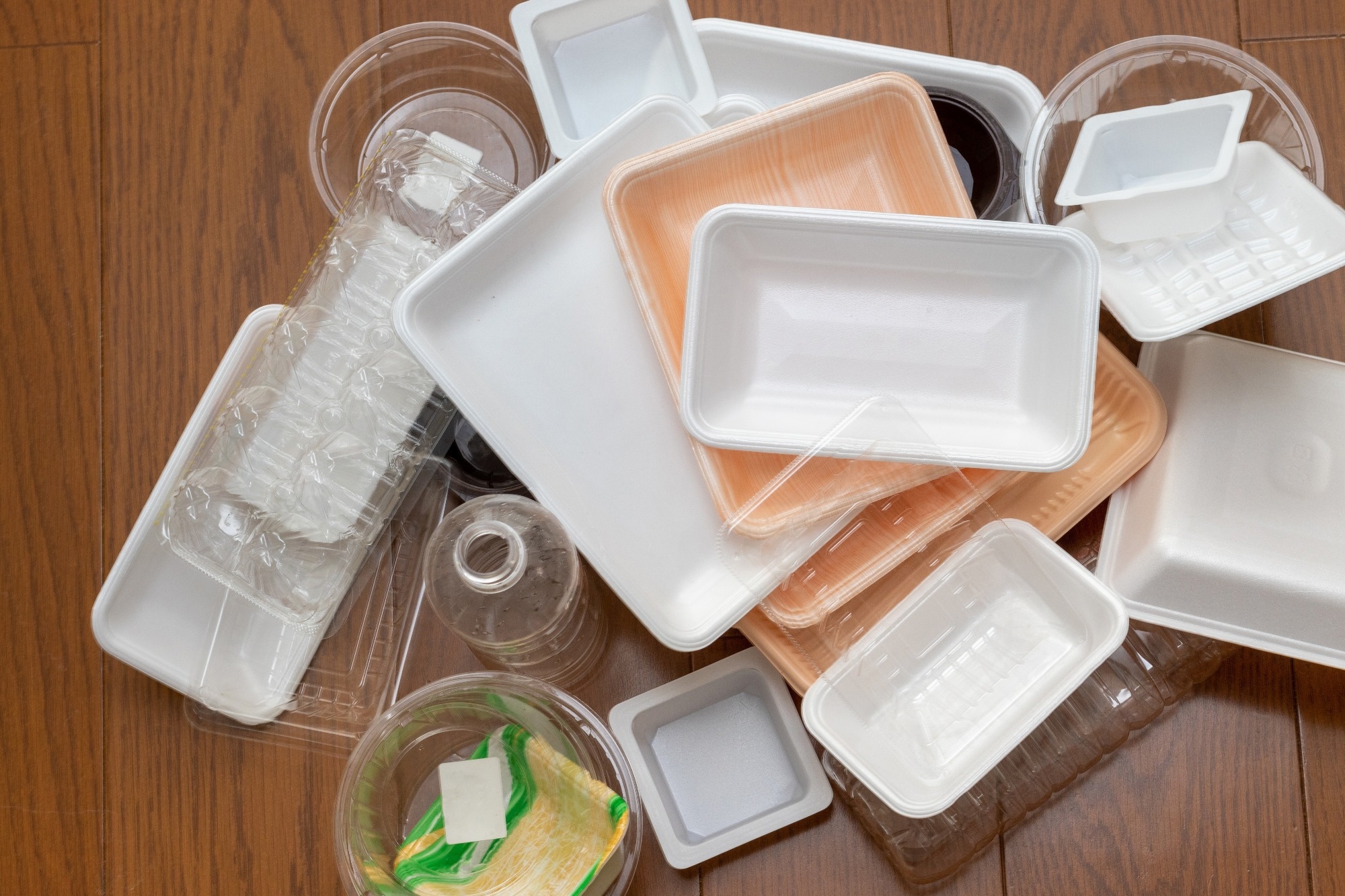
Image Credit: Toru Kimura/Shutterstock.com
Few plastics are as recognizable, or as problematic, as polystyrene. Used extensively in food packaging, disposable cups, insulation, and protective shipping materials, polystyrene has become a basis of modern convenience. Yet its environmental legacy is far less appealing. Lightweight and easily fragmented, polystyrene is a major contributor to microplastic pollution, generating countless particles that disperse through soils, waterways, oceans, and even the atmosphere.
What Makes Polystyrene So Resistant?
Polystyrene’s durability stems directly from its chemistry. The polymer is produced from styrene monomers, forming long chains of carbon-carbon bonds decorated with aromatic phenyl rings. This structure provides strength, chemical resistance, and thermal stability. Unfortunately, these same properties make it exceptionally difficult for nature to break down.
Unlike biodegradable materials such as cellulose or proteins, polystyrene contains few chemical features that microorganisms can readily attack. Its hydrophobic surface discourages microbial attachment, while its aromatic backbone resists enzymatic cleavage. Even after exposure to sunlight, oxygen, and mechanical abrasion, breakdown is often limited to fragmentation rather than complete degradation. As a result, discarded polystyrene can persist for decades, slowly generating microplastics and nanoplastics that accumulate in environmental systems.1,2
Traditional waste-management methods offer only partial solutions. Mechanical recycling is frequently hindered by contamination and the low density of expanded polystyrene foams. Incineration can recover energy but raises concerns about emissions, while landfill disposal simply postpones the problem.
Click here to download a PDF copy of this page
When Plastic Becomes a Microplastic
Environmental weathering initiates a gradual transformation of polystyrene. Ultraviolet radiation, oxidation, temperature fluctuations, and physical abrasion create cracks in the polymer surface. Over time, this process causes chain scission and introduces oxygen-containing functional groups such as carbonyls and hydroxyls. The material becomes increasingly brittle, eventually fragmenting into microplastics and nanoplastics.
Ironically, these aging processes may create opportunities for biological degradation. Weathering increases surface roughness and polarity, making the polymer more attractive to microorganisms. Researchers now view environmental aging as a source of pollution and a preconditioning step that may enhance microbial colonization and enzymatic attack.
Nature's Plastic-Eating Microbiome
One of the most exciting developments in recent years has been the discovery that certain microorganisms can colonize and partially degrade polystyrene.
Researchers identified bacterial genera including Pseudomonas, Rhodococcus, Bacillus, and Exiguobacterium as capable of forming biofilms on polystyrene surfaces and initiating oxidative depolymerization. These organisms produce enzymes that modify the polymer, gradually converting it into smaller compounds that can enter microbial metabolic pathways.1
Among the most important enzymes is styrene monooxygenase, which transforms styrene-derived compounds into intermediates that bacteria can further metabolize. Other oxidative enzymes, including laccases and peroxidases, generate reactive oxygen species that weaken the polymer structure and promote chain scission. Although degradation rates remain slow, these discoveries demonstrate that biological breakdown is possible, challenging previous assumptions that polystyrene was essentially non-biodegradable.
The Surprising Role of Mealworms and Superworms
Some of the most publicized breakthroughs have come from insect studies. Studies have demonstrated that mealworms (Tenebrio molitor) could consume and partially mineralize polystyrene, converting a proportion of the material into carbon dioxide and biomass. Later studies showed similar capabilities in superworms (Zophobas morio), sparking global interest in insect-assisted plastic degradation.1,3
Current evidence suggests the insects themselves are not solely responsible. Rather, their gut microbiomes provide a specialized environment where microorganisms work together to fragment and oxidize the polymer. In fact, antibiotic treatments that suppress gut bacteria significantly reduce degradation efficiency, highlighting the essential role of microbial communities. Studies have demonstrated the importance of gut microorganisms in facilitating polystyrene transformation and metabolism.3,4
While insects are unlikely to become a complete solution to global plastic waste, they provide valuable biological models that may help scientists identify new enzymes and microbial consortia for industrial applications.
Nanotechnology and Next-Generation Solutions
The latest research is increasingly focused on combining biological and nanotechnological approaches. Rather than relying solely on microbes, scientists are exploring hybrid systems that use physical, chemical, and biological treatments in sequence.1
One promising strategy involves oxidative pre-treatment using ultraviolet light, plasma technologies, or catalysts to introduce reactive functional groups into polystyrene before microbial degradation. This approach significantly improves enzyme accessibility and accelerates biodegradation.1
Researchers are also investigating engineered microbial consortia and nanomaterial-assisted bioreactors designed to optimize microbial activity.
Recent studies have shown future remediation systems may incorporate biofilm reactors, synthetic biology, and advanced nanomaterials to improve degradation kinetics while reducing environmental risks.1
Beyond degradation, scientists are beginning to explore biological upcycling. Research has demonstrated the potential for metabolically engineered Pseudomonas putida to convert polystyrene-derived compounds into valuable chemical building blocks, transforming plastic waste from an environmental liability into a resource for a circular economy.5
Reasons for Hope
Despite substantial progress, major challenges remain. Degradation rates are often slow, complete mineralization is rare, and potentially harmful degradation intermediates require further evaluation. Standardized testing methods and scalable engineering solutions are still needed before these technologies can move beyond the laboratory.
Nevertheless, the field has advanced remarkably over the past decade. What was once viewed as an almost indestructible material is now known to be susceptible, albeit slowly, to microbial, enzymatic, and insect-assisted degradation pathways.
The convergence of microbiology, synthetic biology, environmental engineering, and nanotechnology is creating new opportunities to address one of the world's most persistent plastic pollutants.
Tiny technologies alone may not solve the plastic crisis, but they are increasingly proving that even the most stubborn materials can be challenged when nature and innovation work together.
References and Further Reading
- Nguyen, H.L., et al. (2026). Microbial and Insect Gut-Mediated Polystyrene Microplastic Degradation for Environmental Remediation Applications. Nanomaterials, 16, 818. https://doi.org/10.3390/nano16130818
- Choonut, A.; et al. (2025). Microbial degradation of polypropylene microplastics and concomitant polyhydroxybutyrate production: An integrated bioremediation approach with metagenomic insights. J. Hazard. Mater. 490, 137806 https://doi.org/10.1016/j.jhazmat.2025.137806
- Yang, Y., et al. (2015). Biodegradation and Mineralization of Polystyrene by Plastic-Eating Mealworms: Part 1. Chemical and Physical Characterization and Isotopic Tests. Environmental Science & Technology, 49(20), 12080–12086. 10.1021/acs.est.5b02661
- Wang, Y., et al. (2024). Contribution of Gut Microbiota to Biodegradation of Polystyrene in Tenebrio molitor Larvae: Microbiome under Antibiotic Suppression of Gram-Positive, Gram-Negative, and Fungal Microbes. Chemical Engineering Journal, 497, 154841. 10.1016/j.cej.2024.154841
- Kohlstedt, M., et al. (2025). Biological Upcycling of Polystyrene into Ready-to-Use Plastic Monomers and Plastics Using Metabolically Engineered Pseudomonas putida. Chemical Engineering Journal, 524, 168431. 10.1016/j.cej.2025.168431
Disclaimer: The views expressed here are those of the author expressed in their private capacity and do not necessarily represent the views of AZoM.com Limited T/A AZoNetwork the owner and operator of this website. This disclaimer forms part of the Terms and conditions of use of this website.