Helping Crops Do More With Less
How Nano-Tools Help Plants Retain Water
What the Data Shows so Far
What Could Hold Nanotechnology Back?
What Does the Future Look Like?
References and Further Reading
Reliable water supply is critical for agriculture. The UN Office for Disaster Risk Reduction (UNDRR) estimates that droughts cost around $307 billion a year worldwide,1 and El-Ramady et al. suggest that crop yields fall by 20–50% under extreme drought.2
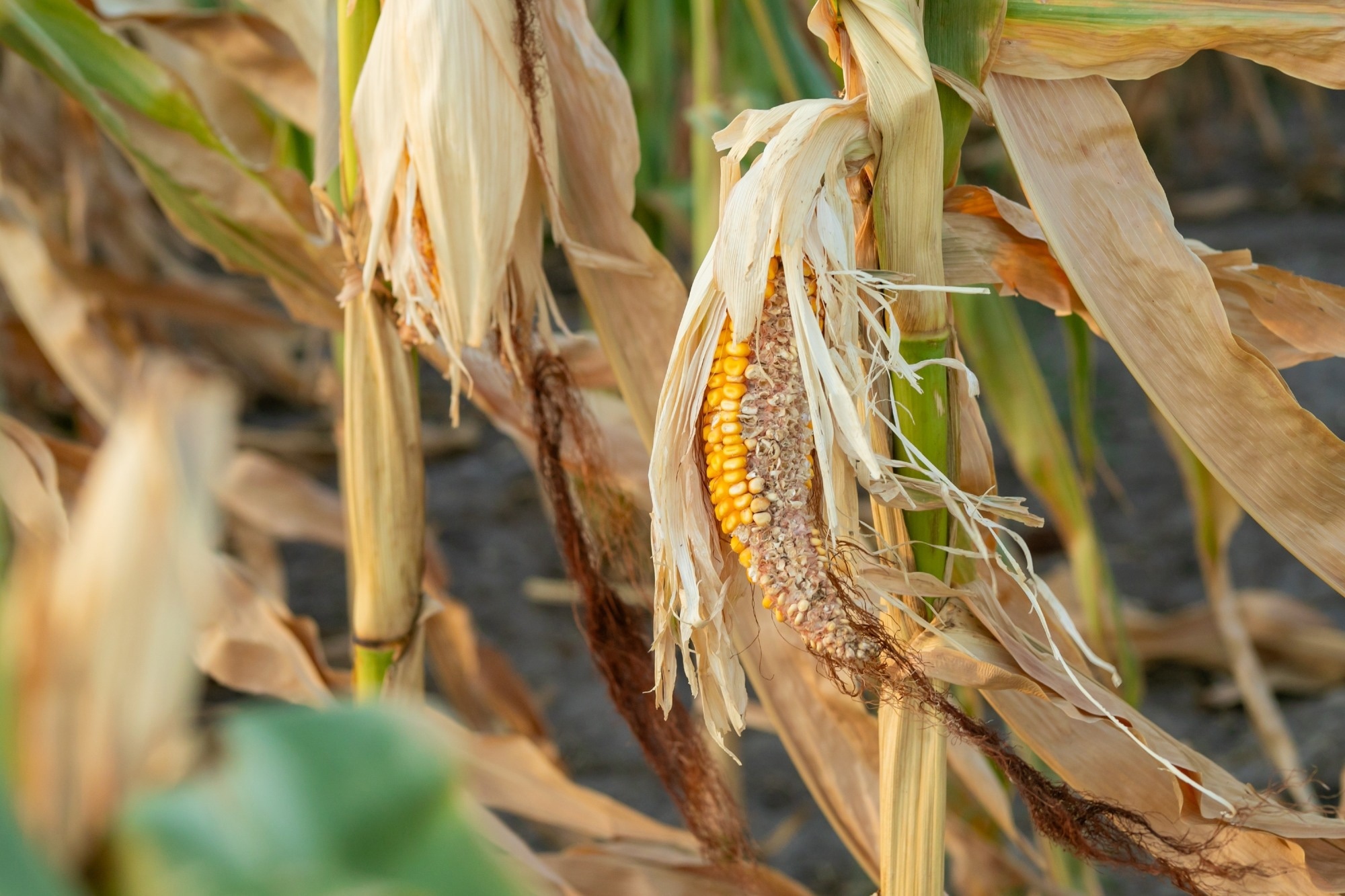
Image Credit: fotogurmespb/Shutterstock.com
Responses to this situation have generally focused on promoting improved irrigation and drought-tolerant crop varieties, but researchers are also testing whether nanotechnology can help plants extract more from each liter of water.
This article discusses the role of nanotechnology in helping crops cope with drought, recent research, commercial examples, and the challenges that need to be solved before the technology sees wide adoption.
Helping Crops Do More With Less
Drought causes many agricultural issues that decrease yield: it lowers plant water status; slows photosynthesis; and causes oxidative stress and osmotic imbalance in plant cells.
El-Ramady et al. describe how nanomaterials may act on several of these processes at once to complement existing water-saving measures.2 In practice, the goal is not to ‘cure’ drought, but to help crops keep yields closer to normal when irrigation is reduced, and to limit losses when rainfall is irregular.
Researchers have developed several approaches to improve crop performance in water-limited conditions. For instance, nanomaterials like silicon dioxide, zinc oxide, titanium dioxide, or carbon-based nanoparticles can improve root water transport and leaf water content.
They also provide several other benefits, including higher activity of antioxidant enzymes, accumulation of osmolytes such as proline, and activation of drought-responsive genes and abscisic acid signaling.2
Another interesting approach is nanobubble irrigation, in which gas bubbles smaller than one micrometer are injected into irrigation water, where they get suspended and raise dissolved oxygen levels around the roots. Better-aerated roots can grow more densely and extract water more efficiently.3,4
Water-retaining gels with nanostructured networks that hold moisture in the soil or capture it from humid air and release it to roots over time are used to maintain water supply.2,5 Alongside these inputs, researchers have also introduced nanosensors that track soil moisture and plant hydration so that farmers irrigate only when crops need it.2,6
What the Data Shows so Far
A field study in Gansu Province, northwest China, tested silicon nanoparticles of about 15–30 nm on three maize varieties under full and mildly reduced irrigation. The particles were applied as a seed soak and three foliar sprays.
Under deficit irrigation, the nanoparticles increased yields of two varieties by 6.88% and 18.98%, respectively, compared with untreated plants under the same water reduction. The authors attributed this to higher stomatal conductance, chlorophyll content, and photosynthesis, and to a canopy that intercepted more light.7
Similarly, in a pot study in Pakistan, spraying wheat with 150 ppm zinc oxide nanoparticles increased grain yield by 25.5% when drought occurred during tillering.8 In Iran, soybean grown at 40% of field capacity and sprayed with zinc oxide nanoparticles gave 39% higher seed yield and had 57% higher relative water content than untreated plants.9
In a greenhouse in south-eastern Spain, tomatoes drip-irrigated with oxygen nanobubbles developed denser roots near the emitters and at greater depths, and showed higher field water-use efficiency than the control.3
Moving from inputs to monitoring, researchers at the University of Texas at Austin have reported a graphene-based sensor that attaches to leaves and measures hydration in real time using very little power.6
What Could Hold Nanotechnology Back?
Though nanotechnology has shown potential, most evidence still comes from laboratory or greenhouse experiments; El-Ramady et al. describe a persistent lab-to-field gap in their work.
Nanoparticles can aggregate or lose activity in soil, and their behavior changes with pH, salinity, and organic matter content.2 Moreover, cost is another limitation, as nanomaterials such as carbon nanotubes, graphene oxide, and metal nanoparticles usually cost $10,000–100,000 per ton.2
Smaller particles tend to be more mobile and reactive in soil and plants, which can increase uptake and the risk of toxic effects, and long-term field data under realistic farming conditions are limited.11 Regulation is also a practical bottleneck: regulations differ widely between the European Union, the USA, China, Brazil, and India, making it harder for products to reach farmers in several markets.10
What Does the Future Look Like?
Nano-agrochemicals are still a small market, currently accounting for less than 1% of the global agrochemical market. A 2026 review in Nature Reviews: Earth & Environment found that nanoformulations can increase yields by about 20%, primarily through improved nutrient use efficiency.10
Nanobubble irrigation is the most established commercial option at present. The US-based company Moleaer reports more than 1000 installations at agricultural facilities, a presence in over 55 countries, and an average yield increase of 15% across agricultural users.4
To see further success, researchers are calling for long-term, multi-site field trials, standardized risk assessment, life-cycle analyses, and greener, cheaper synthesis methods.2,10 In the short term, combining nano-enabled inputs with deficit irrigation and moisture sensors looks more realistic than relying on any single product.2,7
Recent research suggests that nanotechnology can help plants maintain yields with less water, but rather than treating it as a replacement for efficient irrigation and drought-tolerant crops, it should be viewed as a complementary tool.2
References and Further Reading
- GAR 2025 Hazards: Droughts. (2025). [Online] UNDRR. Available at: https://www.undrr.org/gar/gar2025/hazard-exploration/droughts.
- El-Ramady, H., et al. (2026). Nanotechnology for Drought Mitigation and Water Conservation: Opportunities and Limitations. Nanomaterials. 16(9). https://doi.org/10.3390/nano16090523.
- del Moral Torres, F., Hernández Maqueda, R., and Meca Abad, D. E. (2024). Enhancing Root Distribution, Nitrogen, and Water Use Efficiency in Greenhouse Tomato Crops Using Nanobubbles. Horticulturae. 10(5). https://doi.org/10.3390/horticulturae10050463.
- Better Water Leads to Better Crops. (n.d.) [Online] Moleaer. Available at: https://www.moleaer.com/en-us/industries/irrigation-water.
- Park, J., Guan, W., Lei, C., & Yu, G. (2024). Self-Irrigation and Slow-Release Fertilizer Hydrogels for Sustainable Agriculture. ACS Materials Letters. 6(8). https://doi.org/10.1021/acsmaterialslett.4c01120.
- Misra, U., et al. (2026). Graphene In-Sensor Compute Device for Plant Hydration Monitoring. Nano Letters. 26(7). https://doi.org/10.1021/acs.nanolett.5c05507.
- Liang, X., et al. (2025). Silicon nanoparticles enhance maize yield and water productivity via regulating photosynthesis and canopy structure under mild regulated deficit irrigation. Frontiers in Plant Science. 16. https://doi.org/10.3389/fpls.2025.1691443.
- Raza, M. A. S., et al. (2025). ZnO-nanoparticles and stage-based drought tolerance in wheat (Triticum aestivum L.): effect on morpho-physiology, nutrients uptake, grain yield and quality. Scientific Reports. 15. https://doi.org/10.1038/s41598-025-89718-2.
- Shirvani-Naghani, S., et al. (2024). Drought stress mitigation and improved yield in Glycine max through foliar application of zinc oxide nanoparticles. Scientific Reports. 14. https://doi.org/10.1038/s41598-024-78504-1.
- Xiao, Z., White, et al. (2026). Nano-agrochemical use in sustainable agriculture and environmental protection. Nature Reviews Earth & Environment. 7. https://doi.org/10.1038/s43017-026-00796-w.
- Islam, S. (2025). Toxicity and transport of nanoparticles in agriculture: effects of size, coating, and aging. [Online] Frontiers in Nanotechnology. Available at: https://doi.org/10.3389/fnano.2025.1622228.
Disclaimer: The views expressed here are those of the author expressed in their private capacity and do not necessarily represent the views of AZoM.com Limited T/A AZoNetwork the owner and operator of this website. This disclaimer forms part of the Terms and conditions of use of this website.