Digital Holographic Microscopy (DHM) powers the Lyncée Transmission series, which uses interferometric resolution for quantitative imaging and measuring of transparent and semi-transparent materials.
After holograms are captured and digitally recreated, 3D data is extracted. This data is then analyzed by specialized software to produce original and significant insights for applications in materials science and the biological sciences.
DHM provides assessments of morphology and intracellular content (dry mass) and facilitates label-free imaging in life sciences applications. These metrics are endogenous indicators of biological processes and cell health, enabling applications in cell viability, dynamics monitoring, and 4D cell tracking.
DHM is used in materials science to assess thickness variations, surface topography, and intra-sample characteristics such as defects and refractive-index variations. Additionally, it monitors 3D position and dynamic changes over time. It can measure optical MEMS, displays, and acoustofluidic devices because it is compatible with the stroboscopic module.
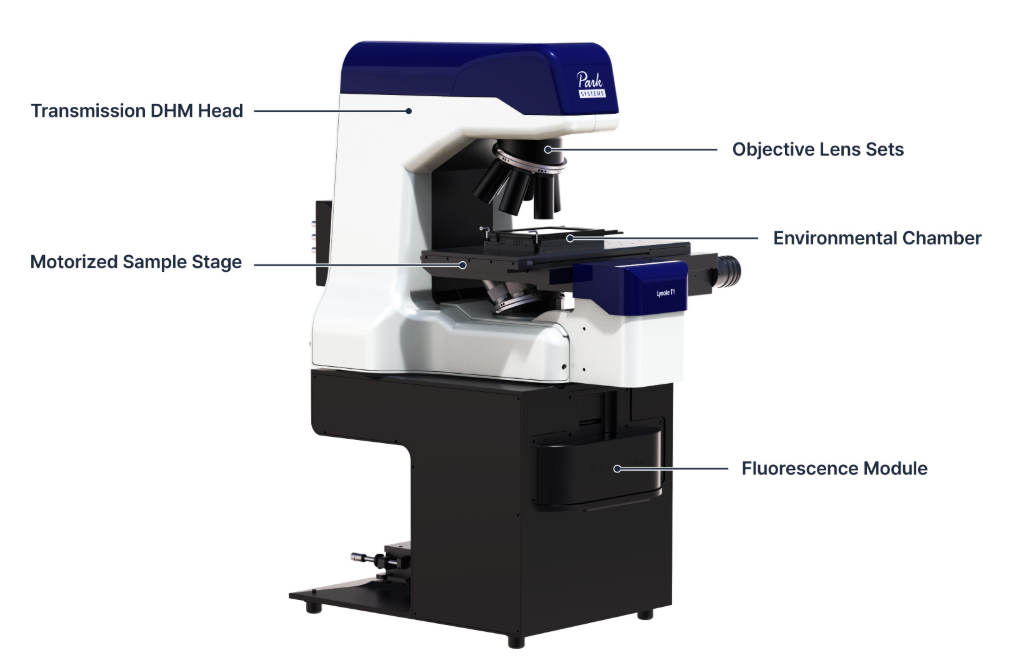
Image Credit: Park Systems
Superior DHM Performance
- Single-shot full-field imaging
- Millisecond time resolution
- Up to 100 kfps acquisition rate
Address All Experimental Needs
- Fully upgradeable
- Multi-objective, multi-wavelength
- Wide range of options tailored to particular applications
Lyncée Transmission Series: Workflow
In a single shot at camera speed, data acquisition encodes all of the sample's information into the recorded hologram. After this, a real-time numerical reconstruction of the recorded hologram is performed. By performing numerical reconstruction, it is possible to refocus the phase image after acquisition and obtain quantitative data that sheds light on the monitored sample.
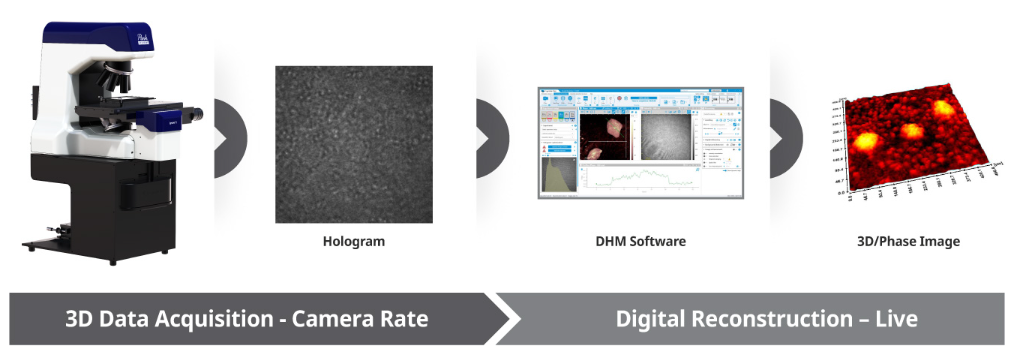
Image Credit: Park Systems