Early Career in Electron Microscopy
Seeing Carbon Nanotubes
Approaching C60 with a Structural Focus
Further Work
Iijima's Legacy
References and Further Reading
Professor Sumio Iijima’s microscopy work helped bring carbon nanotubes into view and changed how scientists study and use carbon at the nanoscale.
Scientists in Focus highlights the people whose ideas, methods, and experiments shaped modern nanoscience. Rather than focusing on single moments of discovery, this series looks at how certain scientists changed what researchers could measure, build, and understand at the nanoscale.
In this article, we take our discussion of carbon nanostructures one step further.1 Professor Sumio Iijima's work helped establish carbon nanotubes as one of the most important structures in nanoscience.
Early Career in Electron Microscopy
Born in Japan in 1939 and educated in solid-state physics, Professor Iijima built his early career around high-resolution transmission electron microscopy (TEM).
In 1970, he began working on improved TEM imaging techniques, developing the structural perspective that would shape his later research.
This was a period when “scientists were enthusiastically trying to discover new things with the newly available microscopes”, and many were turning their attention to the newly discovered Buckminsterfullerene.2,3 Sumio was one of those researchers.
Seeing Carbon Nanotubes
While analyzing carbon deposits from arc-discharge experiments, Professor Iijima observed needle-like graphitic tubes whose atomic arrangement could be directly imaged and interpreted. These structures were later named carbon nanotubes.
His 1991 paper was part of a major new area of research and made carbon a central material in nanoscience.4 Even so, Professor Iijima has consistently described the discovery in modest terms, calling it “accidental”.
For him, that apparent accident was part of the experimental process.3
... you could say my discovery was both fortuitous and coincidental. If you don’t look in the right place, you won’t find the right answer... And that is how I got to see carbon nanotubes - just by pure luck.
Professor Iijima on discovery of nanotubes, JSAP International 2001.3
Approaching C60 with a Structural Focus
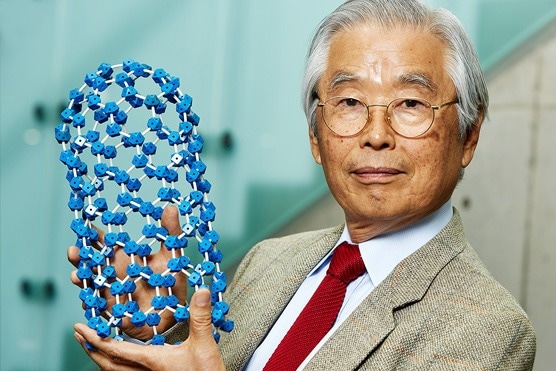 Image Credit: European Patent Office
Following the discovery of Buckminsterfullerene (C60) in 1985, the physics community became deeply interested in its unusual structure and possible superconducting properties. Professor Iijima recalls, however, that the microscopy community did not initially share the same level of excitement. At the time, it was still a relatively small field, focused more on imaging than on applications.3
That changed after the mass production of C60 in 1990. Interest in carbon-based systems expanded quickly, and the field drew much wider attention. Professor Iijima entered this growing area from a structural point of view. Rather than focusing on bulk properties, he focused on how carbon forms and arranges itself.
His focus shifted toward understanding the layered arrangements that hinted at the deeper growth mechanisms underlying fullerene formation, the so-called “onion-like” graphitic structures.3
I thought if I could understand the onion structure and the mechanism of formation of the C60 molecule it could lead to something significant.
Professor Iijima on his work with carbon, JSAP International 2001.3
Instead of following the questions dominating this time, Iijima looked closely at structures other researchers were not yet prioritizing. In doing so, he identified a new form of carbon and expanded what researchers could interpret at the nanoscale.
Further Work
Professor Iijima's work extended beyond nanotubes. Much of his work has remained centered on EM and on unresolved materials problems at the nanoscale.
His more recent work includes revisiting oxide materials he studied decades ago, which are now relevant as electrode candidates for solid-state lithium-ion batteries.3,5
By resolving their crystal structures with advanced electron microscopy, he has supported battery-related research while also demonstrating that microscopy can rival large-scale neutron diffraction facilities in extracting structural information.5
This makes microscopy more than an imaging method. It becomes a practical route to fundamental materials insight.
He has also continued to work on one of the main barriers to nanotube-based electronics: controlled large-scale production.5 Carbon nanotubes offer clear advantages in principle over silicon for some electronic applications, but practical use remains limited because they are difficult to mass-produce and align in a controlled way.
His current efforts focus on methods for orienting these structures at scale, a challenge that remains critical for device integration.
These projects reflect a consistent theme in Professor Iijima’s work. His studies have always been open to innovative new nanostructures, and simultaneously, the technical barriers that prevent them from becoming useful technologies.
Iijima's Legacy
Professor Iijima does not describe science as a process driven by fixed long-term plans. Instead, he emphasizes the uncertain and experience-based nature of experimental work. In his view, progress often emerges from observation, trial and error, and the ability to recognize significance after it appears.
For an ‘experimenter’ like me, ideas for what to do next do not come just by reading some literature or accessing new information. Most research comes about incidentally based on previous experiences. In fact, the real achievement cannot be achieved otherwise.
Professor Iijima on future goals, NEC 2025.5
This perspective reframes his contributions to nanoscience: his discovery of carbon nanotubes was not an isolated breakthrough, but part of a broader approach that values observation, persistence, and openness to unexpected results.
...we, the experimenters, cannot do something by envisioning it from the beginning. When you try doing this, you find something better here. You try doing something here, and then you come across something even better there.
Professor Iijima on his research approach, NEC 2025.5
This philosophy has been integral to his research and carries a practical message for aspiring scientists: impactful discoveries do not require perfect foresight, but the ability to recognize significance when it appears.
References and Further Reading
- Frances Briggs. Scientists in Focus: Professor Mildred Dresselhaus. Published online January 2026. https://www.azonano.com/article.aspx?ArticleID=6981
- Kroto HW, Heath JR, O’Brien SC, Curl RF, Smalley RE. C60: Buckminsterfullerene. Nature. 1985;318(6042):162-163. DOI:10.1038/318162a0, https://www.nature.com/articles/318162a0
- Professor Sumio Iijima. “HOW I FOUND CARBON NANOTUBES AND WHAT THEY CAN DO IN THE FUTURE.” Published online January 2001. https://www.jsap.or.jp/jsapi/Pdf/Number03/Interview.pdf
- Iijima S. Helical microtubules of graphitic carbon. Nature. 1991;354(6348):56-58. DOI:10.1038/354056a0, https://www.nature.com/articles/354056a0
- Professor Sumio Iijima. The Discovery and Future of Carbon Nanotubes: Sumio Iijima. Published online September 2025. https://www.nec.com/en/global/rd/special/202007/index.html
Disclaimer: The views expressed here are those of the author expressed in their private capacity and do not necessarily represent the views of AZoM.com Limited T/A AZoNetwork the owner and operator of this website. This disclaimer forms part of the Terms and conditions of use of this website.