Nanomaterials That Can Safeguard Against Destructive Lasers
Assistant Professor Jayan Thomas from the University of Central Florida has synthesized a new nanomaterial which has the potential to safeguard sensitive equipment and pilots from destructive lasers.
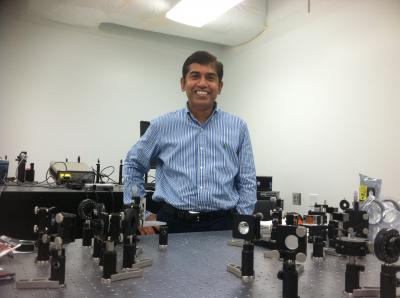
Assistant Professor Jayan Thomas at UCF (Credit: UCF)
Thomas is studying the properties of gold nanoparticles when they are contracted further into a small-sized system known as nanoclusters. These nanoclusters can be considered to occupy the smaller end of the nanoscale while the bigger versions called nanocrystals occupy the bigger end of the nanoscale. Nanoclusters are only bigger than atoms. It is the result of such small dimensions that the normal tenets of physics that apply to particles perceptible by touch and smell are not applicable to nanoclusters.
Thomas states that the process of synthesizing atomically precise nanoclusters of metals is a demanding task. His team developed nanoclusters of gold by sequential addition of atoms. They found that such a synthesis yields nanoclusters with intriguing optical properties. By virtue of these characteristics, gold nanoclusters incorporated as material surfaces can diffuse high energy laser beams. The gold nanoclusters seem to be superior in this aspect vis-à-vis the bigger gold nanocrystals employed in window paintings in churches.
Pilots use helmet shields or glasses to protect their eyes against harsh sunlight. Coating glasses or helmets with the gold nanoclusters developed by Thomas will diffuse the harsh beams of sunlight. Sensitive equipment employed for navigation can be safeguarded against enemy attacks with destructive lasers by applying the gold nanoclusters on their surface. Apart from these applications, Thomas is reviewing the use of the gold nanoclusters in polymers employed in 3D telepresence to increase its light sensitivity.
Disclaimer: The views expressed here are those of the author expressed in their private capacity and do not necessarily represent the views of AZoM.com Limited T/A AZoNetwork the owner and operator of this website. This disclaimer forms part of the Terms and conditions of use of this website.
Written by
Gary graduated from the University of Manchester with a first-class honours degree in Geochemistry and a Masters in Earth Sciences. After working in the Australian mining industry, Gary decided to hang up his geology boots and turn his hand to writing.
When he isn't developing topical and informative content, Gary can usually be found playing his beloved guitar, or watching Aston Villa FC snatch defeat from the jaws of victory.
Please use one of the following formats to cite this article in your essay, paper or report:
APA
Thomas, G.P.. (2019, February 11). Nanomaterials That Can Safeguard Against Destructive Lasers. AZoNano. Retrieved on September 18, 2026 from https://www.azonano.com/news.aspx?newsID=25466.
MLA
Thomas, G.P.. "Nanomaterials That Can Safeguard Against Destructive Lasers". AZoNano. 18 September 2026. <https://www.azonano.com/news.aspx?newsID=25466>.
Chicago
Thomas, G.P.. "Nanomaterials That Can Safeguard Against Destructive Lasers". AZoNano. https://www.azonano.com/news.aspx?newsID=25466. (accessed September 18, 2026).
Harvard
Thomas, G.P.. 2019. Nanomaterials That Can Safeguard Against Destructive Lasers. AZoNano, viewed 18 September 2026, https://www.azonano.com/news.aspx?newsID=25466.
We're committed to providing free access to quality science. By registering and providing insight into
your preferences you're joining a community of over 1m science interested individuals and help us to
provide you with insightful content whilst keeping our service free.
or
Terms
While we only use edited and approved content for Azthena
answers, it may on occasions provide incorrect responses.
Please confirm any data provided with the related suppliers or
authors. We do not provide medical advice, if you search for
medical information you must always consult a medical
professional before acting on any information provided.
Your questions, but not your email details will be shared with
OpenAI and retained for 30 days in accordance with their
privacy principles.
Please do not ask questions that use sensitive or confidential
information.
Read the full Terms & Conditions.