A team of materials scientists from the University of Oklahoma has achieved what was widely considered impossible: successfully magnetizing quantum dots by "doping" them with manganese.
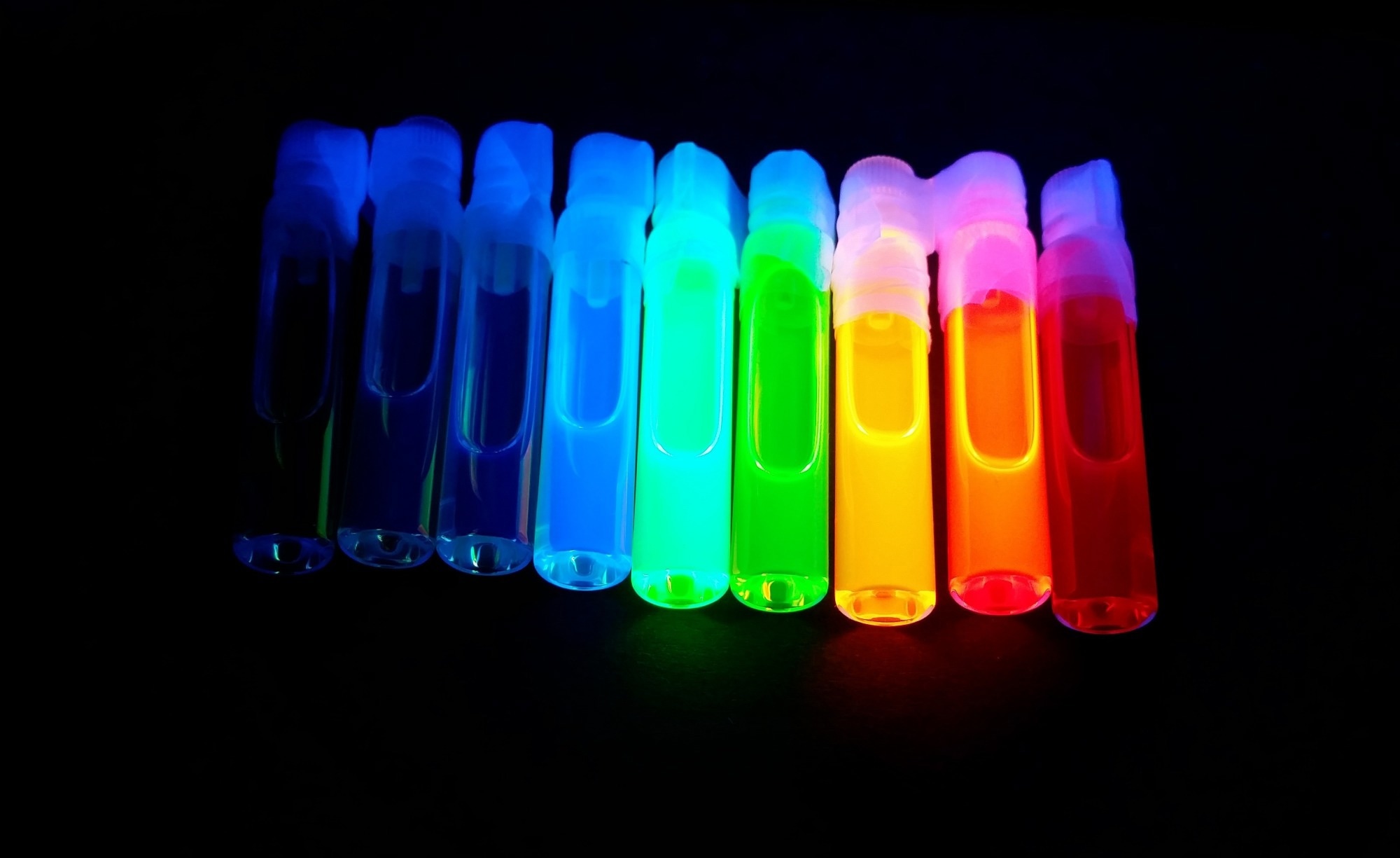 Study: Efficient Mn2+ Doping in Non-Stoichiometric Cesium Lead Bromide Perovskite Quantum Dots. Image Credit: Leo Matyushkin/Shutterstock.com
This breakthrough has far-reaching implications across multiple sectors, potentially impacting areas such as home power supply, computer construction, medical scanning, agricultural development, and lighting technology. The study was published in the Journal of the American Chemical Society.
Cesium lead bromide nanoparticles (CsPbBr3) are a perovskite crystalline material used in a variety of commercial and consumer technologies.
It’s surprisingly difficult to integrate manganese, a good magnetic dopant, into cesium lead bromide nanoparticles.
Yitong Dong, Assistant Professor, University of Oklahoma
The breakthrough follows the 2023 Nobel Prize in Chemistry, which was awarded for the discovery of quantum dots – microscopic semiconductor crystals measuring billionths of a meter in width.
To illustrate their size, the Nobel Foundation remarked that the difference between a quantum dot and a soccer ball is analogous to the difference between a soccer ball and the Earth.
Despite their tiny dimensions, quantum dots are crucial drivers of modern innovation.
Their color can be adjusted simply by altering their size, establishing them as vital components in television displays, computer monitors, and LED lighting. Their broad versatility also makes them essential ingredients in solar cells, biomedical imaging, quantum communication, and even next-generation computing.
Dong’s group specifically works with cesium lead bromide perovskite quantum dots, a particularly promising class of nanoparticles recognized for their bright emission and low-cost production.
Our paper details a method to do it efficiently and consistently. We’ve doped the undopable.
Yitong Dong, Assistant Professor, University of Oklahoma
Researchers have previously attempted to incorporate manganese, a dopant active both optically and magnetically, into the dots to boost their luminescent efficiency and overall utility. However, earlier methods for dot synthesis struggled to integrate sufficient manganese to make the resulting materials practically viable.
Dong's team devised an effective solution by first removing positively charged cations, specifically cesium, from the dots and simultaneously creating a solution environment rich in bromide.
When manganese cations were subsequently introduced into this process, the fast growth of the crystals was regulated, enabling the dots to absorb the magnetic cations into their structure, which resulted in the displacement of approximately 40 % of the lead ions.
Essentially, the crystals swallowed the manganese, which resulted in successful dots doping with very high concentrations.
Yitong Dong, Assistant Professor, University of Oklahoma
The resulting dots emitted an orange glow when excited, representing a shift from the blue light emitted before doping. While quantum dots typically change color when their size is altered, this color change was achieved through chemical alteration in Dong's research. The manganese-doped dots exhibited remarkable brightness, glowing with nearly 100 % efficiency.
Dong stated that with the continued development of this method, the advancements offer several practical benefits. Humans generally prefer the low energy of orange light over high-energy blues, and many crops absorb warmer orange hues more efficiently; this makes the manganese-doped quantum dots an ideal candidate for use in agricultural and indoor lighting.
Dong noted that these improved optical properties have the potential to boost the efficiency of solar cells.
At scale, the dots produced by Dong's team would be more cost-effective than those made with conventional methods because they do not require coating with an additional material to protect their surface.
And that only scratches the surface of the potential.
Since the manganese-doped dots possess magnetic properties, their behavior could pave the way for an entirely new class of technologies, ranging from spin-electronics to enhanced medical imaging.
The potential applications extend to quantum computers: these magnetically doped quantum dots could function as building blocks for qubits that are manipulated using light rather than electricity. This is a significant advantage, as Dong explained, because quantum dots exhibit greater stability under optical excitement.
Dong emphasized that, despite the optimistic outlook, further research is needed to control the doping process in dots of varying sizes and to investigate the properties of the doped manganese ions in more detail. Nonetheless, he believes this discovery signals the emergence of a powerful new class of materials.
We’re so excited that a new family of materials can join this field. They’re cheap, scalable, and amazingly efficient without extensive engineering. With doping, they can be even more versatile.
Yitong Dong, Assistant Professor, University of Oklahoma
Journal Reference
Hidayatova, L., et al. (2025) Efficient Mn2+ Doping in Non-Stoichiometric Cesium Lead Bromide Perovskite Quantum Dots. American Chemical Society. DOI:10.1021/jacs.5c12086.