A continuous flat-jet reactor allowed researchers a closer look at how laser timing, particle collisions, and flow conditions shape boron carbide spheres during high-power processing.
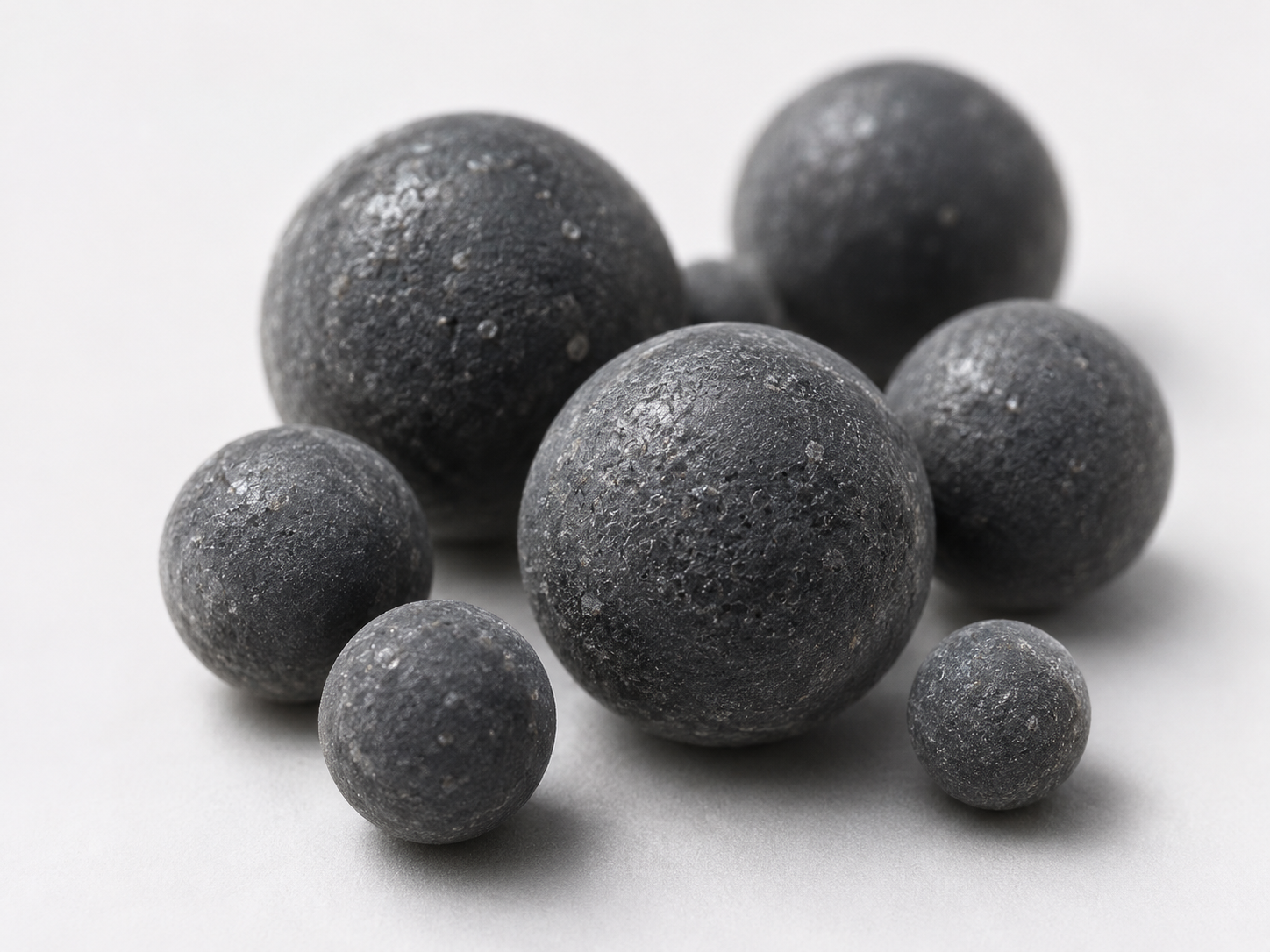
Paper: Kinetically controlled boron carbide composite sub-micrometer particle formation pathways during continuous-flow laser melting in liquids with high-power lasers. AI-generated abstract conceptual image created using ChatGPT/OpenAI
A paper recently published in the Beilstein Journal of Nanotechnology implemented laser melting in liquids (LML) in a flat jet reactor to decouple and systematically assess the effects of laser parameters on the formation of sub-micrometer spheres (SMSs), using boron carbide as the model material.
Controlled Fabrication Challenges and LML
Hard ceramic SMSs are materials with excellent chemical and mechanical stability, making them important for emerging technologies. They play an important role in diverse applications, including solid lubricant systems, drilling materials, abrasives, and composite reinforcements.
In materials science, the controlled fabrication of hard-ceramic SMSs and nanoparticles (NPs) remains a major challenge, as precise control of particle size, sphericity, and crystallinity is required to tailor functional performance.
A mechanistic understanding of the collective role of melting, aggregation, and fusion kinetics in determining the yield and size selectivity is necessary to realize this balance.
LML offers a chemically clean, direct approach to NP reorganization through temporally and spatially confined energy input. This approach enables reagent-free, solvent-based synthesis consistent with green chemistry principles, though the authors note that ethanol may not be fully recyclable.
Yet, traditional batch-mode LML is difficult to scale up for industrial production. Developing a continuous LML method that precisely controls the interaction between matter and lasers is needed to address this issue.
The Proposed LML-based Evaluation
In this work, researchers examined the extent to which high-power steady-state laser processing in flowing ethanol can be used for continuous-flow synthesis of boron carbide SMSs with scale-up potential.
This design also allowed the researchers to study kinetically controlled particle formation under conditions that differ from the thermodynamic-equilibrium description commonly used for prolonged batch processing.
The study extended LML to a continuous flat jet flow-through reactor where boron carbide composite (B4CC) NPs dispersed in ethanol were fed perpendicular to a high-power nanosecond pulsed ultraviolet laser beam.
They also performed additional experiments using pristine boron carbide. The objective was to explain how particle formation pathways are altered by high-repetition-rate modern lasers and flow conditions.
B4CC replaced boron to reduce the required pulse count; its narrower particle-size distribution also helped separate the particle-formation pathways.
The thin, flat jet minimized fluence gradients along the laser beam path and allowed precise control of the number of pulses per unit volume (PPV) across the processed volume under uniform flow conditions.
The setup also used a high-repetition-rate laser with pulse intervals 100 times shorter. The pulse intervals were potentially shorter than the time required for particle cooling between pulses.
The Methodology
The manufacturer specified B4CC particle diameters of 40–80 nm, while TEM of the purified feedstock gave a mean of about 30 ± 12 nm. The particles were dispersed in absolute ethanol, and the resulting suspension was filtered through a syringe filter to remove large feedstock particles (cutoff>100 nm). The commercial composite contained about 21 wt % boron carbide, plus graphitic carbon and boron oxide.
Each experiment used 100 mL of feedstock suspension with a B4CC mass concentration of 250 mg•L ¹. The overall particle concentration remained constant because the LML setup operated as a closed-loop recirculation system with no deliberate mass removal.
Irradiation used an ultraviolet nanosecond laser system (18 ns, 343 nm, 400 W at 10 kHz) integrated into a flat jet setup. The authors used a cylindrical lens with a 500 mm focal length to focus the laser beam to a 0.12 cm² spot size.
A laminar liquid layer 35 µm thick was generated through a 90° nozzle.
Scanning and transmission electron microscopy (SEM and TEM) assessed the morphological changes, while light-scattering measurements (DLS) provided quantitative insight into size distributions. DLS can register aggregates as larger hydrodynamic objects, so its absolute size estimates differed from TEM.
These analyses examined the relationship between SMS formation mechanisms, laser parameters, and the resultant material properties under kinetically controlled LML.
Findings from the Assessment
TEM and DLS characterization of B4CC irradiated at fluences of 45–135 mJ•cm-² revealed spherical particles with a smaller mode around 50 nm and a larger mode that varied with processing conditions. The resulting bimodal size distribution supported the interpretation of two simultaneous mechanisms: isochoric reshaping, in which particles melt and become spherical without substantial growth, and aggregation–melting–fusion.
XRD and XPS measurements also showed loss or strong reduction of oxide-related signals after laser treatment.
The smaller particle fraction agreed with calculations based on thermal equilibrium, but the second size mode, originating from multistep aggregation–melting–fusion, was substantially smaller than predicted. The model assumed pure B4C properties, so the authors treated its predictions as approximate for the composite feedstock.
Systematic variation of laser PPV from 1 to 16, achieved by changing the laser repetition rate while the interpulse delay (τIP) fell from 1.4 to 0.1 ms, initially increased the second mode’s mean diameter, which peaked at 4 PPV.
But further particle growth was stalled at higher PPV. The authors linked the plateau mainly to low particle-collision rates associated with the low particle concentration and short τIP. They did not measure kinetic rate constants or vary PPV and τIP independently, while cavitation bubbles remain a possible contributor. This indicated kinetically controlled particle formation, meaning growth was limited by how quickly particles could encounter and fuse with one another rather than being determined only by the thermodynamic conditions for melting.
At 180 mJ•cm-², laser fragmentation in liquid dominated, producing a small mass fraction of ultrasmall NPs (approximately 2 nm). This marked the upper limit of the LML processing window.
The study found that kinetically controlled LML in a flat-jet reactor can produce size intermediates that are difficult to obtain in prolonged batch-mode laser processing. The researchers also assessed the flat-jet design for its production potential. The current reactor yielded about 100 mg•h-¹, below the 195 mg•h-¹ reported for a guided-flow reactor; the projected 900 mg•h-¹ figure came from an estimate rather than an experimental measurement.
Disclaimer: The views expressed here are those of the author expressed in their private capacity and do not necessarily represent the views of AZoM.com Limited T/A AZoNetwork the owner and operator of this website. This disclaimer forms part of the Terms and conditions of use of this website.
Source:
- Koch, N. G., Rehbock, C., Koshizaki, N., & Barcikowski, S. (2026). Kinetically controlled boron carbide composite sub-micrometer particle formation pathways during continuous-flow laser melting in liquids with high-power lasers. Beilstein Journal of Nanotechnology, 17(1), 1582-1595. DOI: 10.3762/bjnano.17.108, https://www.beilstein-journals.org/bjnano/articles/17/108