By pairing precisely patterned chiral structures with a disordered gold nanosponge, researchers tested whether concentrated optical hotspots could strengthen normally weak interactions between light and molecular handedness.
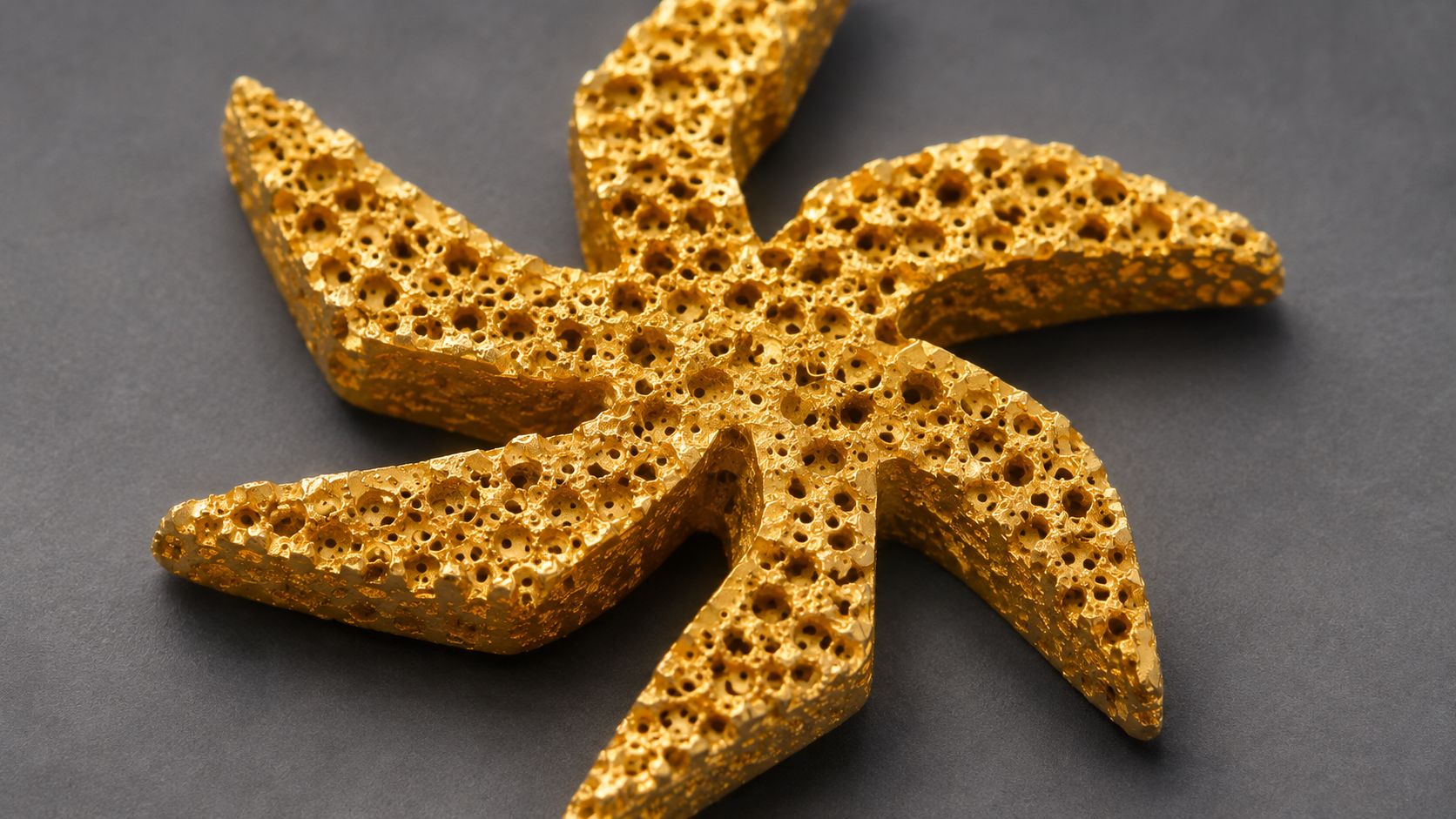
Paper: Chiral SERS and photochemistry via collective hotspot asymmetry in metasurface-templated gold networks with disordered nanoscale porosity. AI-generated abstract conceptual image created using ChatGPT/OpenAI
*Important notice: This news reports on an unedited version of an accepted paper and is awaiting final editing. Therefore, the paper should not be regarded as conclusive or treated as established information.
In a recent research article published in the journal Nature Communications, researchers developed a chiral plasmonic nanoporous network that combines lithographically defined chiral templates with disordered nanoscale porosity to produce strong superchiral near-fields, near-theoretical chiral SERS asymmetry, ultrasensitive chiral detection, and enantioselective photochemistry.
Chiral Plasmonic Design Principles
Controlling and detecting molecular chirality with light is difficult because interactions between chiral molecules and electromagnetic waves are inherently weak. Conventional approaches rely on circularly polarized light (CPL), which often exhibits low sensitivity and limited efficiency for enantioselective chemistry.
Increasing these interactions requires structures that generate intense chiral electromagnetic near-fields, sometimes termed superchiral fields, in which optical chirality can exceed that of CPL.
Prior strategies have employed either bottom-up self-assembly or top-down nanofabrication, yet both have limitations. Bottom-up methods often lack mechanical stability and precise field confinement, while top-down lithographic nanostructures face fabrication limits such as minimum gap sizes of about 20 nm, restricting electromagnetic field localization.
Fabrication of Shuriken Networks
The study describes a chiral plasmonic nanoporous network (CPNN) fabricated through a combined top-down/bottom-up strategy. The chiral component consists of lithographically patterned six-fold shuriken-shaped indentations on silicon, with right- or left-handed geometries arranged in a square lattice. Each shuriken is about 500 × 500 nm.
These shuriken templates are coated with a titanium adhesion layer (~5 nm) followed by a gold film (~115 nm thick), forming plasmonic nanostructures with strong intrinsic optical chirality.
The nanoporous network is then deposited through electrochemical soft-template electrodeposition, producing a disordered gold sponge with nanoscale pores and ligaments. The mean pore diameter was about 32.8 nm, with a separate version at about 9 nm. The porous layer increases surface area and creates dense plasmonic hotspots.
Scanning electron microscopy, optical rotation dispersion (ORD), reflectivity spectroscopy, and SERS were used to assess morphology, chiroptical responses, and enantiomer discrimination.
Enantioselectivity was tested using the R- and S-enantiomers of metalaxyl, a common chiral fungicide. Numerical simulations modeled near-field distributions and optical chirality.
Superchiral Field Generation & Applications
Simulations showed that isolated shurikens and CPNNs both produced spatially heterogeneous superchiral near-fields. Maximum normalized chirality increased from about 122 for the isolated shuriken to about 198 after addition of the nanoporous layer, relative to CPL. This increase was moderate compared with the much larger change in measured chiral SERS asymmetry.
The authors propose that the nanoporous network adds a multiply scattered field that can interfere coherently with the shuriken’s chiral scattered field. In this interpretation, the interference cross-term locally increases optical chirality and, with denser hotspots, helps explain the measured asymmetry. The paper states that this mechanism has not been verified by direct field decomposition.
Changing deposition time revealed a balance between preserving shuriken geometric fidelity and increasing hotspot density. A 150-second electrodeposition time gave the best balance, while longer deposition degraded the chiral geometry even as surface area continued to increase.
Experiments with smaller nanopores (~9 nm) confirmed that tighter nanoscale confinement improves plasmonic response, but SERS activity is not determined by surface area alone. Hotspot density, optical efficiency, and molecule access also matter.
SERS measurements of metalaxyl under linearly polarized laser excitation showed strong chiral discrimination. For S-metalaxyl, ILH/IRH reached 9.4; R-metalaxyl showed the opposite preference with IRH/ILH of about 9.2. The paper also reports response at concentrations down to 10−9 M, attomole-range detection, and measurements of defined R/S mixtures.
The stronger SERS discrimination occurred alongside larger ORD signals. This is consistent with a connection between far-field chiroptical response and chiral near-field behavior, but ORD does not directly measure hotspot topology.
To account for the much larger SERS asymmetry, the model treats total optical chirality as the intrinsic shuriken field, a negligible net contribution from the achiral nanoporous structure alone, and an interference cross-term where the fields overlap. This model is consistent with controls, deposition trends, ORD-SERS correlations, and simplified simulations.
In the model, the interference term depends on the optical rotation angle and relative phase shift. Raman scattering adds another weighting effect because its intensity scales with the fourth power of the electric-field magnitude, |E|4.
The ensemble signal emphasizes the relatively few locations where field intensity and optical chirality are both high. This provides a physical explanation for why the measured SERS asymmetry can be much larger than the change in peak simulated optical chirality.
The CPNNs also supported enantiospecific photochemical reactions of metalaxyl under continuous-wave linearly polarized excitation around 780 to 785 nm, far from the molecule’s UV absorption maximum near 260 nm. Controls found no reaction without CPNNs or on nonporous chiral shurikens, while matched substrate-enantiomer pairs showed photocleavage rates about two to three times faster than mismatched pairs.
Because direct photolysis at this wavelength is ruled out, the authors interpret the reactivity primarily as local field-assisted multiphoton excitation. Racemic metalaxyl reached about 26% enantiomeric excess at 44-51% conversion. The molecular pathway remains unresolved, with near-field excitation, hot-carrier processes, and photothermal effects not fully separated.
These experiments used continuous-wave excitation rather than the high-intensity pulsed lasers common in multiphoton photochemistry.
Implications for Chiral Photochemistry
This work describes a chiral plasmonic nanoporous network that combines lithographically defined chiral shuriken nanostructures with a disordered gold nanosponge to concentrate electromagnetic fields and produce strong chiral SERS responses. The authors also calculate a six-order-of-magnitude increase over conventional Raman optical activity.
The architecture increases accessible surface area and field confinement while preserving a reproducible chiral pattern. Direct near-field measurements and full three-dimensional modeling are still needed to test this interference model and establish how broadly the design principle applies to other systems.
Source:
- Guselnikova O., Gorbunova A., et al. (2026). Chiral SERS and photochemistry via collective hotspot asymmetry in metasurface-templated gold networks with disordered nanoscale porosity. Nature Communications. DOI: 10.1038/s41467-026-78158-9, https://www.nature.com/articles/s41467-026-78158-9