Bio-based lignin nanoparticles improved laboratory oil recovery in sandstone and carbonate cores, revealing how particle size and rock type can shape next-generation enhanced oil recovery strategies.
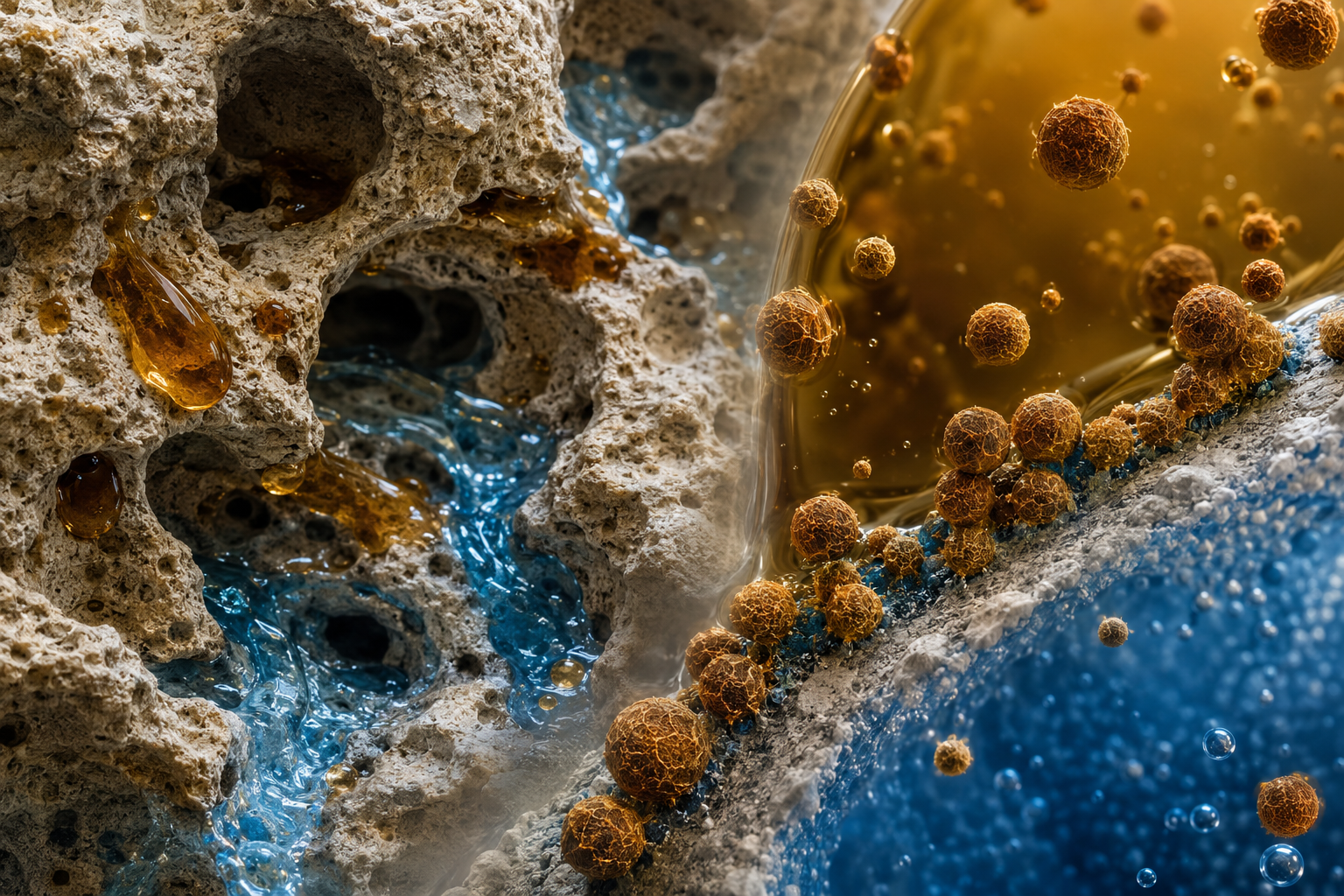
Paper: Lignin-based nanoparticles as sustainable agents for enhanced oil recovery in sandstone and carbonate reservoirs. Image credit: AI-generated image created using ChatGPT/OpenAI
In a recent research article published in the journal Scientific Reports, researchers investigated the synthesis and application of lignin-based nanoparticles with controlled sizes derived from alkali and kraft lignins to enhance oil recovery in sandstone and carbonate reservoirs by modifying interfacial properties and rock wettability.
Lignin Nanoparticles for EOR
The global energy demand continues to heavily rely on petroleum resources despite the growing emphasis on renewable energy. Enhanced oil recovery (EOR) techniques are essential for maximizing extraction from existing reservoirs and minimizing environmental impact by reducing the need for new exploration.
Among EOR methods, chemical agents such as polymers and surfactants have demonstrated the ability to increase oil displacement by altering rock wettability and reducing interfacial tension. However, their application is often limited by reservoir heterogeneity, lithology differences, and harsh conditions, especially in carbonate and sandstone formations.
Nanotechnology introduces novel opportunities, enabling nanoparticles (NPs) to manipulate rock-fluid interfaces and improve transport and stability in porous media. Lignin, a natural aromatic polymer widely available as a byproduct of the pulp and paper industry, offers a sustainable alternative for nanoparticle synthesis.
Lignin-based nanoparticles (LNPs) exhibit favorable interfacial activity, potential to alter wettability, and bio-based material advantages, positioning them as promising EOR agents. Nonetheless, previous research has not extensively explored the interplay between lignin source, nanoparticle size, and reservoir lithology.
Nanoparticle Synthesis and Characterization
Nanoparticles were synthesized from two technical lignin sources: alkali lignin (AL) and kraft lignin (KL). To assess nanoscale effects, three size fractions targeting approximately 200 nm, 330 nm, and 500 nm diameters, denoted NP-1, NP-2, and NP-3, were prepared via source-specific nanoprecipitation approaches: kraft lignin via aqueous acetone fractionation and alkali lignin at varying lignin concentrations in ethylene glycol and nitric acid.
Particle size and distribution were characterized by dynamic light scattering (DLS) and scanning electron microscopy (SEM), confirming spherical morphology and generally narrow size distributions, with KL-NPs showing lower polydispersity than AL-NPs. The zeta potential was measured to evaluate surface charge variations with particle size, indicating a decrease in magnitude with increasing particle size.
Stability and colloidal behavior were assessed in 3000 ppm sodium chloride brine and laboratory flooding experiments at 60 °C and 100 psi back-pressure. Interfacial properties were quantified using oil-water interfacial tension (IFT), surface tension, and contact angle measurements on representative sandstone and carbonate substrates to analyze wettability alteration.
Core flooding experiments employed rock samples from the Mansouri and Ahvaz Asmari oilfields, representing sandstone and carbonate lithologies, respectively. Both brine flooding and stepwise injection scenarios of brine followed by nanoparticle suspensions, with and without surfactants, were performed to determine incremental oil recovery.
Recovery efficiencies were statistically analyzed, and mechanistic insights were developed correlating nanoparticle characteristics with their interfacial and transport behaviors in porous media.
Interfacial Effects and Oil Recovery
The synthesized lignin nanoparticles exhibited well-controlled sizes with narrow distributions: approximately 206-214 nm (NP-1), 330-351 nm (NP-2), and 500-531 nm (NP-3) for both AL and KL sources. Zeta potentials decreased from smaller to larger particles, reflecting diminished surface charge density and functional group exposure.
SEM imaging revealed spherical, slightly rough-surfaced nanoparticles, confirming synthetic consistency. Wettability assessments evidenced significant reductions in contact angle across both rock types, indicating a shift toward more water-wet conditions.
Notably, although smaller NP-1 particles produced the lowest equilibrium contact angles, intermediate-sized NP-2 formulations delivered the strongest oil recovery, highlighting that wettability alteration must be balanced with interfacial activity and transport through pore networks.
Interfacial tension measurements revealed that both lignin types effectively reduced oil-water IFT, thereby improving oil mobility. NP-2 consistently outperformed smaller and larger sizes in reducing IFT and surface tension, indicating size-dependent optimization of interfacial activity.
Core flooding data demonstrated that AL-based intermediate-sized nanoparticles (AL-NP-2) yielded the highest incremental oil recovery in sandstone cores, approximately 23.64 ± 2.49%, with KL-NP-2 also enhancing recovery, approximately 19.61 ± 3.54%. These differences were consistent with variations in lignin molecular structure and surface chemistry influencing nanoparticle-fluid interactions, although the study reported that lignin-source effects were not statistically significant.
Sandstone cores exhibited superior nanoparticle transport and adsorption due to their higher porosity, permeability, and more water-wet mineralogy, resulting in comparatively lower overall recovery improvements.
Stepwise flooding strategies combining brine and AL-NP-2 injections delivered cumulative oil recovery enhancements reaching approximately 53.48 ± 5.53% in sandstone and 34.95 ± 3.46% in carbonate cores.
These stepwise cumulative effects arose from nanoparticle-mediated wettability shifts and reductions in interfacial tension following initial brine flooding. Additional surfactant injection further increased recovery, suggesting that lignin nanoparticles are compatible with conventional chemical EOR agents.
Mechanistically, lignin nanoparticles adsorbed onto rock surfaces, modifying wettability toward more water-wet conditions, which reduced capillary trapping forces. Concurrently, their accumulation at the oil-water interface lowered interfacial tension, promoting droplet deformation and mobilization.
Optimizing Lignin NPs for EOR
This research establishes that lignin-based nanoparticles synthesized from two prevalent technical lignin types provide effective, potentially more sustainable nano-agents for enhanced oil recovery in sandstone and carbonate reservoirs.
Collectively, these results demonstrate that tuning nanoparticle size and selecting appropriate lignin sources enables the development of bio-based nanofluids tailored for diverse reservoir conditions.
The work contributes mechanistic insights to bridge nanoscale material design and macroscale reservoir engineering, supporting further evaluation of lignin nanotechnology for sustainable, efficient petroleum production.
Source:
- Soleimani, M., & Khaksar Manshad, A. (2026). Lignin-based nanoparticles as sustainable agents for enhanced oil recovery in sandstone and carbonate reservoirs. Scientific Reports. DOI: 10.1038/s41598-026-62132-y, https://www.nature.com/articles/s41598-026-62132-y