From disease-linked breath molecules to food spoilage and environmental pollutants, researchers are rethinking how sensors recognize the subtle molecular signatures hidden within complex odors.

Paper: “Smelltronics” - From Gas to Smell Sensing. AI-generated abstract conceptual image created using ChatGPT/OpenAI
A review recently published in the journal Advanced Materials examined recent trends in smell and odor-sensing studies, collectively referred to as “smelltronics”. The authors describe smelltronics as a materials-focused approach that bridges conventional gas sensing and biological olfaction by targeting larger, information-rich volatile organic compounds (VOCs) and designing sensing interfaces that can distinguish subtle differences in molecular structure, rather than relying primarily on downstream pattern recognition.
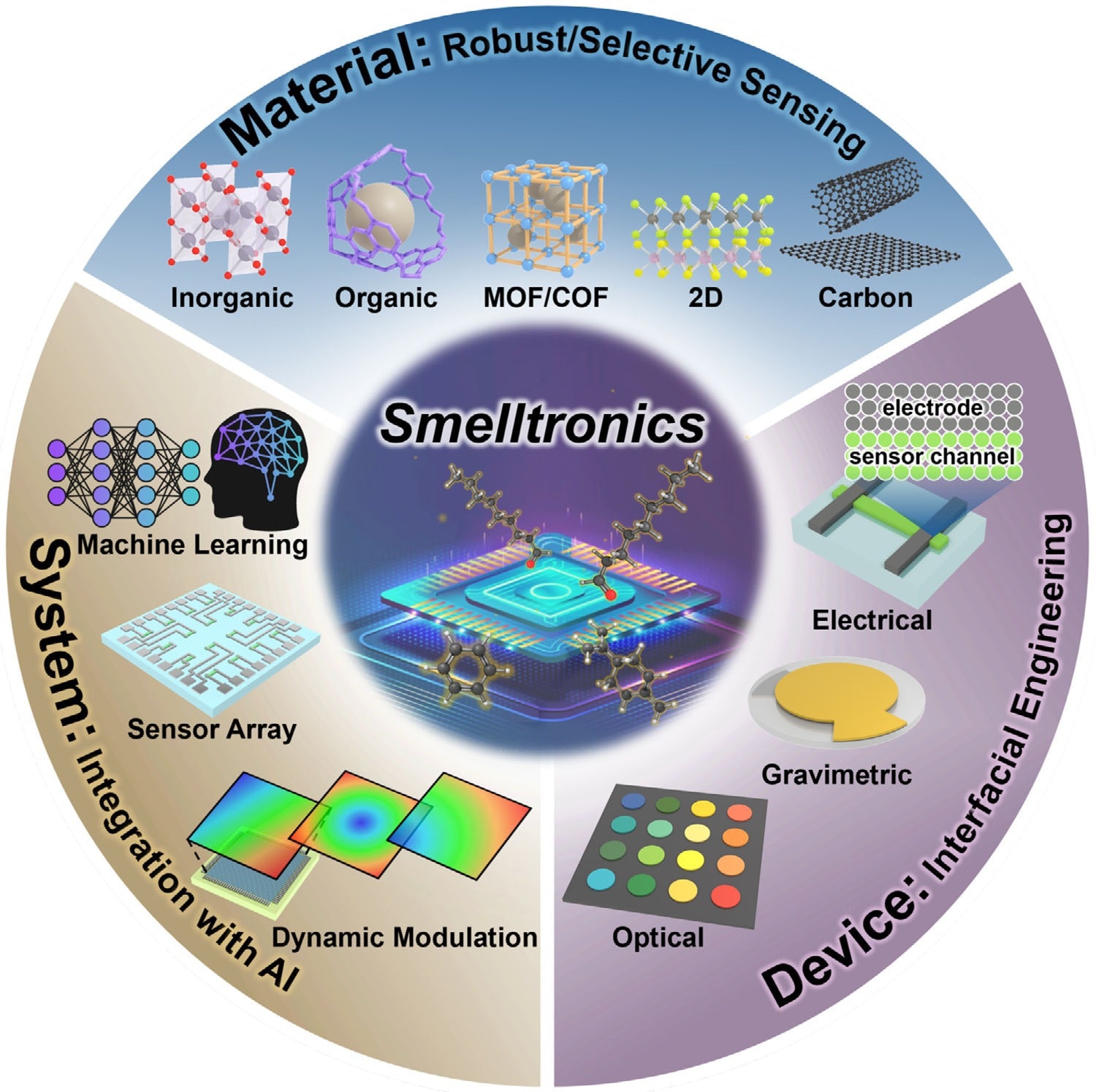
Conceptual overview of smelltronics. The domain of chemical sensing is undergoing a transformation from traditional gas sensing, which predominantly focuses on highly volatile gases, to smelltronics, which seeks to detect and differentiate complex VOCs that convey specific odor information. To achieve precise odor identification, smelltronics relies on the development of three hierarchies: (1) diverse sensing materials engineered for specific interactions, (2) devices that transduce physicochemical events into digitized signals, and (3) systems that integrate sensor arrays with information science.
Engineering Materials for Odor Recognition
Noble metals, including platinum, gold, and palladium, can be incorporated into metal oxide chemiresistors to enhance their sensitivity to hydrogen, nitrogen dioxide, carbon monoxide, and other small gases. Tin dioxide nanowires have been functionalized using palladium, gold, or platinum nanoparticles and integrated into chemiresistors.
Octadecylphosphonic acid (ODPA) has been used to modify zinc oxide nanowire-based chemiresistors to accelerate sensor recovery during nonanal gas sensing. Results showed that the ODPA-modified zinc oxide chemiresistor detected nonanal with higher sensitivity than the unmodified chemiresistor and did so reversibly.
Cysteine was used to functionalize gold nanorods or nanoparticles, which were then used as plasmonic aggregative colorants. Gold nanoparticles with cysteine display color changes when exposed to a late blight biomarker, (E)-2-hexenal.
Based on conventional organic dyes and gold nanomaterials, this colorimetric sensor array classified 10 plant volatiles and enabled the diagnosis of tomato late blight as early as 2 days post-inoculation.
A chemiresistor has been successfully developed using pentiptycene polymer/single-walled carbon nanotube (CNT) composites with a large surface area. Planar cavities formed within the composites provided selectivity toward benzene, toluene, and o-xylene by accommodating their planar aromatic structures. A quartz crystal microbalance (QCM) sensor array modified using two-dimensional (2D) transition metal dichalcogenide (TMD) nanosheets was employed to identify large molecules in air.
The modified QCM sensor array demonstrated unique response patterns toward aldehydes, esters, terpenes, and alcohols, illustrating how cross-reactive materials can generate multidimensional patterns for VOC discrimination.
Optical Sensors for Odor Sensing
A study fabricated single-crystalline 2D nanosheets by synthesizing and exfoliating chiral fluorescent metal-organic frameworks (MOFs). Using vapors of 17 chiral terpenoids and terpenes, the nanosheets' molecular recognition was analyzed.
Upon exposure to chiral terpenoids/terpenes, the fluorescence of the nanosheets was quenched through the supramolecular interactions between gaseous analytes and the chiral binding sites of the MOF nanosheets. The specific arrangement of the binding sites and chiral nature enabled enantioselective fluorescence quenching.
Localized surface plasmon resonance (LSPR) occurs when the incident light frequency matches the oscillation frequency of conduction-band electrons in silver or gold nanoparticles.
This alignment enhances light scattering and absorption at frequencies that excite LSPR, resulting in distinct extinction spectra influenced by the refractive index of the surrounding medium and the nanoparticles' characteristics.
Such approaches are important because smelltronics must often discriminate between structurally similar VOCs, including isomers and enantiomers, by exploiting subtle noncovalent interactions, such as van der Waals forces.
Chemiresistors for Odor Sensing
Chemiresistors have an inherent baseline resistance that changes in response to the chemical environment, such as exposure to gaseous analytes. The sensors are used in diverse applications due to their advantages, including low-power operation, ease of fabrication, gas sensitivity, and straightforward output.
Yet, chemiresistors are often integrated into sensor arrays as their output is a single parameter (conductance/resistance). CNTs, polymers, metal nanoparticles, and metal oxides have been used as sensing materials in chemiresistors.
Metal nanoparticle networks and polymer-based composites operate at room temperature. They transduce signals depending on the thermodynamic partition equilibrium between the VOC and the soft organic matrix or ligand.
VOCs partition into the organic ligand shells of metal nanoparticle networks, such as thiol-capped gold. Swelling induced by this partitioning substantially increases the electron-tunneling resistance between particles and simultaneously alters the local dielectric environment.
A study used organic molecules comprising thiol groups to decorate gold nanoparticles, synthesized chemiresistors using these functionalized nanoparticles, and integrated those chemiresistors into a nine-channel array.
The interactions between nanoparticles and VOCs modulated interparticle distances, thereby altering chemiresistor resistance. This cross-reactive sensor array could distinguish patients with lung cancer from healthy controls based on their breath, without requiring preconcentration or dehumidification of exhaled biomarkers.
1024 nanofilm channel tin dioxide sensors were integrated successfully into a single chip in a study to create a reliable sensing system. Interconnect parasitic resistance was mitigated by combining lateral nanofilm-channel devices with a crossbar interconnect geometry, enabling rapid and robust VOC detection by the integrated chemiresistor array chip.
Similarly, another study integrated a chemiresistor array on nanotubes within the chip, employing 10,000 individual sensors despite the array comprising only four metal oxides. The array was highly sensitive to different gases and could differentiate between mixed gases and odors.
However, the review highlights a fundamental trade-off in smelltronics. Robust inorganic semiconductors such as metal oxides generally offer high chemical and thermal stability but limited molecular recognition, whereas organic and bio-derived materials provide highly tunable recognition but often have poorer long-term robustness.
Electrochemical and FET Sensors
A study enhanced electrochemical sensor electrodes using hexanethiol-capped gold nanoparticles, in which interactions between the thiolated capping agent and limonene vapors improved sensitivity and enabled quantification of limonene in breath samples from cirrhotic patients.
VOC discrimination was also achieved using a single field-effect transistor (FET) sensor based on silicon nanowires functionalized with self-assembled monolayers (SAMs). Four parameters, hole mobility, subthreshold swing, threshold voltage, and source-drain current, were extracted and used in artificial neural network (ANN) models.
Proper SAM modification and ANN training enabled discrimination of similar alkanes and alcohols using a single FET device. However, robustness remains a key challenge.
More broadly, the review emphasizes that materials alone will not be sufficient for practical smelltronics. Sensor arrays must increasingly be integrated with signal processing and machine learning to interpret the high-dimensional response patterns produced by complex VOC mixtures.
In conclusion, the review highlighted how smelltronics is evolving from proof-of-concept VOC sensors toward an integrated technology platform for encoding, exploiting, and extracting odor information in real-world environments. The authors outline a 5- to 10-year roadmap in which advances in molecularly designed interfaces, hybrid materials, heterointerface engineering, and dynamically modulated sensors are followed by greater integration with neuromorphic computing, reservoir computing, and Edge artificial intelligence">AI. They also propose sustainability as a fifth key sensor challenge, alongside stability, speed, selectivity, and sensitivity, as smelltronics moves toward potentially widespread, disposable devices.
Disclaimer: The views expressed here are those of the author expressed in their private capacity and do not necessarily represent the views of AZoM.com Limited T/A AZoNetwork the owner and operator of this website. This disclaimer forms part of the Terms and conditions of use of this website.