Tescan has introduced the new generation of Tescan CLARA™, an ultra-high-resolution scanning electron microscope for nanoscale materials characterization. The system combines low-energy high-resolution SEM imaging, multi-contrast detection, support for challenging materials, and faster navigation from setup to results for research laboratories, shared microscopy facilities, and industrial R&D environments.
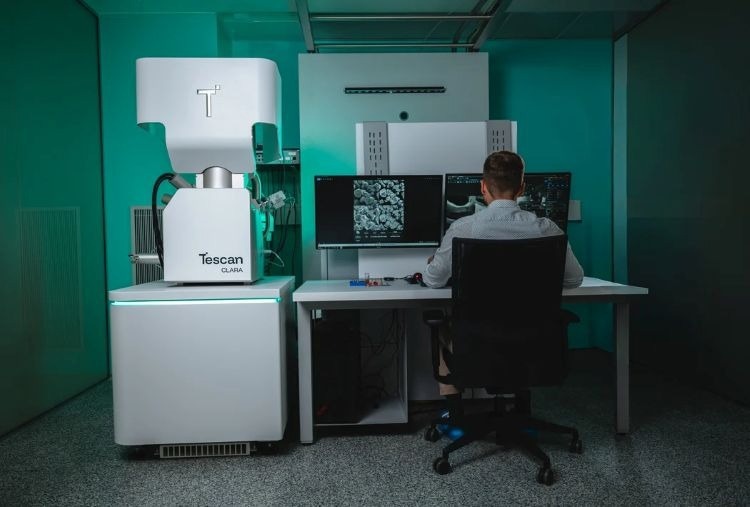 Image Credit: Tescan
The new CLARA™ is intended for work in materials science, nanotechnology, advanced manufacturing, industrial R&D, and shared microscopy facilities. It supports imaging and analysis across a range of sample types, including polymers, magnetic materials, metals, ceramics, coatings, particles, and failure analysis samples.
“In materials research, important information is often found in subtle surface structures, thin layers, local composition changes, or features that are difficult to image without changing the sample,” said Sirine Assaf, CRO at Tescan. “CLARA™ is designed to support this work by combining low-energy imaging, rich detection, and practical workflow control in one platform.”
Clearer Nanoscale Imaging with Less Sample Preparation
Many important material features can only be understood at the nanoscale. CLARA™ enables ultra-high-resolution imaging at low energy levels, which is especially valuable when working with delicate, non-conductive, or beam-sensitive samples.
Low-energy imaging helps researchers observe fine surface structures while reducing the need for additional preparation steps such as conductive coating. This allows teams to study materials closer to their natural state and reduce the risk of preparation artifacts.
For researchers studying nanoparticles, thin surface layers, coatings, contamination, or small defects, this combination of resolution and sample protection supports the interpretation of fine structural and material features.
More Insight From Every Measurement
CLARA™ is designed to collect complementary types of information from the same area of a sample, helping researchers distinguish surface detail from material differences.
This multi-contrast approach can help identify near-surface particles, contamination layers, composition changes, or material variations that may be difficult to separate from topographic contrast alone.
Analytical Flexibility for Research and Industrial Laboratories
Modern research and industrial laboratories rarely work with one simple sample type. One day may involve a conductive metal, the next a polymer, magnetic material, porous structure, coating, fracture surface, or sensitive prototype component.
CLARA™ supports high-resolution SEM imaging across challenging materials and offers low-vacuum capability for samples that charge, outgas, or require gentler imaging conditions. Researchers can adapt imaging conditions to the sample rather than forcing the sample into a fixed workflow.
The system also supports a range of analytical techniques, enabling laboratories to connect high-resolution imaging with deeper material analysis. CLARA™ is suited to applications in advanced materials research, electronics, energy materials, metallurgy, polymers, coatings, nanotechnology, failure analysis, and quality control.
With CLARA™, Tescan continues to develop electron microscopy solutions that combine performance, usability, and analytical flexibility for routine and advanced nanoscale characterization.