A synthesis of more than 200 studies traces how particle size, polymer chemistry, and exposure conditions shape toxicity while highlighting the evidence gaps that still cloud real-world risks.
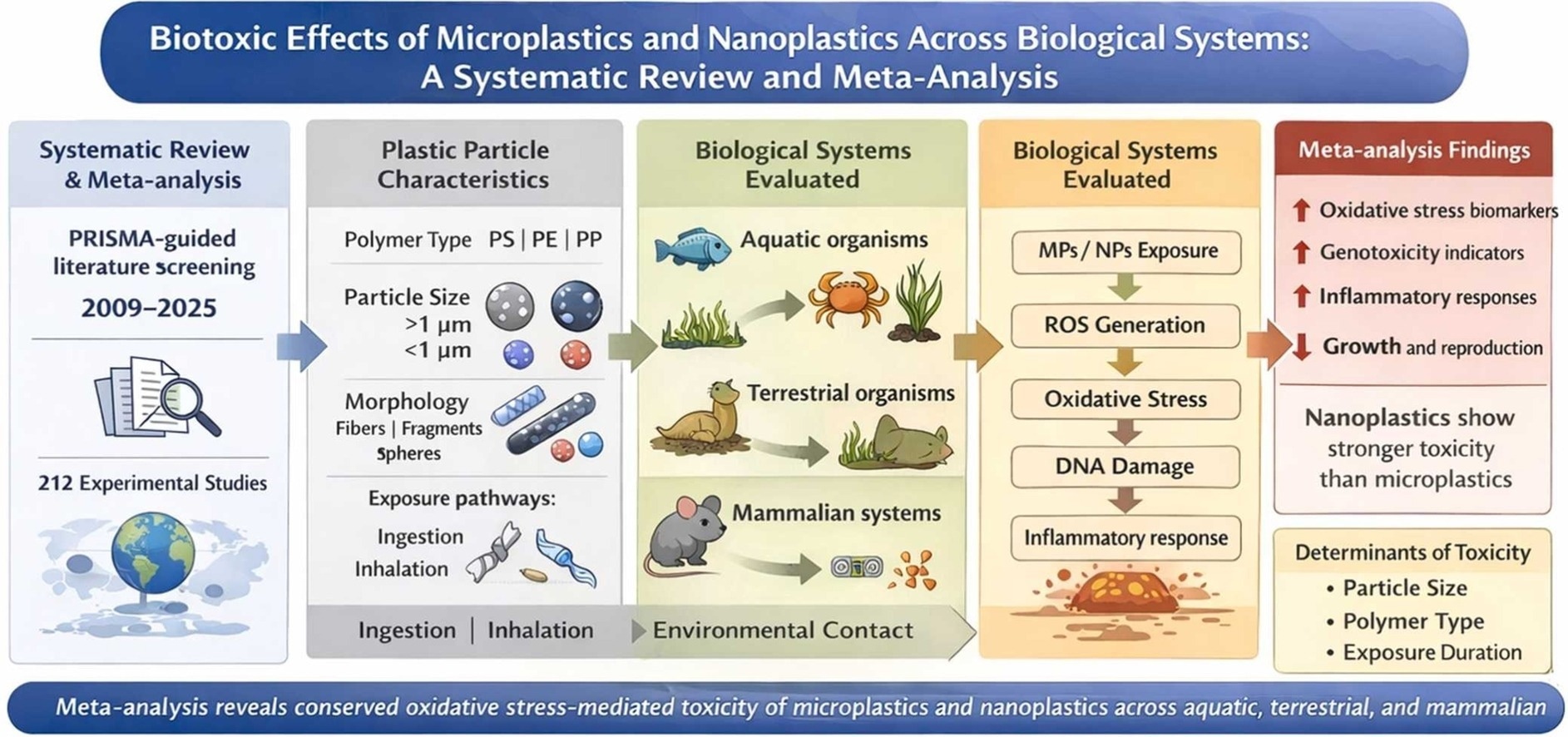
Paper: Biotoxic effects of microplastics and nanoplastics across biological systems: A systematic review and meta-analysis
A recent review and meta-analysis published in the journal Next Nanotechnology examines the biological effects of microplastics and nanoplastics across diverse biological systems. The authors report combining findings from 212 studies to provide a comprehensive assessment of their toxicity across aquatic, terrestrial, and mammalian systems. Overall, the review provides evidence that may inform understanding of the biological impacts of microplastics and nanoplastics and support environmental risk assessment.
Why Microplastics and Nanoplastics Pose a Growing Concern
Global plastic production now exceeds 400 million metric tons annually, yet only a small fraction is recycled. As larger plastic products weather through sunlight, mechanical abrasion, and biological degradation, they break down into microscopic particles that accumulate in soil, rivers, oceans, air, and drinking water. Particles smaller than 5 mm are classified as microplastics, while the review defines those below 100 nm as nanoplastics. Their widespread presence has made them a significant environmental pollution concern.
Aquatic animals often mistake microplastics for food, while humans encounter them through contaminated seafood, drinking water, food packaging, and airborne dust. Experimental evidence suggests that some particles may cross biological barriers, while microplastics have been detected in human blood, lungs, liver, and placenta, as well as other biological samples. Studies have linked microplastics and nanoplastics to oxidative stress, inflammation, DNA damage, mitochondrial dysfunction, and other forms of cellular injury under experimental conditions. However, differences in particle size, polymer type, exposure conditions, biological models, and experimental methods have produced inconsistent findings across studies. Evidence linking environmental exposure to specific health effects in humans also remains limited.
Most reviews have focused on individual species or specific toxicological endpoints, making it difficult to identify broader biological patterns. To address these challenges, the researchers conducted a systematic review and meta-analysis to quantify the biological effects of microplastics and nanoplastics and identify the factors that influence their toxicity.
Combining Evidence From More Than 200 Studies
The researchers conducted the review according to the Preferred Reporting Items for Systematic Reviews and Meta-Analyses (PRISMA) 2020 guidelines and prospectively registered the study protocol with PROSPERO. They searched six major scientific databases through November 2025 and reported that 212 studies were included in the qualitative synthesis. Of these, 174 provided sufficient data for quantitative meta-analysis. Together, the studies spanned diverse experimental models, including fish, aquatic invertebrates, rodents, human cell lines, and other organisms exposed to microplastics and nanoplastics.
The researchers considered multiple biological endpoints, including oxidative stress, inflammation, genotoxicity, growth, reproduction, mortality, and physiological function. They also assessed how particle size, polymer type, exposure concentration, and exposure duration influenced these responses. Subgroup analyses and meta-regression further explored which experimental factors were associated with the magnitude of the reported effects.
Across 84 independent studies, exposure to microplastics and nanoplastics was associated with reduced antioxidant defense capacity and increased oxidative damage, including lower activity of key antioxidant enzymes that help cells control damaging reactive oxygen species, such as superoxide dismutase, catalase, and glutathione peroxidase. Nanoplastics generally produced stronger biological effects than microplastics. A subgroup analysis also found stronger effects after chronic exposure than after acute exposure, although exposure duration was not significantly associated with oxidative stress in the meta-regression. Among the polymers evaluated, polystyrene exhibited the largest effect sizes under the experimental conditions included in the analysis. However, polystyrene was the most frequently studied polymer, accounting for 48% of the included evidence, suggesting its prominence may partly reflect its disproportionate use in experimental research.
How Particle Properties Shape Toxicity
The findings have important implications for researchers developing more sustainable polymer materials. Although plastics remain essential in packaging, healthcare, construction, transportation, and electronics, their persistence in the environment continues to present significant challenges. The review suggests that particle characteristics strongly influence biological responses, underscoring the need to consider a material's environmental consequences alongside its performance during use.
Among the factors examined, particle size emerged as one of the strongest determinants of toxicity. The authors propose that nanoplastics may produce greater biological effects because their small size may enable them to cross cellular membranes more easily and interact directly with intracellular components. Their high surface-area-to-volume ratio may also increase chemical reactivity and enhance the adsorption of environmental contaminants. Together, these properties may help explain why nanoplastics behave differently from their larger counterparts.
Surface chemistry also influences how plastic particles interact with biological systems. Evidence from the review suggests that environmental weathering, driven by ultraviolet radiation, oxidation, and mechanical abrasion, can alter plastic surfaces by increasing roughness and introducing oxygen-containing functional groups. These changes may enhance contaminant adsorption and promote biological uptake. The authors therefore highlight the importance of evaluating aged plastics, which better represent real environmental conditions than pristine laboratory particles. However, the meta-analysis could not formally compare aged and pristine particles because aging status was inconsistently reported.
The authors also identify several research priorities, including the use of environmentally relevant exposure conditions and standardized methods for particle characterization and reporting. Consistent information on polymer chemistry, particle size, surface charge, and weathering status would further improve comparisons across studies and strengthen environmental risk assessments.
Emerging analytical tools could also advance this field. Multi-omics approaches, including transcriptomics, proteomics, and metabolomics, can reveal the molecular pathways affected by plastic exposure. Integrating these techniques with advanced materials characterization and environmental monitoring may provide deeper insights into how particle properties shape biological responses, while supporting the development of safer, more sustainable polymer materials.
Implications and Research Priorities
The authors describe this systematic review as one of the most comprehensive quantitative assessments of the toxicity of microplastics and nanoplastics. By synthesizing this broad evidence base, the review found that experimental exposure to microplastics and nanoplastics was associated with disrupted antioxidant defense mechanisms, increased oxidative stress, and impaired biological function across diverse model systems. It also highlights how particle size, polymer type, exposure concentration, and exposure duration shape the severity of these effects. However, many included experiments used concentrations exceeding those typically found in natural environments, while moderate differences between studies, variable study quality, and inconsistent particle characterization limit the translation of the findings to real-world exposure.
The findings further emphasize the need for standardized testing protocols and environmentally relevant exposure conditions to improve the consistency and reliability of subsequent studies. The results characterize potential biological hazards under experimental conditions rather than proving that typical environmental exposures cause disease in humans. As global plastic production continues to rise, integrating materials science with environmental toxicology will be critical for developing safer polymer materials and better assessing the long-term impacts of plastic pollution.
Disclaimer: The views expressed here are those of the author expressed in their private capacity and do not necessarily represent the views of AZoM.com Limited T/A AZoNetwork the owner and operator of this website. This disclaimer forms part of the Terms and conditions of use of this website.