Inspired by the compartmentalized machinery of natural photosynthesis, the three-layer catalyst channels electrons and holes along separate pathways to produce hydrogen while turning lactic acid into a valuable chemical.
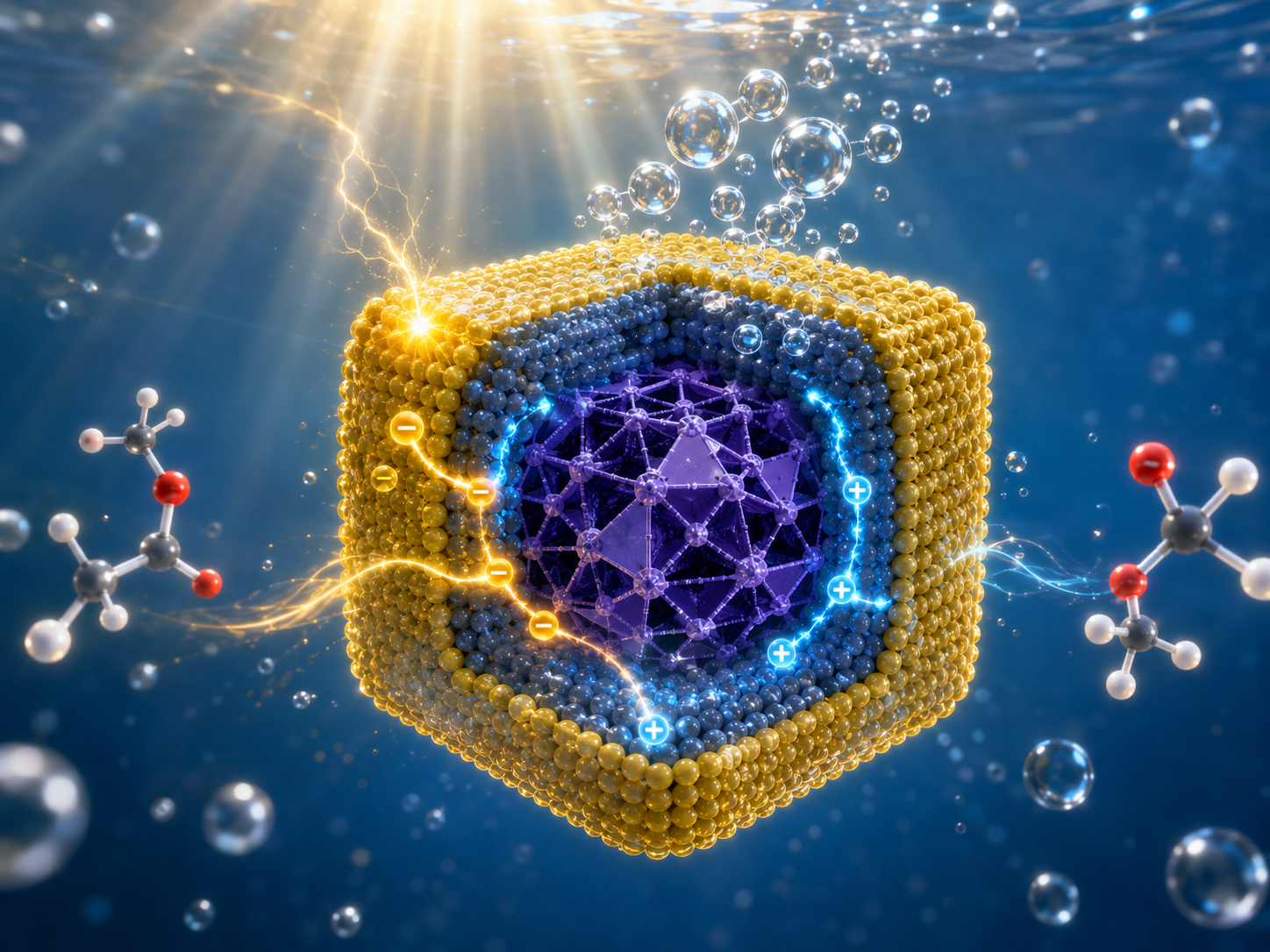
Paper: Organelle-mimetic nanoreactors for scalable solar H2 and pyruvic acid co-production. Image credit: AI-generated conceptual image created using ChatGPT/OpenAI
A recent study published online as an 'Article in Press' in the journal Nature Communications presents an organelle-mimetic nanoreactor that enhances solar-driven hydrogen production while simultaneously converting lactic acid into the value-added chemical pyruvic acid. The researchers designed a three-layer photocatalyst that promotes directional charge transport and regulates the local reaction microenvironment. The work demonstrates how biomimetic nanostructure design can improve photocatalytic efficiency and provides initial outdoor-area scaling evidence for artificial photosynthesis technologies.
Designing Nanoreactors Inspired by Natural Photosynthesis
Artificial photosynthesis offers a promising route for converting abundant solar energy into clean hydrogen fuel. Among the available approaches, photocatalytic hydrogen evolution coupled with organic oxidation has attracted considerable interest because it can produce hydrogen using sunlight while directing photogenerated holes toward useful chemical synthesis. However, many photocatalysts still depend on expensive noble-metal cocatalysts or non-value-added sacrificial reagents to achieve high efficiencies.
Nature addresses these challenges through highly organized photosynthetic machinery. In chloroplasts, oxidation and reduction reactions occur within compartmentalized membrane structures that promote directional electron transport while minimizing recombination. Enzymes further increase efficiency by regulating the local chemical environment and lowering reaction energy barriers. Reproducing these structural and functional features in artificial photocatalysts remains a major challenge.
Researchers have developed Z-scheme heterojunctions and incorporated metal-organic frameworks (MOFs) to improve charge separation and catalytic activity. However, few systems simultaneously control long-range electron transport and the local reaction microenvironment within a single nanostructure. To overcome these challenges, the researchers designed an organelle-mimetic nanoreactor composed of ZIF-67, CoS, and CdS arranged in a sequential three-layer architecture. Together, these features improve hydrogen evolution while selectively converting lactic acid into pyruvic acid under solar irradiation.
Engineering a Biomimetic Photocatalytic Nanoreactor
The researchers synthesized the photocatalyst via a multistep process, yielding a sequential ZIF-67/CoS/CdS nanostructure. Cadmium sulfide (CdS) formed the outer light-absorbing layer, cobalt sulfide (CoS) functioned as an intermediate charge-transfer layer, and the metal-organic framework ZIF-67 formed the porous inner core. This hierarchical design mirrors the compartmentalized organization of natural photosynthetic organelles, allowing each component to perform a specific role while contributing to overall photocatalytic performance.
The team characterized the catalyst using structural and chemical analysis techniques. Scanning and transmission electron microscopy confirmed the layered architecture, while X-ray diffraction, X-ray photoelectron spectroscopy, and elemental mapping verified the successful integration of the three components. Nitrogen adsorption measurements further showed that the three-layer composite provided a porous, high-surface-area structure that exposed additional reactive sites. Spectroscopic measurements and theoretical calculations separately indicated that ZIF-67 modified the local hydrogen-bond environment.
The researchers then evaluated photocatalytic performance under simulated sunlight using lactic acid as both a hole scavenger and the feedstock for selective oxidation to pyruvic acid. They measured hydrogen evolution, pyruvic acid production, apparent quantum efficiency, and catalyst stability over repeated reaction cycles. Additional experiments under natural sunlight assessed the catalyst's performance under realistic operating conditions.
The team combined experimental measurements with theoretical modeling to understand the factors contributing to the effective performance of the nanoreactor. Together, these analyses explained how the biomimetic architecture promoted efficient carrier transport, reduced barriers to water activation and hydrogen evolution, and accelerated lactic acid oxidation.
Biomimetic Design Improves Solar Hydrogen Production
The organelle-inspired nanoreactor demonstrated superior photocatalytic performance compared with the reference catalysts. The sequential ZIF-67/CoS/CdS architecture produced substantially higher hydrogen evolution rates while maintaining excellent selectivity for converting lactic acid into pyruvic acid. The catalyst also achieved apparent quantum efficiencies of 74.2% at 400 nm and 78.5% at 420 nm and showed good cycling durability, although its outdoor hydrogen-production activity declined to around 80% of its initial level after 12 days.
Its superior performance resulted from the coordinated functions of the three structural components. Under solar irradiation, CdS generated electron-hole pairs, while the built-in electric fields across the CdS-CoS and CoS-ZIF-67 interfaces directed electrons inward from the outer CdS layer through CoS toward the inner ZIF-67 core. This ordered migration suppressed charge recombination, allowing more photogenerated electrons to participate in hydrogen evolution at the inner reduction sites. Meanwhile, the remaining holes accumulated at the outer surface and efficiently oxidized lactic acid, enabling simultaneous fuel production and chemical synthesis.
The porous ZIF-67 inner core also played a key catalytic role by regulating the local reaction microenvironment. Coordination at unsaturated cobalt sites reorganized the water-lactate hydrogen-bond network, reducing the calculated water-dissociation barrier from 1.26 to 0.70 eV and the hydrogen-evolution barrier from 0.70 to 0.52 eV. Density functional theory calculations, electron paramagnetic resonance spectroscopy, and scavenger experiments supported pyruvic acid formation through a carbon-centered radical pathway initiated by cleavage of the lactic acid α-C-H bond. Rather than serving only as a structural core, the MOF actively enhanced photocatalytic kinetics by facilitating water activation and hydrogen formation.
Photoelectrochemical analyses showed improved charge separation and higher photocurrent responses than the control catalysts, while electron paramagnetic resonance and in situ infrared spectroscopy identified carbon-centered radicals and pyruvate-related molecular signatures consistent with the proposed selective dehydrogenation pathway. Isotope and scavenger experiments further indicated that hydrogen formation involved contributions from water and lactic acid dehydrogenation. Together, these results demonstrate how carefully engineered nanoscale architectures can simultaneously improve carrier dynamics and catalytic selectivity.
Advancing Biomimetic Nanotechnology for Artificial Photosynthesis
The study demonstrates how biomimetic nanostructure design can overcome several long-standing challenges in photocatalysis. The findings highlight that MOFs can play an active catalytic role rather than simply serving as structural supports. In this system, the porous ZIF-67 inner core reorganizes the local water-lactate hydrogen-bond network, lowering calculated barriers for water dissociation and hydrogen evolution, while holes at the outer surface drive the selective conversion of lactic acid into pyruvic acid.
The work presents a promising strategy for coupling solar-driven hydrogen production with the synthesis of value-added chemicals. Efficient utilization of both photogenerated electrons and holes could increase the overall efficiency of solar-driven chemical manufacturing while potentially increasing its economic value. The successful outdoor experiments, including a 1000 cm2 catalyst area that produced 145.71 mmol of hydrogen over five hours, showed that the catalyst could be enlarged without a substantial decrease in area-normalized hydrogen output under natural sunlight.
Although these experiments support further area-scale-up research, the work remains a proof-of-concept rather than an industrial-scale process demonstration. Future research could focus on replacing cadmium-based semiconductors with more environmentally benign materials, reducing metal-ion release, improving long-term durability, developing continuous-flow reactors, and extending this biomimetic approach to other photocatalytic reactions. Lifecycle and technoeconomic assessments would also be needed to establish whether the approach is environmentally and commercially viable.
Overall, the study provides a valuable design framework for developing next-generation photocatalysts that combine biological inspiration with nanoscale engineering to support further advances in sustainable hydrogen production and solar-driven chemical conversion.
Disclaimer: The views expressed here are those of the author expressed in their private capacity and do not necessarily represent the views of AZoM.com Limited T/A AZoNetwork the owner and operator of this website. This disclaimer forms part of the Terms and conditions of use of this website.