A mild, surfactant-free coating strategy uses glucan and ethylcellulose shells to curb TiO2 photoreactivity, improve formulation stability, and substantially boost laboratory-measured UVA and UVB protection.
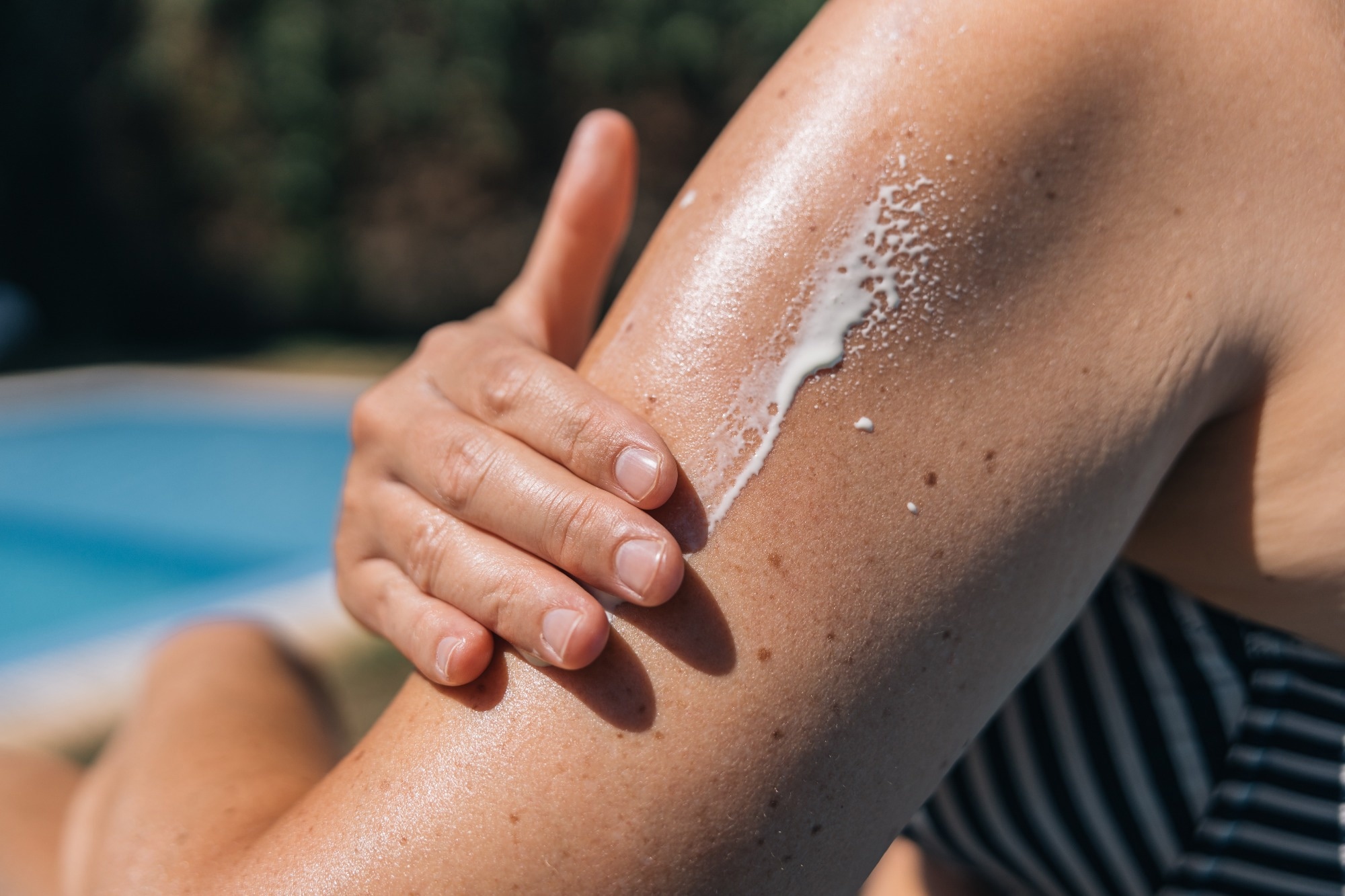
Paper: Polysaccharide coatings unlock high-performance TiO2 UV filters for sunscreen formulations. Image Credit: Amparo Garcia / Shutterstock
A paper accepted for publication in the journal Communications Materials proposed a scalable, surfactant-free, room-temperature dissolution–precipitation approach for synthesizing glucan- and ethylcellulose-coated titanium dioxide (TiO2) with reduced photocatalytic activity and improved ultraviolet (UV)-blocking efficiency for sunscreen formulations.
Inorganic Filters for UV Radiation Risks
UV radiation increases cancer risk and accelerates skin aging by inducing reactive oxygen species (ROS), oxidative stress, deoxyribonucleic acid (DNA) damage, and immunosuppression. Thus, developing photoprotective materials is crucial to address these risks. In these materials, inorganic or organic UV filters remain the key factor.
Inorganic nanoparticles such as TiO2 and zinc oxide (ZnO) provide improved UV protection through minimal skin penetration and enhanced minimal erythema dose. These nanoparticles can stabilize emulsions through the Pickering mechanism in oil-in-water sunscreen formulations.
Potential of TiO2
TiO2 nanoparticles, with a 3.0–3.2 eV bandgap, absorb and scatter UVB and UVA rays, deliver higher overall UV protection than ZnO-based formulations, and exhibit better stability across a broad pH range.
However, TiO2 has limitations as its photocatalytic activity promotes ROS generation and can induce skin irritation. Additionally, TiO2 aggregation, driven by strong van der Waals interactions and high surface energy, diminishes UV absorption efficiency.
Surface coatings can enhance colloidal stability and suppress photocatalytic activity. Although inorganic shells derived from silica, manganese oxide, and alumina improve particle stability and enable emulsion stabilization, they have several drawbacks.
Similarly, organic coatings, primarily methacrylate- and aromatic-based systems such as functionalized methacrylates, block copolymers, and lignin, often require harsh reaction conditions and complex synthesis, limiting scalability.
The Polysaccharide-coated TiO2 UV Filters
In this work, researchers introduced a surfactant-free room-temperature dissolution–precipitation approach for synthesizing ethylcellulose- and α−1,3-glucan-coated TiO2 core–shell particles.
An in situ precipitation method was used to synthesize glucan-coated TiO2 nanoparticles with core-shell structures and varying thicknesses of glucan shells on the TiO2 surface.
The Research Effort
Initially, TiO2 nanoparticles were dispersed in a 4:1 isopropyl alcohol (IPA)-to-water mixture and homogenized for 2 min to improve particle wetting and dispersion.
Then the glucan solution was added, and a 10% acetic acid solution was used for in situ precipitation to pH 7 through neutralization. The team investigated the impact of glucan loading on coating thickness using 2 wt.% and 1 wt.% glucan solutions, and the samples were designated G2-TiO2 and G1-TiO2, respectively.
Commercially available silica (SiO2)@TiO2 nanoparticles (NPs) dispersed in water and bare TiO2 NPs, homogenized in an IPA/water mixture, served as controls. The samples were washed with water to remove byproducts such as sodium acetate, IPA, and sodium hydroxide.
Subsequently, a highly stable colloidal system was obtained by dispersing each purified sample in water and homogenizing for 2 min. A related dissolution–precipitation approach was used for ethylcellulose samples. Ethylcellulose was first dissolved in IPA, then combined with dispersed TiO2, and water was added to induce precipitation and encapsulation. The dispersion formulations with 2 and 1 wt.% ethylcellulose were designated EC2-TiO2 and EC1-TiO2, respectively.
Kolliphor CS A, Zemea, CosmoSurf DDG 20, sorbitan laurate, and cetearyl alcohol were added to 8 g of the dispersion formulation, followed by 2 g of caprylic/capric triglyceride. The mixture was homogenized for 2 min to prepare an oil-in-water emulsion sunscreen.
Sun protection factor (SPF) performance was evaluated using a UV-transparent poly(methyl methacrylate) (PMMA) plate, which served as a simulated skin substrate.
Evaluation of the Approach
The approach successfully produced α−1,3-glucan- and ethylcellulose-coated TiO2 core–shell particles for sunscreen formulations using the proposed surfactant-free room-temperature dissolution–precipitation strategy.
Experimental characterization showed improved nanoparticle dispersion, while spectroscopy and density functional theory (DFT) indicated reduced interfacial charge-transfer pathways associated with ROS generation, with strong UV absorption maintained.
Photocatalytic rhodamine B (RhB) degradation fell from approximately 90% at 24 h for bare TiO2 to about 5% or less for the coated samples, with ROS fluorescence at baseline. Both glucan- and EC-coated TiO2 increased attenuation across 290–400 nm relative to bare TiO2, with the thinner ≤4 nm shell in G1-TiO2 yielding the highest absorbance.
Mie modeling further indicated a shell-thickness trade-off: approximately 2.5–4 nm shells favored absorption-dominated UVB protection and higher SPF, while thicker shells of around 6 nm increased scattering and strengthened UVA protection and ultraviolet A protection factor (UVAPF).
The dissolution–precipitation strategy enabled hydrophobic ethylcellulose and hydrophilic glucan to form nanometric shells that suppressed photoinduced ROS, increased UV absorbance relative to commercial SiO2@TiO2, and immobilized TiO2 nanoparticles.
Thus, the resulting glucan-coated core-shell particles, G1-TiO2 and G2-TiO2, produced in vitro, had SPF and UVAPF values approximately twice those of commercial SiO2@TiO2 nanoparticles on PMMA substrates. EC2-TiO2 and EC1-TiO2 also outperformed SiO2-coated and bare TiO2 benchmarks. These measurements provide a relative comparison between formulations rather than clinical SPF values.
The ethylcellulose and glucan shells also enhanced emulsion stability through distinct mechanisms. Ethylcellulose-coated particles primarily accumulated at the oil-water interface and provided Pickering-type stabilization, whereas glucan-coated particles additionally formed a hydrated particle network in the aqueous phase that provided bulk support. Both systems retained their droplet structure during three months of room-temperature storage, although the ethylcellulose emulsions were less thermally robust and showed substantial coalescence after 24 h at 60 °C.
Electrochemical impedance spectroscopy (EIS) revealed a 20-25% increase in interfacial charge-transfer resistance for glucan- and ethylcellulose-coated samples. Additionally, X-ray photoelectron spectroscopy (XPS) revealed a small reproducible +0.2 eV shift in the Ti 2p1/2 binding energy, which was qualitatively consistent with the interfacial charge redistribution predicted by DFT rather than a change in the intrinsic TiO2 electronic or band structure.
The Way Forward
In conclusion, the findings of this study demonstrated the feasibility of the proposed dissolution-precipitation strategy for suppressing photocatalytic activity while enhancing emulsion stability and UV protection within a single coating.
However, several more steps are crucial before translating this platform into commercial sunscreen products, including direct biological evaluation, such as keratinocyte cytotoxicity and skin-penetration studies, in vivo SPF testing, and standardized biodegradation and environmental-fate studies. The authors also cautioned that the biodegradability of free polysaccharides cannot be automatically extrapolated to assembled TiO2-polysaccharide nanoparticles.
Disclaimer: The views expressed here are those of the author expressed in their private capacity and do not necessarily represent the views of AZoM.com Limited T/A AZoNetwork the owner and operator of this website. This disclaimer forms part of the Terms and conditions of use of this website.