Nanoscale glass-glass interfaces with unusually high excess volume could give researchers new control over atomic transport, mechanical behavior, and functional properties beyond the limits of conventional glasses.
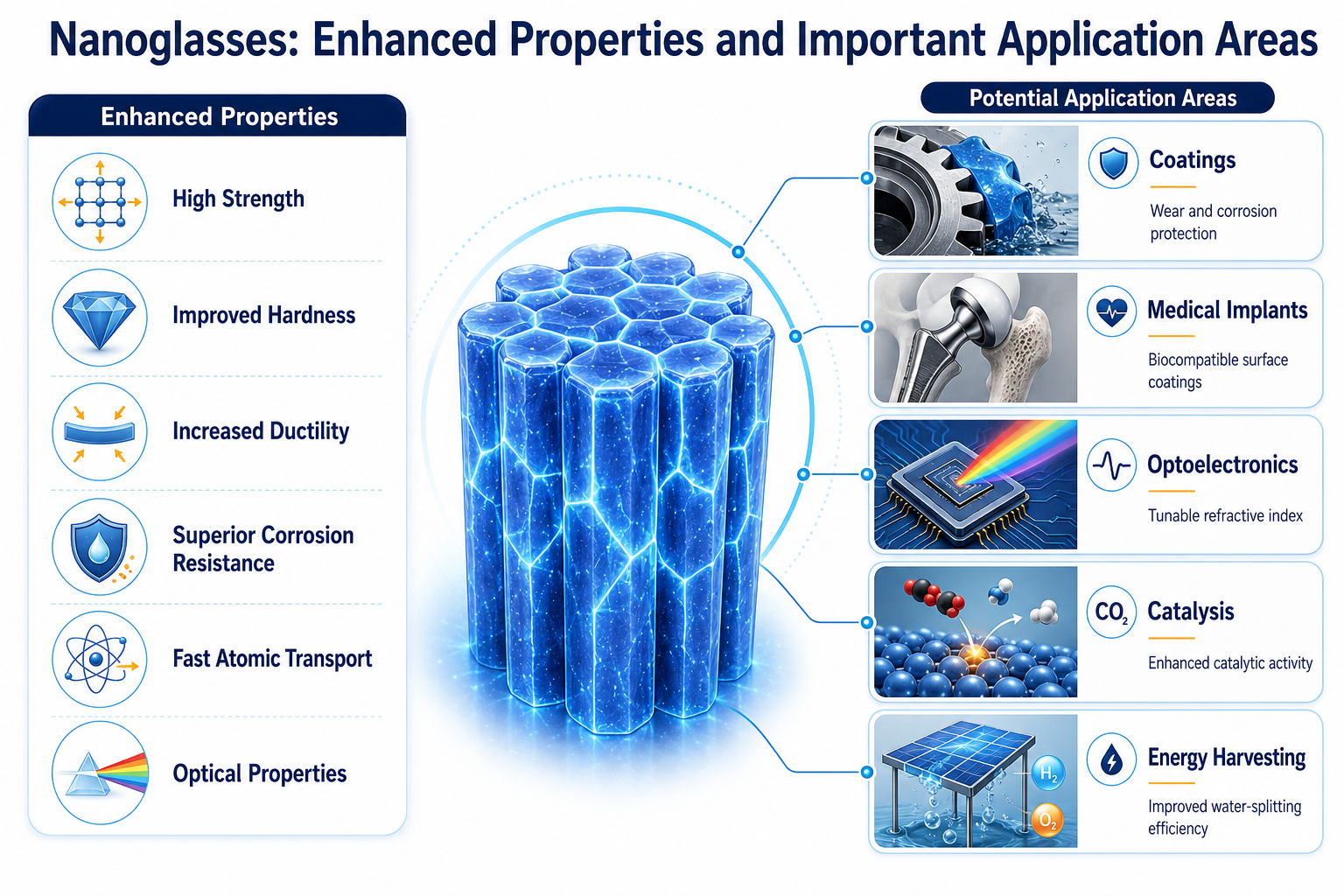
Property enhancements of nanoglasses and potential application areas of columnar thin-film nanoglasses. Paper: Nanoglasses: a trail towards uncharted regions of vitreous materials and their properties? AI-generated image created using ChatGPT/OpenAI
A recent perspective published in the Beilstein Journal of Nanotechnology examines how nanoglasses are creating new opportunities for designing amorphous materials at the nanoscale. The authors explore how these nanoscale features influence the thermodynamics, stability, transport, and functional properties of amorphous materials. It particularly highlights columnar thin-film nanoglasses as a controllable platform for studying and engineering new structural states.
Engineering Structure in Amorphous Materials
Conventional materials engineering has traditionally relied on microstructural control. In crystalline materials, researchers can modify grain boundaries, dislocations, and phase distributions to tune mechanical and functional properties. Amorphous materials present a different challenge because they lack long-range crystalline order. Researchers describe their structure in terms of short-range order (SRO), medium-range order (MRO), and variations in free or excess volume.
Nanoglasses offer a different way to introduce structure into amorphous materials. They contain nanoscale glass regions, often referred to as glass grains, separated by glass–glass interfaces (GGIs). These interfaces can contain substantially more excess volume than conventional glasses and exhibit distinct atomic arrangements and chemical characteristics. This nanoscale heterogeneity creates features that conventional melt quenching, aging, or rejuvenation do not typically produce.
The perspective examines nanoglasses as intentionally structured amorphous materials rather than simply glasses containing nanoscale defects. The authors discuss the structure, thermodynamics, stability, synthesis, and properties of GGIs. The authors propose viewing nanoglasses as conditional two-phase amorphous composites comprising vitreous glass grains and a distinct GGI phase that can exist only adjacent to the grains. This framework could provide a basis for relating interface structure to mechanical, transport, magnetic, optical, and catalytic behavior.
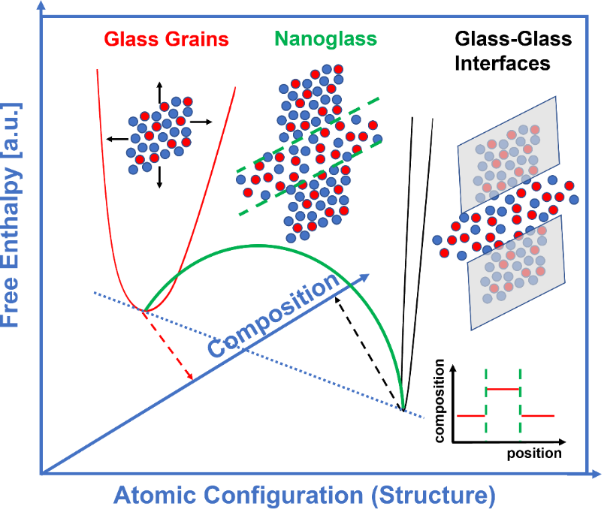
Schematic representation of the free enthalpy of a nanoglass (green curve) as well as its constituent phases, namely the glass grains (red curve) and the GGIs (black curve). The convex shape of the green curve stems from the excess energy contributions of the interfaces between glass grains and the GGI phase. The linear common tangent (blue dotted line) would correspond to determining the free enthalpy of a classical two-phase state without taking curvature terms (due to interfaces) into account. The compositions of the glass grains and the GGIs differ due to the different chemical potentials of the two phases. This is indicated by the different amounts of red or blue particles and is also shown in the insert in the lower right corner, where the dashed green lines indicate the positions of the interfaces between glass grains and the GGI phase. Both phases also have different local structures, as indicated by the different mean distances between particles and their different arrangements. The transparent grey boxes indicate that only the GGI phase contributes to the free enthalpy indicated by the black curve.
Characterizing the Structure and Behavior of Nanoglasses
The researchers bring together findings from previous experiments, atomistic simulations, thermodynamic models, and structural analyses to develop a unified view of nanoglasses. They give particular attention to columnar Cu–Zr thin-film nanoglasses because their architecture allows GGIs to be aligned edge-on to local probes, reducing projection artifacts and enabling detailed examination of the glass grains and interfaces at the nanoscale.
Several characterization techniques help establish the structure of these materials. Scanning electron microscopy (SEM) reveals the overall columnar morphology. High-resolution transmission electron microscopy (HRTEM) provides detailed views of the nanoscale glass regions and connecting channels. Cross-sectional high-angle annular dark-field scanning transmission electron microscopy (HAADF-STEM) distinguishes glass grains and GGIs based on differences in density contrast. In the reported columnar Cu–Zr films, the interface channels measure approximately 2–4 nm across.
The authors also discuss ion-beam sputtering combined with time-of-flight secondary ion mass spectrometry (ToF-SIMS) to examine atomic transport through different regions of the nanoglass. The theoretical framework draws on energy-landscape concepts and thermodynamic descriptions of heterogeneous nanoscale systems, including the possibility that glass grains and GGIs occupy different energy meta-basins.
Glass–Glass Interfaces Drive Distinct Nanoglass Properties
The perspective shows that GGIs create a distinct structural environment within nanoglasses. These interfaces typically span several nanometres and can contain approximately 10% or more excess volume, compared with the 1–3% volume change associated with conventional vitrification. This larger excess volume can increase atomic mobility and impart transport characteristics to nanoglasses that differ from those of homogeneous glasses.
In this view, glass grains and GGIs represent two amorphous regions with different structural and thermodynamic characteristics. The authors further argue that GGIs may not strictly qualify as glass because their transition to a supercooled liquid remains uncertain, making nanoglasses more appropriately described as vitreous–amorphous composites, with glass-like grains connected by a distinct amorphous interface phase. The large interfacial area becomes particularly important at the nanoscale because it increases the contribution of interface-related energy. GGIs additionally act as sinks for impurities such as oxygen and nitrogen, making interface chemistry another potential tool for controlling nanoglass properties.
Transmission electron microscopy (TEM) observations and radioactive tracer diffusion measurements support the presence of genuine GGIs rather than simple open porosity. This distinction helps address the limitations of earlier powder-compacted nanoglasses. The interfaces also create distinctive transport behavior. In columnar Cu–Zr nanoglasses, atomic diffusion along the GGI phase can be approximately four orders of magnitude faster than in a homogeneous glass of identical nominal composition. Longer annealing reduced this diffusivity, consistent with continuing structural relaxation, although neither the nanoglass nor homogeneous reference samples were fully relaxed under all conditions.
Studies link nanoglasses with improvements in hardness, yield strength, and ductility, with GGIs proposed to hinder shear-band propagation, although the contributions of excess volume, structural differences, and chemical segregation remain unresolved. Magnetic nanoglasses show improved soft-magnetic behavior, while enhanced ionic diffusion in oxide nanoglasses could make them attractive for solid-state batteries and fuel cells.
The authors also draw parallels between GGIs and high-excess-volume regions in deformation-induced shear bands, suggesting that non-liquid processing routes may provide additional pathways for creating nanoglass-like amorphous states.
Nanoglasses Broaden the Design Space for Amorphous Materials
Nanoglasses introduce a new approach to designing amorphous materials. Glass grains and GGIs form a vitreous–amorphous composite with distinct structural, chemical, and thermodynamic characteristics. These features create additional parameters for tuning material properties.
Columnar thin-film nanoglasses offer a controllable architecture for studying and engineering GGIs. Gas-phase sputter deposition can produce well-defined columnar structures, making the interfaces more accessible to nanoscale characterization. This approach may facilitate exploration of a broader range of nanoglass compositions and structures for systematic studies.
The potential applications span both structural and functional materials. Controlling GGI structure and chemistry offers a route to tuning strength and ductility, atomic and ionic transport, magnetic behavior, optical properties, and catalytic activity. Researchers could also use selective segregation of dopants or alloying elements at the interfaces to introduce additional control over material performance.
Future studies should focus on resolving the atomic structure of GGIs, understanding their relaxation mechanisms, assessing their long-term stability, and establishing clearer structure–property relationships. Combining controlled synthesis with advanced nanoscale characterization and computational modeling may help establish nanoglasses as a platform for engineering amorphous materials.
Disclaimer: The views expressed here are those of the author expressed in their private capacity and do not necessarily represent the views of AZoM.com Limited T/A AZoNetwork the owner and operator of this website. This disclaimer forms part of the Terms and conditions of use of this website.