A molecularly imprinted nanosensor combines selective BPA recognition with real-time optical detection, offering a new way to track trace contamination in drinking water.
Paper: Nanomolecularly imprinted polymer–surface plasmon resonance platform for monitoring trace-level Bisphenol A in drinking water. Image Credit: Kateryna Kon / Shutterstock
Bisphenol A (BPA) stands as a pervasive endocrine-disrupting chemical, frequently found in aquatic environments and posing significant health concerns, including potential links to endocrine disruption and increased cancer risk.
In a recent study published in the journal Communications Chemistry, researchers developed a nanomolecularly imprinted polymer–surface plasmon resonance (nanoMIP–SPR) platform designed for sensitive, selective, and label-free detection of BPA in drinking water.
Traditional methods for BPA detection, such as gas chromatography–mass spectrometry (GC–MS) and liquid chromatography–tandem mass spectrometry (LC–MS/MS), while highly selective, are often hampered by their reliance on expensive equipment, labor-intensive procedures, and toxic organic solvents.
These limitations highlight an urgent need for more affordable, environmentally conscious, and rapid analytical tools to safeguard public health.
NanoMIP-SPR Platform Construction
The detection system relies on the solid-phase synthesis of nanomolecularly imprinted polymers (nanoMIPs). This solid-phase process begins with the preparation of BPA-derivatized glass beads, which serve as the solid support for templating. The glass beads were first activated with sodium hydroxide to generate reactive silanol groups, then functionalized with 3-aminopropyltriethoxysilane (APTES) to introduce amine groups.
These amine groups were subsequently used to couple BPA-specific antibodies to the bead surface through EDC/NHS chemistry. The antibody-functionalized beads were then incubated with BPA, allowing the template molecules to bind to and become immobilized on the functionalized surface. This template immobilization step on a solid phase is crucial for guiding subsequent polymerization and ensuring the formation of highly specific binding sites.
Following template immobilization, the polymerization process was initiated using a defined blend of monomers, including N-isopropylacrylamide (NIPAm) as the structural monomer, N,N′-methylenebisacrylamide (BIS) as the crosslinker, N-(3-aminopropyl)methacrylamide hydrochloride (APMA) and acrylic acid (AAc) as functional monomers, and N-tert-butylacrylamide (TBAm) to enhance hydrophobic interactions.
Ammonium persulfate (APS) and N,N,N′,N′-tetramethylethylenediamine (TEMED) served as the initiator and accelerator, respectively, driving the polymerization around the immobilized BPA template. The choice of monomers is key to tailoring the binding cavities with appropriate chemical functionalities to enable strong yet reversible BPA interactions.
After polymerization, cold washing removed unreacted monomers and low-affinity particles, while high-affinity BPA-imprinted nanoMIPs were released from the solid-phase template using repeated hot-water washes at 65 °C. The resulting nanoscale polymer particles contained specific recognition sites complementary in shape and chemical functionality to BPA.
These resulting nanoMIPs exhibited a uniform spherical morphology with an average hydrodynamic diameter of approximately 94 nm by dynamic light scattering (DLS), while transmission electron microscopy (TEM) indicated a smaller average physical diameter of approximately 78 nm in the dried state. The nanoscale dimensions can facilitate rapid mass transfer and enhance accessibility to the binding sites, which is particularly beneficial for real-time sensing.
For integration into the SPR platform, gold SPR chips were cleaned and then functionalized with an 11-mercaptoundecanoic acid (MUDA) self-assembled monolayer (SAM) to introduce terminal carboxyl groups.
These carboxyl groups were subsequently activated using EDC/NHS chemistry, enabling covalent amide bond formation with amine groups present on the nanoMIPs, thus achieving homogeneous immobilization of the recognition layer on the gold surface.
This stable and uniform surface coverage by the nanoMIPs was verified using atomic force microscopy (AFM) and electrochemical methods, including cyclic voltammetry (CV) and square-wave voltammetry (SWV). AFM analysis confirmed the dense, uniform distribution of spherical nanoMIP structures, indicating the successful formation of a stable receptor layer.
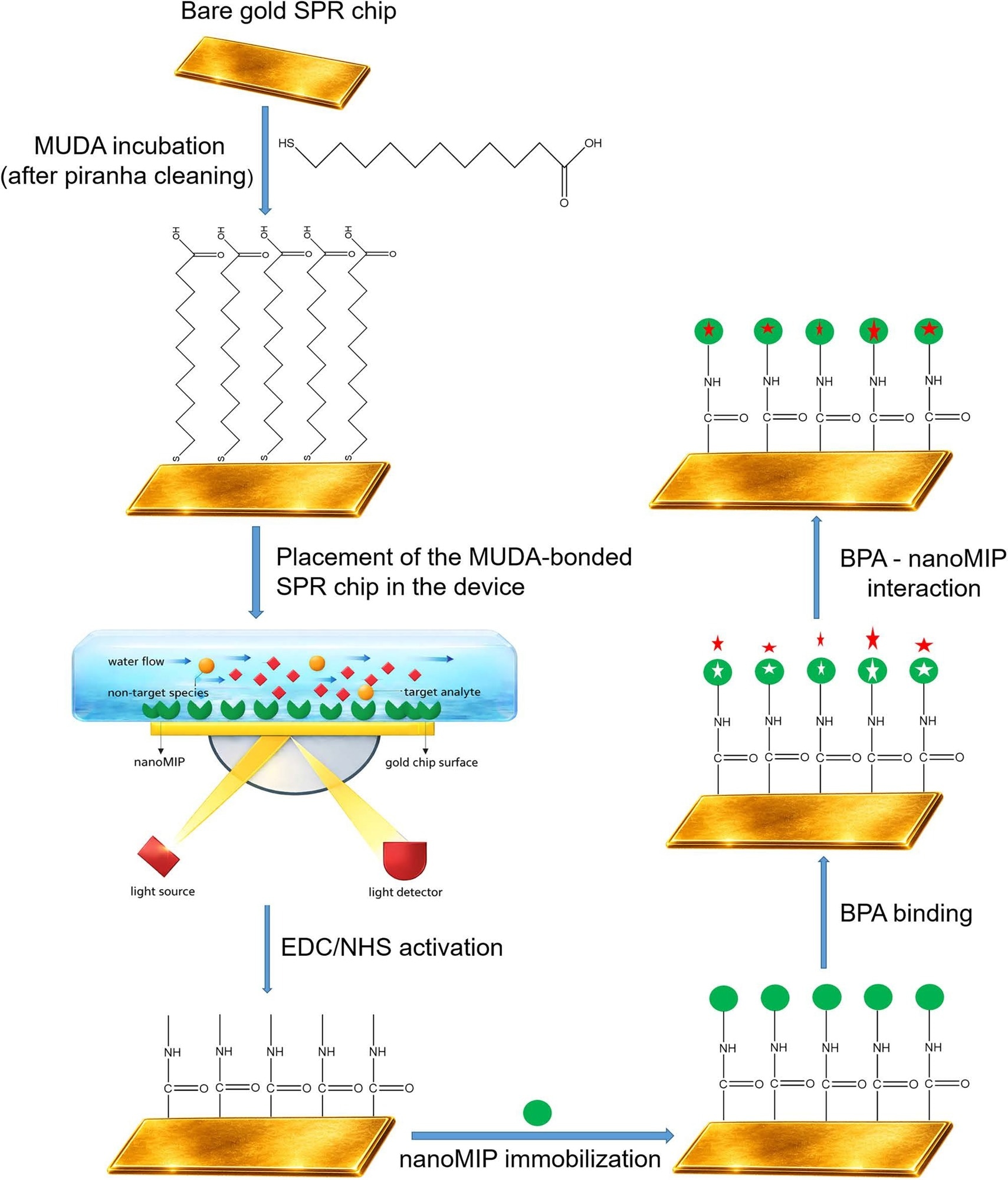
Construction of the nanoMIP-modified SPR sensing interface. Stepwise surface modification and nanoMIP immobilization process on the gold SPR chip, including SAM formation, EDC/NHS activation, covalent nanoMIP attachment, and BPA binding mechanism.
Sensor Performance and Insights
The newly developed nanoMIP–SPR platform demonstrated sensitive BPA detection. Real-time SPR measurements revealed a clear concentration-dependent binding of BPA over a wide range of 5–800 nM, with a detection limit of 1.46 nM.
This sensitivity appears to reflect, in part, the nanoscale dimensions and homogeneous immobilization of the nanoMIPs, which increase the accessibility of recognition sites on the sensor surface. Isotherm modeling comparing the Langmuir, Freundlich, and Sips models indicated predominantly heterogeneous binding behavior, with the Freundlich model providing the best fit.
The sensor also exhibited strong discrimination between BPA and related compounds. Selectivity experiments demonstrated a significant preference for BPA over structurally related bisphenol analogs, such as bisphenol E (BPE), bisphenol F (BPF), and bisphenol S (BPS), as well as against control MIPs imprinted with a different template (4-aminophenol). Although measurable responses to the analogs occurred at higher concentrations, BPA consistently produced stronger signals. This high selectivity underscores the efficiency of template-specific cavity formation in nanoMIPs.
The reusability of the nanoMIP–SPR sensor was also evaluated, showing good stability across five regeneration cycles, with the normalized SPR response declining by approximately 5.1%. This supports its potential for repeated measurements rather than establishing continuous monitoring performance. Furthermore, validation against liquid chromatography–mass spectrometry (LC–MS), used as a reference method, yielded SPR recovery rates ranging from 96.90% to 97.84%, compared with 98.20% to 98.93% for LC–MS, supporting the analytical accuracy and repeatability of the nanoMIP-SPR system.
The researchers also tested drinking water from 10 commercial polycarbonate carboy-water brands, detecting BPA in every sample at concentrations ranging from 2.73 to 8.15 nM. In water from the brand with the highest initial concentration, BPA increased by only about 1.6% after 10 weeks at 25 °C but rose by approximately 256% at 50 °C, highlighting the influence of elevated storage temperature on BPA migration. The authors noted that the BPA concentrations detected under the tested local conditions did not appear to pose an immediate health risk when assessed against the regulatory thresholds they cited.
Effective BPA Monitoring Strategy
This research successfully demonstrates the integration of solid-phase synthesized BPA-imprinted nanoMIPs with an SPR platform, yielding a highly sensitive and selective sensor for Bisphenol A detection.
The nanoscale design of the imprinted polymers, characterized by uniform morphology and a narrow particle-size distribution, appeared to contribute to reproducible immobilization and sensor performance. This label-free, reusable, and amplification-free strategy could offer advantages over some traditional analytical approaches by enabling rapid BPA monitoring with reduced reliance on labels and signal-amplification reagents.
The successful validation and application to real-world water samples underscore the platform's potential as a practical analytical tool for monitoring BPA in drinking water and other aqueous environments.
Source:
- Erol K., İlhan M., Gökmeşe E. (2026). Nanomolecularly imprinted polymer–surface plasmon resonance platform for monitoring trace-level Bisphenol A in drinking water. Communications Chemistry. DOI: 10.1038/s42004-026-02183-4, https://www.nature.com/articles/s42004-026-02183-4