By shifting photoacoustic imaging deeper into the NIR-IIb spectrum, researchers tested whether a redesigned molecular contrast agent could suppress biological background signals while preserving useful imaging detail.
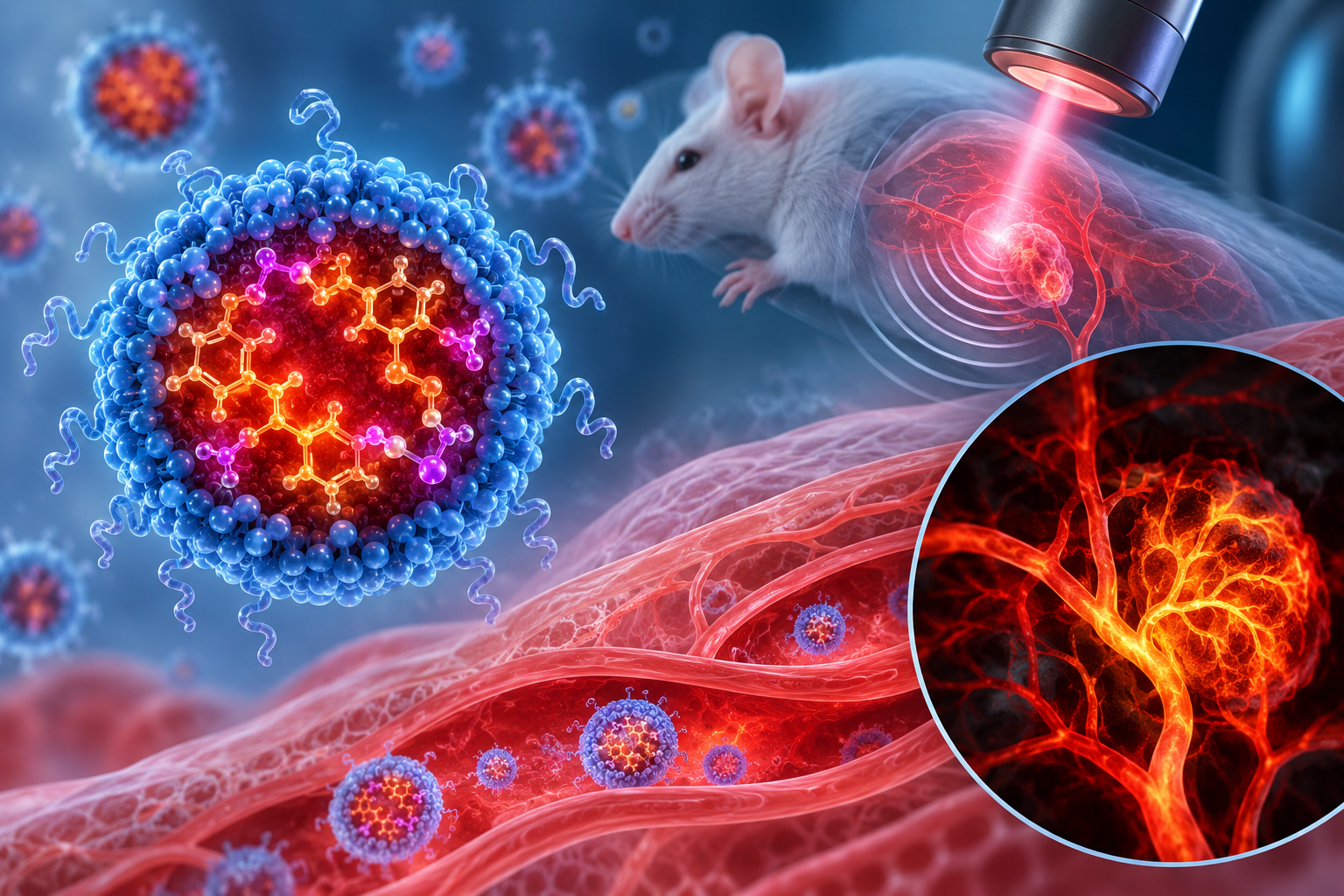
Paper: Short Wavelength Infrared Diimmonium Nano-Agents for Photoacoustic Imaging. AI-generated abstract conceptual image created using ChatGPT/OpenAI
*Important notice: This news reports on an unedited version of an accepted paper and is awaiting final editing. Therefore, the paper should not be regarded as conclusive or treated as established information.
A paper recently published in the journal Nature Communications reported the development of diimmonium DB·2X (X = borate oxalate (BOB-), bis(trifluoromethanesulfonyl)imide (TFSI-), or tetrafluoroborate (BF4-)) nano-agents designed for 1700 nm excitation, increasing the available molecular platforms for near-infrared (NIR)-IIb photoacoustic imaging (PAI).
PAI Adoption Challenges
PAI, a biomedical imaging technique, enables noninvasive, high-clarity imaging of deep tissue structures by combining ultrasound's spatial resolution with optical imaging's high contrast.
Yet, extensive clinical use of PAI faces major challenges, including selecting excitation wavelengths that maximize signal-to-background ratios (SBRs) while limiting photon scattering in biological tissues.
Conventional (780–900 nm) NIR/NIR-I contrast agents and existing NIR-II agents (1000–1700 nm) have several drawbacks. For instance, NIR-I agents have limited tissue penetration, while the authors note that existing NIR-II agents are predominantly limited to 1064 nm excitation.
The NIR-IIb Window
The NIR-IIb window (1500–1700 nm), which the authors identify as clinically relevant, remains largely unexplored.
While the paper notes that preclinical work shows NIR-II can reduce tissue scattering and suppress autofluorescence, the authors also state that existing contrast agents have not fully exploited NIR-II's reported potential for high-contrast, centimeter-scale penetration. This reflects the study's scientific rationale rather than a performance level demonstrated in the experiments reported here.
The paper attributes this problem partly to an incomplete understanding of molecular engineering principles in this spectral range and to challenges in designing materials that absorb well at 1500–1700 nm.
While researchers have developed different NIR-II molecules using molecular engineering approaches such as side-chain modification and donor substitution, their optical absorption is often limited to the NIR-IIa region (1000–1500 nm).
Designing new conjugated systems through original molecular design could help extend PAI into the 1500–1700 nm region. Solving these scientific barriers could benefit applications such as tumor-margin delineation and intraoperative guidance, where suppressing endogenous background signals matters.
The authors say developing NIR-IIb contrast agents is a crucial step toward precision PAI-based diagnostics.
DB·2X Nano-agents for PAI
The researchers developed a new class of DB-based dicationic nano-agents, DB·2X, that can be excited at 1700 nm. Among the three formulations, DB·2TFSI showed particularly strong PAI performance and was selected for the animal imaging experiments.
DB·2TFSI Synthesis: 0.30 g sodium persulfate, 20 mL acetone, 0.56 g lithium bis(trifluoromethanesulfonyl)imide, and 0.90 g of N,N,N’,N’-tetrakis[4-(dibutylamino)phenyl]-p-phenylenediamine were added to a 50 mL single-neck flask. The reaction mixture was stirred in the dark for 1 hour at 60 °C.
After cooling to room temperature, 20 mL of acetone was added for washing, followed by solvent evaporation and drying. The dried material was then dissolved in 10 mL of dichloromethane and extracted with water.
The organic phase was dried in a vacuum oven at 40 °C and redissolved in a small amount of dichloromethane. The team then added a large amount of n-hexane for recrystallization. They repeated the recrystallization three times to obtain DB·2TFSI as the final product for later experiments.
DB·2BOB and DB·2BF4 Synthesis: The team also synthesized DB·2BOB and DB·2BF4 separately.
Reagents and solvents used for DB·2BOB synthesis included water, ethanol, lithium bis(oxalato)borate, N,N,N’,N’-tetrakis[4-(dibutylamino)phenyl]-p-phenylenediamine, sodium persulfate, anhydrous magnesium sulfate, and dichloromethane.
For DB·2BF4 synthesis, the team used N,N,N’,N’-tetrakis[4-(dibutylamino)phenyl]-p-phenylenediamine, hot N,N-dimethylformamide, silver tetrafluoroborate, diethyl ether, and petroleum ether as reagents and processing solvents.
They then prepared DB·2X NPs by nanoprecipitation with a PEG-containing phospholipid to improve aqueous dispersion and stability.
How the Nano-agents Work and Perform
Theoretical and spectroscopic investigations showed that anion-directed charge-transfer complexation induces substantial electronic restructuring in the DB²+ cation.
Oxidation reorganized the molecule's frontier orbitals: the highest occupied molecular orbital (HOMO) of neutral DB formed the lowest unoccupied molecular orbital (LUMO) of DB²+. Meanwhile, the neutral DB’s HOMO-1 orbital formed the HOMO orbital of DB²+.
This reorganization lowered the excitation energy and increased absorption in the NIR-II region. DFT calculations predicted an excitation energy of 1.24 eV and an oscillator strength of about 1.11 for DB²+. For the three DB·2X complexes, the corresponding calculated excitation energy was about 1.08 eV, with oscillator strengths of about 1.20–1.24.
In aggregated DB·2X, single-crystal X-ray diffraction analysis showed π–π interaction distances above 5.0 Å in the crystal packing. DB·2TFSI showed the loosest packing, with an adjacent phenyl-ring distance of about 7.7 Å.
The authors linked this looser packing to greater molecular motion and more efficient non-radiative energy dissipation. Both in vitro and in vivo experiments showed that the DB·2TFSI nano-agents display strong PAI performance at 1700 nm.
The in vivo study using two mouse models (n = 3 per model) showed that the agent produced lower endogenous background and higher SBR at 1700 nm than with 1064 nm illumination. In the tumor model, raw signal intensity was slightly lower for two selected vessels at 1700 nm, but the lower background produced SBRs of 58.62 and 71.45, versus 20.46 and 8.59 at 1064 nm.
Under the tested conditions, 1700 nm excitation produced clearer anatomical delineation and higher contrast than 1064 nm excitation, while measurements of individual uterine vessels did not show uniformly narrower image profiles at 1700 nm.
The evidence supports better background suppression and contrast more clearly than a general claim of improved spatial resolution. Preliminary cell tests and short-term animal safety assessments found minimal cytotoxicity and no obvious toxicity in these experiments. These results support further development of DB·2TFSI nano-agents.
This study establishes 1700 nm-excitable PAI nano-agents as a molecular platform for further NIR-IIb photoacoustic research and provides mechanistic and preclinical evidence for continued investigation. Human safety and clinical performance were not tested.
Disclaimer: The views expressed here are those of the author expressed in their private capacity and do not necessarily represent the views of AZoM.com Limited T/A AZoNetwork the owner and operator of this website. This disclaimer forms part of the Terms and conditions of use of this website.
Source:
- Liu, L., Chen, Y., Yu, L., Mou, X., Feng, G., & Cai, Y. (2026). Short Wavelength Infrared Diimmonium Nano-Agents for Photoacoustic Imaging. Nature Communications. DOI: 10.1038/s41467-026-78613-7, https://www.nature.com/articles/s41467-026-78613-7