High-resolution X-ray imaging follows a graphite-silicon electrode through its first formation cycle, exposing how particles, pores, and ion-transport routes interact across multiple length scales.
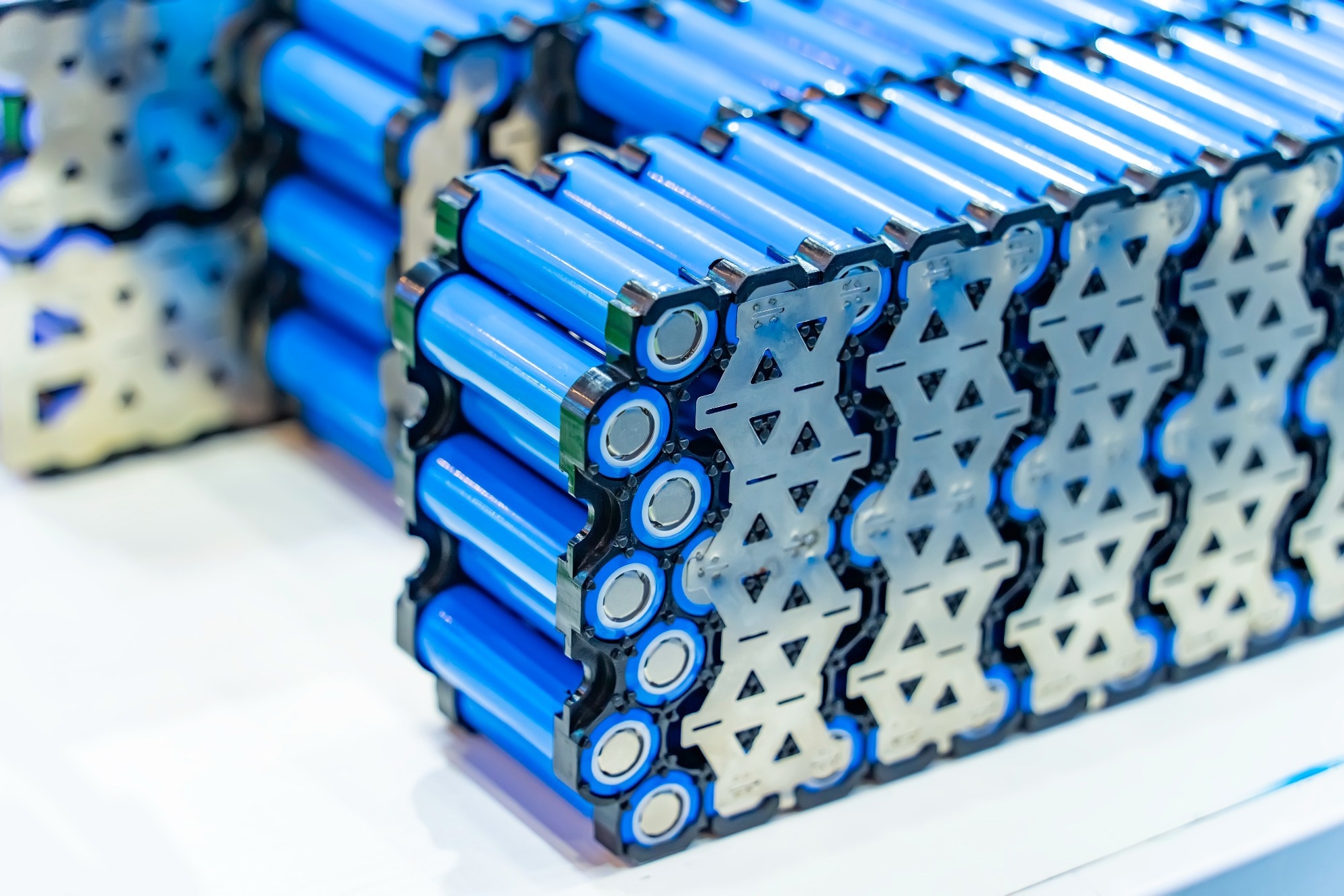
Paper: Four-dimensional X-ray nano-holotomography reveals multiscale chemomechanics in composite graphite–silicon battery electrodes. Image Credit: Asharkyu / Shutterstock
A paper recently published in the journal Nature Nanotechnology demonstrated a customized interrupted-operando X-ray nano-holotomography workflow for reproducible, reliable tracking of the morphological evolution of graphite–silicon (Gr–Si) composite electrodes during the initial formation cycle in lithium (Li)-based battery cells at high spatial resolution.
Importance of Structure–Performance Relationships
The degradation of Li-ion battery electrodes involves intertwined, complex phenomena. While these mechanisms heavily rely on electrode material properties and microstructure, precisely controlling electrode architecture remains difficult.
Understanding the complex chemomechanical interactions that regulate electrode activity is crucial for establishing structure (electrode microstructure)–performance (electrochemical performance) relationships.
Advanced methodologies are required to monitor electrode changes at both electrode and particle scales to determine how transport and morphology interact.
Three-dimensional (3D) space-resolved techniques with adjustable resolution are needed to determine the hierarchical structure of electrodes under representative operando conditions.
Role of X-ray Nano-CT
As a non-invasive 3D method, synchrotron X-ray computed tomography (CT) can analyze different chemistries with high spatiotemporal resolution. Tomographic datasets can measure mechanical failure modes and 3D strain fields in electrode materials like Gr and Gr–Si electrodes when coupled with digital volume correlation (DVC).
Yet, the submicrometer resolution required for complete particle-scale analysis is often absent in electrode-level studies. X-ray nano-CT can address this gap by combining large fields of view (FoV) with high spatial resolution (≤200 nm).
The propagation-based phase-contrast approach helps distinguish low-attenuating materials, which makes it suitable for Gr–Si composites and other light-element electrodes. So far, the nano-CT technique has been used extensively for post-mortem characterization.
Recent developments at fourth-generation synchrotrons have reduced acquisition times to below tens of minutes at submicrometer resolution, allowing four-dimensional (time + 3D) operando measurements during cell operation.
But specialized experimental workflows, setups, and battery cells need to be developed to ensure reproducibility and representativeness across measurements.
The Proposed Workflow
In this work, researchers demonstrated interrupted-operando synchrotron X-ray nano-holotomography coupled with DVC to track chemomechanical changes at electrode (averaged) and particle (local) scales. Quantitative scale-bridging image analysis was applied to composite Gr–Si electrodes during their electrochemical formation cycle.
Gr–Si was selected because it is suitable for investigating chemomechanical coupling, as during lithiation, Si undergoes 300% volume expansion and displays sequential (de)lithiation relative to Gr.
The authors compared electrode-wide and particle-scale mechanical responses to investigate the structure–performance relationship within Gr–Si electrodes by analyzing electrode-averaged features, individual particles, and particle subgroups.
The Methodology
In a Li metal cell configuration, the Gr–Si composite electrodes were cycled galvanostatically with cell-potential limits at 1 V and 5 mV at 110 mA g-¹. After attaining the lower cutoff cell potential, a potentiostatic hold was added.
The authors performed tomography acquisitions upon reaching a specific cell-potential limit or every hour. During each measurement, the current was interrupted, and the cell relaxed toward open-circuit potential, with an approximately 50 mV shift over about 12 minutes before the previous potential was recovered after current resumed.
At the ID16B beamline of the European Synchrotron Radiation Facility (ESRF), X-ray nano-tomography acquisition was conducted using the holotomography method, with a conic beam generated by a nano-focused beam, enabling multiscale measurements via geometric magnification.
Researchers first imaged the Gr–Si composite electrode at low magnification with a 257 nm voxel size, then carried out ex situ higher-resolution scans at 25 and 50 nm voxel sizes. Overall, 3,203 projections and 21 and 20 dark and reference images, respectively, were recorded for the multiscale acquisition settings. For the interrupted-operando 50 nm time series, the projection count was reduced to 2,205, giving a 9-minute scan.
Because the effective spatial resolution was insufficient to resolve much of the nanosilicon, about 75% of the silicon remained indistinguishable where it was intimately mixed with graphite or grafted onto graphite surfaces. The researchers monitored much of its (de)lithiation indirectly through changes in graphite and larger carbon-binder-domains–silicon (CBD–Si) clusters.
The multiscale acquisition scheme allowed researchers to quantify the complex microstructure of the Gr–Si composite electrodes while keeping the imaged volume representative of the electrode.
For the interrupted-operando measurement, the sample was located 280 mm from the detector and 52 mm from the focal spot, yielding a final voxel size of 50 nm and a 102 × 102 µm² FoV. This 50 nm value refers to voxel size rather than the smallest feature that could necessarily be resolved.
Findings of the Study
The particle-scale analysis showed that microstructural conditions could account for much of the variation not captured by electrode-wide averages. Of 14 local parameters assessed, nine had correlation factors above 0.35, and including microstructural factors could account for up to 90% of particle deviation from ensemble behavior, compared with 45% using conventional macroscale parameters.
The analysis found that local ionic diffusion, electrolyte contact, proximity to Si clusters, Gr particle position and morphology, and mechanical deformation were associated with local electrochemical activity and irreversibility. In this analysis, graphite volumetric strain at full lithiation was used as a proxy for electrochemical activity.
The strongest statistical relationships with electrochemical activity involved distance to fast geometric paths, particle/electrolyte surface fraction, and electrode depth. Fast ionic diffusion channels played a crucial role in counterbalancing depth-dependent reaction heterogeneities caused by ionic and electronic diffusion limitations.
Researchers found that electrode deformation was irreversible and highly anisotropic, predominantly driven by Gr particle deformation rather than Si. This supported Gr's role as the structural backbone, while localized particle movements induced microstructural rearrangements.
The spatial distribution of carbon-binder-domains–silicon (CBD–Si) clusters influenced the electrochemical activity and mechanical reversibility of surrounding Gr particles.
These results show why electrode-wide properties alone cannot fully describe the state of individual particles: transport pathways, surface contact, and surrounding microstructure can alter how particles respond even at similar electrode depths.
The authors conclude that the proposed workflow offers a practical approach to improving materials and electrode manufacturing. The study covers the initial formation cycle; the authors identify later cycles and advanced aging states as subjects for future operando work.
Disclaimer: The views expressed here are those of the author expressed in their private capacity and do not necessarily represent the views of AZoM.com Limited T/A AZoNetwork the owner and operator of this website. This disclaimer forms part of the Terms and conditions of use of this website.
Source:
- Vanpeene, V., Stamati, O., Cadiou, F., Jacquet, Q., Villanova, J., & Lyonnard, S. (2026). Four-dimensional X-ray nano-holotomography reveals multiscale chemomechanics in composite graphite–silicon battery electrodes. Nature Nanotechnology. DOI: 10.1038/s41565-026-02327-6, https://www.nature.com/articles/s41565-026-02327-6