A nanoscale “connecting-the-dots” network of carbon black and nanotubes traps visible light, producing an intensely black coating designed for established automotive spraying processes.
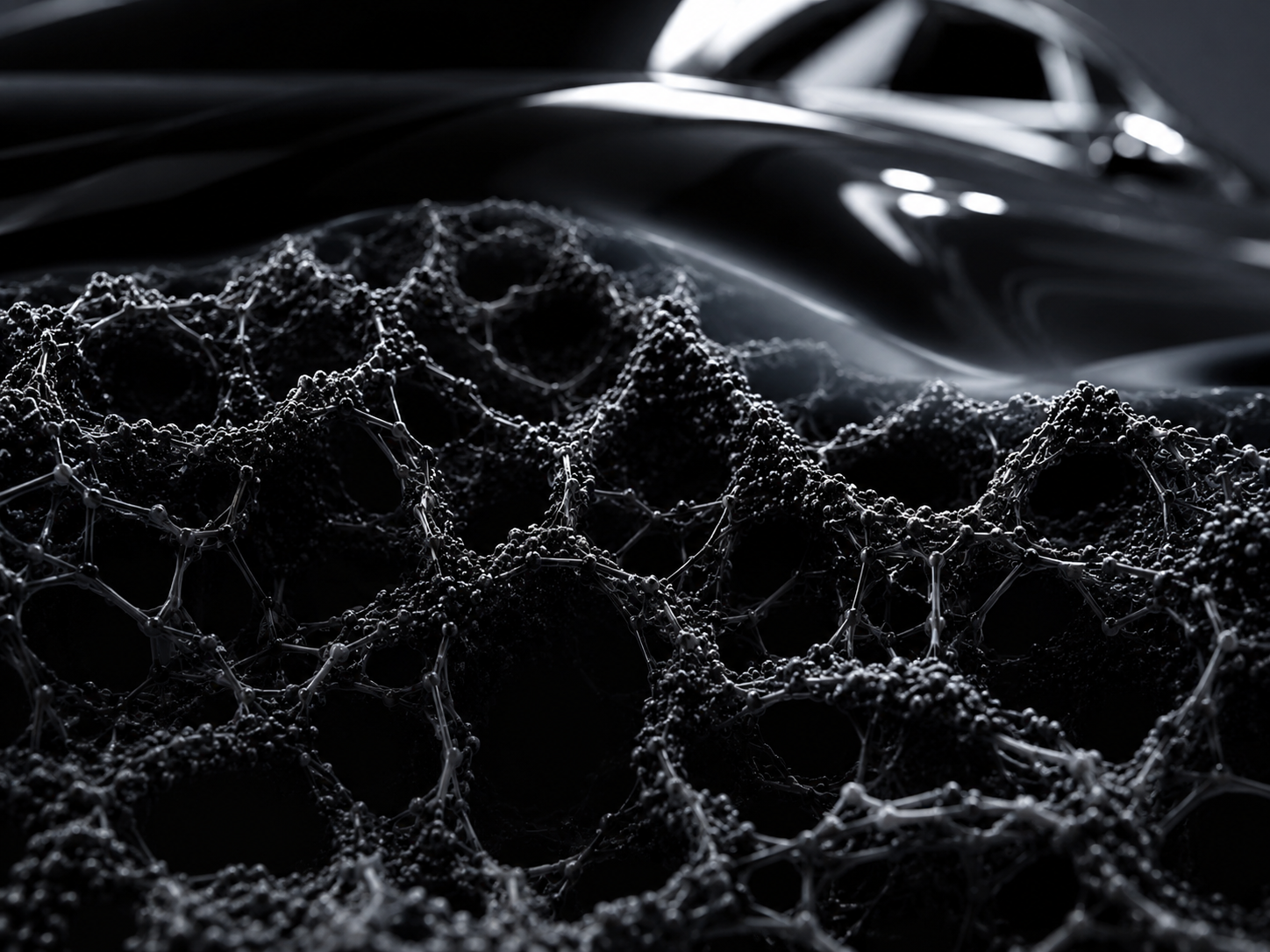
Paper: Robust ultra-black automotive coating with structural absorption and high absorption efficiency based on waterborne carbon black/CNT composite. Image credit: AI-generated image created using ChatGPT/OpenAI
A research paper recently published in the journal Matter & Light described a waterborne, spray-processable approach for fabricating ultra-black automotive coating formulations with structural absorption properties using a well-stabilized, ultra-fine carbon black-carbon nanotube (CB-CNT) composite dispersion.
Challenges in Realizing Ultra-Black Coatings
In the automotive coating industry, ultra-black coatings have attracted significant attention since the 2019 launch of the BMW concept car with ultimate blackness, which was coated with vertically aligned carbon nanotube (VACNT) arrays.
The VACNT arrays are highly suitable materials for fabricating ultra-black coatings, as they produce a visual optical black hole effect by absorbing almost all incident light.
However, the application of coatings based on VACNT arrays remains challenging in the automotive industry due to stringent film property standards and complex application requirements of automotive coatings.
The blackness of coatings is determined by the intrinsic light-absorption potential of black materials, which is the primary factor, and by the presence of structural optical traps in the coating that can mimic total internal reflection (TIR) to further increase the coatings' light-absorption capability.
Existing black-coating methods primarily rely on carbon black (CB) dispersions, exploiting the pigment's intrinsic absorption rather than structural light trapping. This common approach imposes a practical limit on further advances in blackness because of constraints on the achievable degree of dispersion.
Ultra-small particles experience strong cohesive forces, which can promote the formation of larger pigment particles through reaggregation. These larger particles reduce the light-absorption potential of CB pigments.
Thus, the current demand for ultra-black coatings in the automobile industry may be difficult to meet using traditional black coatings based on CB.
The Proposed Ultra-Black Coating Fabrication Approach
In this study, researchers described a straightforward approach for synthesizing ultra-black coatings with application-relevant adhesion under selected automotive coating test conditions, based on a well-stabilized and ultra-fine CB-CNT black dispersion.
Carbon nanotube (CNT) and crude CB pigment were dispersed by a high-energy sand-milling machine with high-performance dispersants to produce a well-dispersed CB-CNT black dispersion. Subsequently, the ultra-black coating was fabricated by incorporating the nanoscale CB-CNT black dispersion into a coating binder and applying it via spraying.
CB pigment, CNT, high-performance dispersant, and defoaming agent were used as starting materials.
CB-CNT and CB black dispersion: A mixture of deionized water, CB, CNTs, defoamer, and dispersant was added to the high-energy sand-milling machine. The dispersion was milled for 5 h to obtain a CB-CNT black dispersion with 20.5% solid content.
A corresponding CB-only dispersion was prepared under the same milling conditions and at the same solid content.
Pristine CB and CB-CNT film: The CB black dispersion was applied to a black-and-white card using a 100 μm wet film applicator. Subsequently, the card was placed in an oven for 15 min at 120 °C to create the pristine CB film. The CB-CNT film was prepared under the same conditions.
CB black and CB-CNT ultra-black automotive coatings: A homogeneous liquid coating was obtained by stirring a mixture of a waterborne transparent binder with either CB black dispersion or CB-CNT black dispersion for 30 min.
Deionized water was used to dilute the liquid coating, and then the resulting coating and common clearcoat binder were sprayed sequentially with a rotary bell sprayer onto iron panels. The panels were then cured in an oven at 130 °C for 30 min.
The Coating Absorbed More Than 99.90% of Visible Light
Researchers successfully prepared a nanoscale CB-CNT dispersion for use in ultra-black coatings. They demonstrated a sprayable method compatible with established coating processes for constructing ultra-black coatings with application-relevant performance in the selected tests.
Accelerated centrifugation and rheological testing supported the dispersion’s long-term stability, although the study did not involve two years of real-time storage.
The combined effects of high inherent absorption capacity and structural absorption produced an average visible-region reflectance of approximately 0.08%, corresponding to more than 99.90% apparent absorption based on multi-angle specular reflectance measurements, along with high jetness and blackness. The authors attributed the preferential distribution of nanoscale CB particles along CNTs to strong π-π interactions, resulting in a distinct “connecting-the-dots” nanostructure.
Additionally, the highest jetness Mc and blackness My values reached 328.7 and 315.0, respectively. By comparison, the highest values measured for the CB-only coating were 304.3 and 296.4, respectively. The coating also displayed stable adhesion after a 14-day humidity test and a separate 10-day water-resistance test, supporting further development for practical automotive applications while stopping short of full validation.
The authors noted that comprehensive film-performance validation, including additional durability tests required for automotive coatings, remains necessary.
In conclusion, the findings of this study advance color technology for ultra-black automotive coatings from both industrial application and materials science perspectives.
The researchers were affiliated with NIPSEA Group and Nippon Paint (China), which supported the work, and the authors declared no competing interests.
Disclaimer: The views expressed here are those of the author expressed in their private capacity and do not necessarily represent the views of AZoM.com Limited T/A AZoNetwork the owner and operator of this website. This disclaimer forms part of the Terms and conditions of use of this website.