Inspired by bacterial injection systems, the programmable nanosyringe mechanically crosses synthetic membranes, controls molecular transport, and switches biochemical reactions on inside cell-sized compartments.
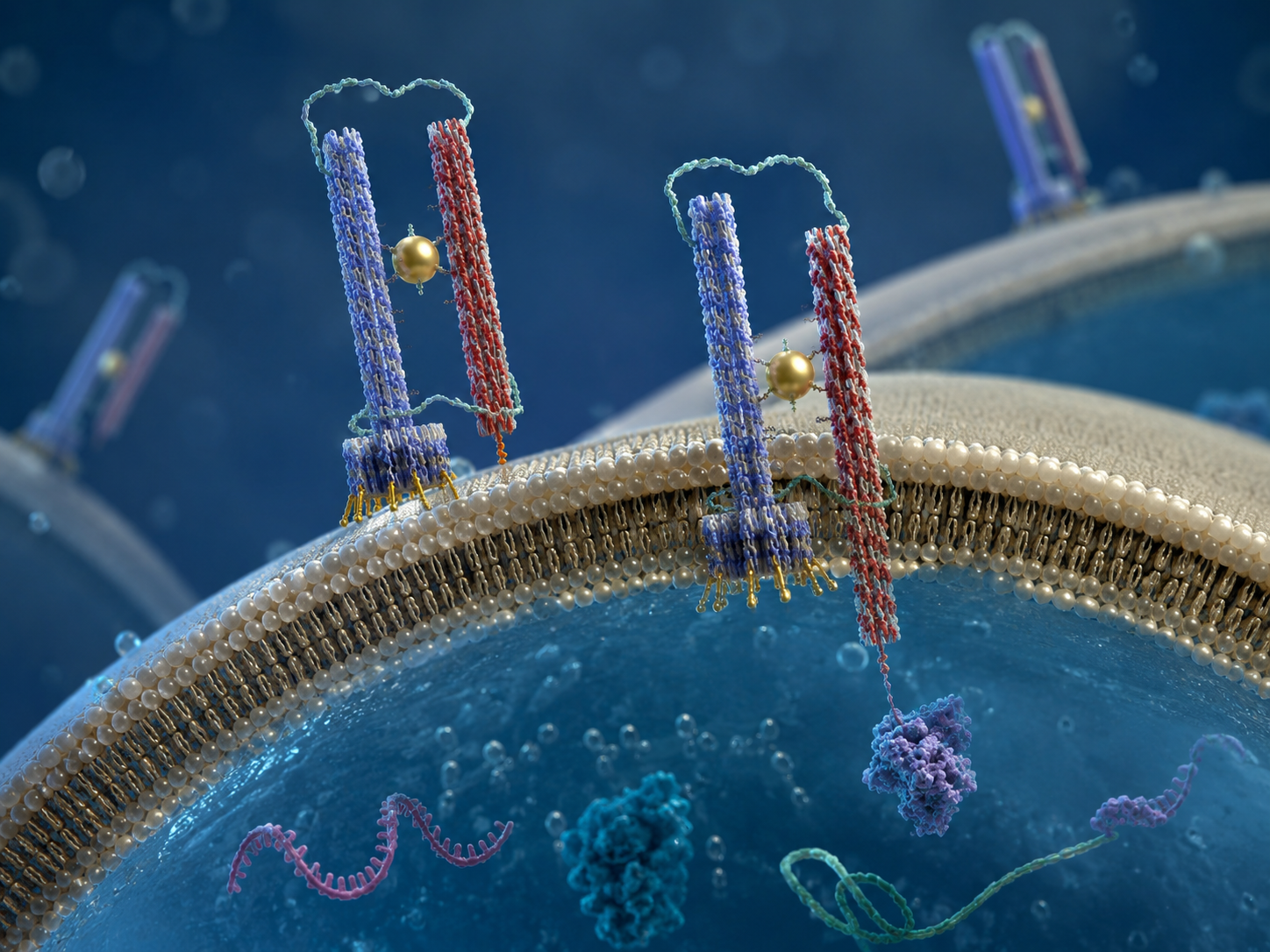
Paper: A programmable DNA origami nanosyringe for directed membrane translocation. AI-generated conceptual image created using ChatGPT/OpenAI.
In a recent study published in the journal Nature Nanotechnology, researchers introduced a fuel-driven DNA origami nanosyringe capable of precise, reversible membrane penetration and directed molecular delivery across model lipid membranes. Inspired by bacterial contractile injection systems, this device utilizes DNA strand displacement to generate controlled mechanical motion at lipid interfaces.
The nanosyringe achieves stepwise linear movement in increments of approximately 14 nm to penetrate lipid bilayers, thereby forming stable conductive pathways and delivering functional biomolecular cargo into compartmentalized environments. This marks a significant advancement in nanobiotechnology by transforming passive DNA origami scaffolds into mechanically actuated nanomachines that interact with cell-like membranes.
Natural Mechanisms and DNA Nanotechnology
Biological systems have evolved nanomachines that cross cell membranes by direct mechanical force, such as bacterial contractile injection systems that puncture target cell walls to deliver proteins. While these natural machines achieve good delivery efficiency, their structural complexity limits rational engineering and functional customization.
Structural DNA nanotechnology leverages predictable base-pairing rules to build modular architectures with high structural precision. Recent advancements have produced sophisticated DNA nanodevices, including rotary motors, synthetic turbines, and artificial nanopores. However, integrating programmable structure with reversible actuation and precise spatiotemporal control at lipid membranes has remained a major challenge.
Functionality of the Programmable Nanosyringe
Researchers constructed a programmable DNA origami nanosyringe from two antiparallel 70 nm DNA origami bundles, each comprising a 14-helix bundle. These bundles were connected by a single scaffold strand and crosslinked with a 10-nm gold nanoparticle. One bundle serves as the stationary membrane-anchoring base, incorporating a multihelix domain functionalized with cholesterol-modified DNA strands for stable membrane attachment. The second bundle forms a sliding needle built on a honeycomb lattice with three 2-nm central channels for passive diffusion and seven functionalization sites for cargo attachment.
Mechanical actuation is driven by four rows of oppositely oriented DNA footholds spaced at 7 nm intervals along the inner surfaces of both bundles. The gold nanoparticle binds to two foothold rows on each bundle with an assembly efficiency of nearly 91%. To achieve sliding steps, blocking strands detach the nanoparticle from occupied footholds, while removal strands reactivate previously deactivated footholds to enable rebinding at adjacent positions. This produces 14 nm sliding steps and a maximum displacement of 28 nm over two steps for membrane penetration.
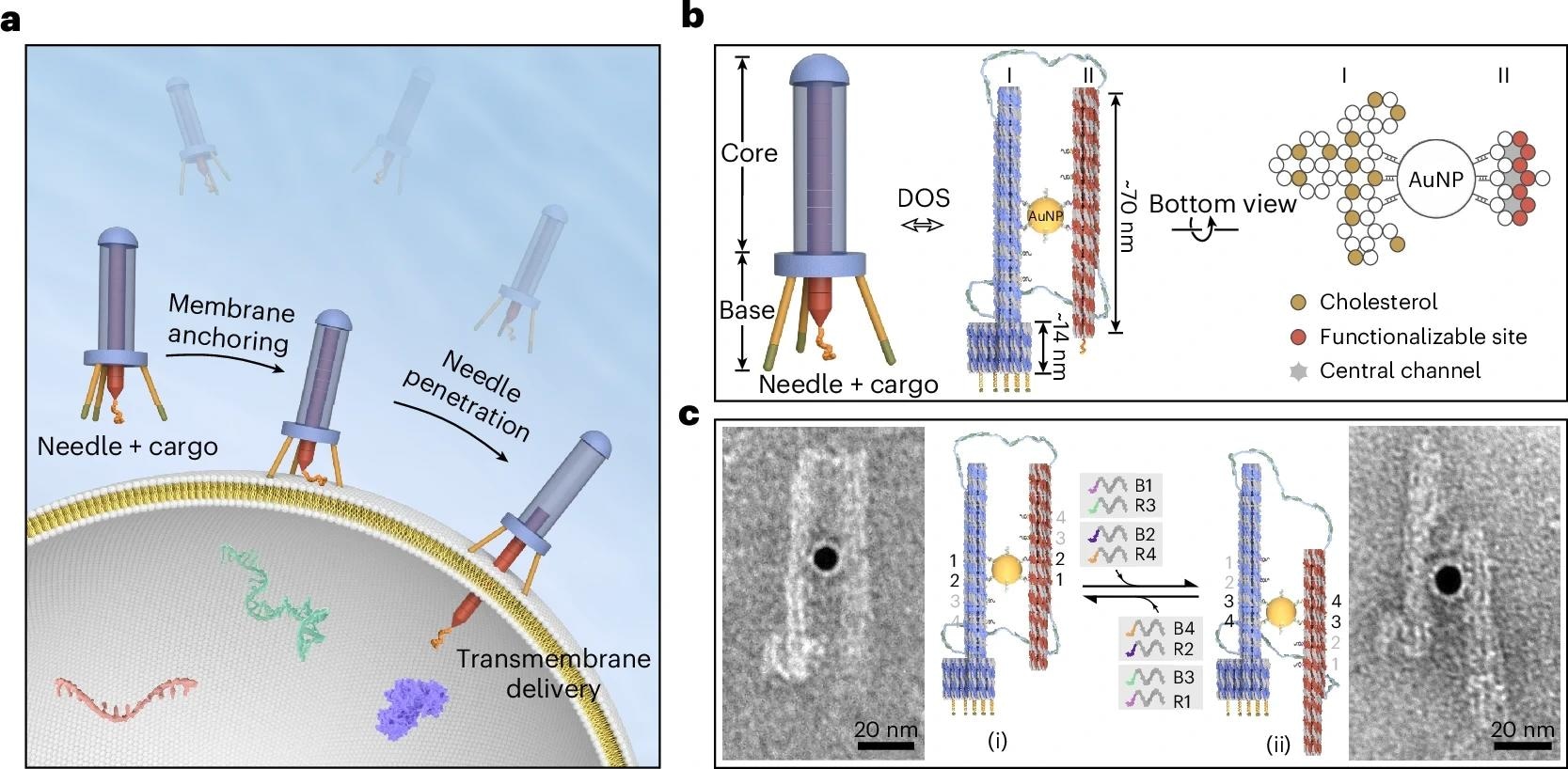
a, Conceptual illustration of the DOS’s operation on lipid membranes, highlighting two key steps: membrane anchoring and needle penetration. b, Schematic of the DOS architecture. The core consists of two antiparallel, 14-helix DNA origami bundles crosslinked by a 10-nm AuNP. The bottom of bundle I is appended with a multihelix, cholesterol-modified base for membrane binding. Bundle II features seven functionalizable sites at its bottom for cargo conjugation and serves as the needle, enclosing three ~2-nm central channels arranged in a honeycomb lattice. The scaffold strand passing through both bundles reinforces structural alignment, while preserving flexibility. Four rows of footholds are positioned along the inner surface of each bundle. c, AuNP-mediated reversible sliding between the two bundles, activated by toehold-mediated strand displacement upon the addition of DNA fuel strands. The AuNP binds to two foothold rows on each bundle, maintaining antiparallel alignment. Sliding is initiated by the simultaneous addition of specific DNA fuel strands. Blocking strands (B1–B4) release the AuNP from bound footholds, while removal strands (R1–R4) reactivate previously deactivated footholds, enabling AuNP binding. TEM images: (i) before and (ii) after two-step sliding.
Membrane Penetration and Reversible Resealing
Electrophysiological recordings showed that the nanosyringe remained non-conductive before activation, preserving lipid bilayer integrity. After adding DNA fuel strands, ionic current increased at approximately 33 minutes in a representative recording, indicating the formation of a stable transmembrane pore.
The current-voltage relationship remained linear, supporting a symmetric conductive pathway consistent with the needle's 2 nm central channels. Time-resolved kinetic analysis demonstrated that membrane penetration exhibited onset kinetics comparable to those of natural transmembrane proteins, including OmpF and aerolysin.
Confocal fluorescence microscopy demonstrated selective molecular transport based on size and charge. Sulforhodamine B readily diffused into vesicle lumens, reducing the normalized fluorescence difference from 0.94 before activation to 0.20 after activation. In contrast, the negatively charged 6-carboxyfluorescein showed limited transport, whereas 3-kDa dextran-Cy3 was completely excluded due to the channel dimensions.
Nanosyringes with blocked channels indicated almost no permeability, confirming that transport occurred predominantly through the needle lumen rather than by nonspecific membrane disruption. Fluorescence recovery after photobleaching and electrophysiological measurements supported operational reversibility and membrane resealing, with needle insertion reducing lateral mobility and subsequent fuel-triggered upward sliding restoring mobility and substantially reducing molecular transport after retraction.
The researchers also found that penetration efficiency decreased with increasing membrane mechanical resistance, indicating that membrane composition and physical properties can influence needle insertion.
Enabling Biochemical Reactions in Synthetic Cells
The nanosyringe integrates site-specific nucleic acid tethering with dynamic mechanical translocation, functioning as an externally controlled trigger for biochemical reactions inside an artificial cell. When DNA hairpin substrates were encapsulated within giant vesicles, they initially remained uniformly distributed, with no evident membrane-localized hybridization chain reaction. After fuel activation, initiator DNA strands attached to the needle tip were exposed to the vesicle interior, confining the hybridization cascade to the membrane surface and redistributing fluorescence from the lumen into a ring-shaped DNA polymer cortex.
To demonstrate gene circuit regulation, researchers delivered T7 promoter-activating DNA into giant vesicles containing T7 RNA polymerase, nucleoside triphosphates, and a Spinach RNA aptamer template. Following activation and 12 hours of incubation at 25 °C, fluorescence emerged within the vesicle lumen, confirming externally triggered transcription.
The nanosyringe was also functionalized with 10-23 DNAzymes to evaluate controlled RNA cleavage. Vesicles encapsulating a dual-labeled RNA substrate were activated in the presence of magnesium ions, which diffused through the nanosyringe channels to activate the translocated DNAzymes. Hydrolysis of a phosphodiester bond at the defined RNA cleavage site separated the fluorophore from its quencher, producing bright fluorescence throughout the vesicle interior.
Potential for Nanomedicine and Future Directions
In summary, the DNA origami nanosyringe establishes a platform for precise mechanical manipulation at biological interfaces. By integrating directional sliding, molecular channels, and functional cargo transport into a single system, this approach provides a programmable method for molecular transport across model lipid membranes. Unlike bacterial contractile injection, the nanosyringe needs no complex protein machinery and operates through programmable DNA strand displacement.
Future work could investigate alternative cargo-tethering chemistries, as the current design is most readily suited to biomolecules that can be conjugated to DNA. Such approaches may broaden the range of molecules that can be transported, although delivery into living cells, cell-selective targeting, and therapeutic delivery were not demonstrated in the present study. Together, these advancements provide a strong foundation for synthetic biology, cellular engineering, molecular diagnostics, and future therapeutic delivery applications.
Disclaimer: The views expressed here are those of the author expressed in their private capacity and do not necessarily represent the views of AZoM.com Limited T/A AZoNetwork the owner and operator of this website. This disclaimer forms part of the Terms and conditions of use of this website.