Clemson Researchers Bait Nanoparticle to Capture and Recycle Biologically Active Enzymes
Researchers at Clemson University have developed a new model system to gather and harvest enzymes while retaining the biological functioning of the enzymes. Living organisms produce enzymes which are round proteins that act as a catalyst for chemical reactions.
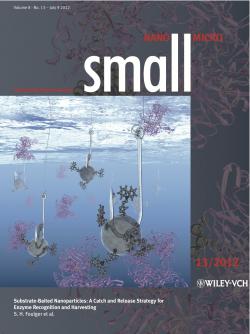 Baiting and harvesting of enzymes (Credit: Stephen H Foulger)
The research finding has significant impact on cancer research. The model can be applied not just in the extraction of recognized enzyme pairing but can also be employed in identifying unrecognized enzymes. With the method offering promise in biomedical applications, it is an indication of the direction of cancer research where the focus is shifting to the outer portion of nanoparticles in order to isolate proteins that guide the growth of cancer cells.
In order to find out the structure, function and interaction of a protein occurring in a complex mixture, it is essential to sequester the protein from the mixture. This is a difficult task. The researchers achieved this by employing a nanoparticle with the enzyme’s target attached to its outer surface. The enzyme in question was a protein produced in the soil. The enzyme was frozen in place while it took the target bait on the nanoparticle. On removing the nanoparticle, the team found that the enzyme still remained functional.
The ultimate aim of the researchers is to modify the proteins’ cellular concentration in cancer to prevent the cell from spreading and subsequently controlling the growth of cancerous cells in the body.
Written by
Will has a B.Sc. in Chemistry from the University of Durham, and a M.Sc. in Green Chemistry from the University of York. Naturally, Will is our resident Chemistry expert but, a love of science and the internet makes Will the all-rounder of the team. In his spare time Will likes to play the drums, cook and brew cider.
Please use one of the following formats to cite this article in your essay, paper or report:
APA
Soutter, Will. (2019, February 12). Clemson Researchers Bait Nanoparticle to Capture and Recycle Biologically Active Enzymes. AZoNano. Retrieved on September 10, 2026 from https://www.azonano.com/news.aspx?newsID=25375.
MLA
Soutter, Will. "Clemson Researchers Bait Nanoparticle to Capture and Recycle Biologically Active Enzymes". AZoNano. 10 September 2026. <https://www.azonano.com/news.aspx?newsID=25375>.
Chicago
Soutter, Will. "Clemson Researchers Bait Nanoparticle to Capture and Recycle Biologically Active Enzymes". AZoNano. https://www.azonano.com/news.aspx?newsID=25375. (accessed September 10, 2026).
Harvard
Soutter, Will. 2019. Clemson Researchers Bait Nanoparticle to Capture and Recycle Biologically Active Enzymes. AZoNano, viewed 10 September 2026, https://www.azonano.com/news.aspx?newsID=25375.
We're committed to providing free access to quality science. By registering and providing insight into
your preferences you're joining a community of over 1m science interested individuals and help us to
provide you with insightful content whilst keeping our service free.
or
Terms
While we only use edited and approved content for Azthena
answers, it may on occasions provide incorrect responses.
Please confirm any data provided with the related suppliers or
authors. We do not provide medical advice, if you search for
medical information you must always consult a medical
professional before acting on any information provided.
Your questions, but not your email details will be shared with
OpenAI and retained for 30 days in accordance with their
privacy principles.
Please do not ask questions that use sensitive or confidential
information.
Read the full Terms & Conditions.