A nanoscale layer of boron nitride addresses several weaknesses that have long limited perovskite QLEDs, with researchers uncovering how it affects defects, ion transport, heat flow, and light emission.
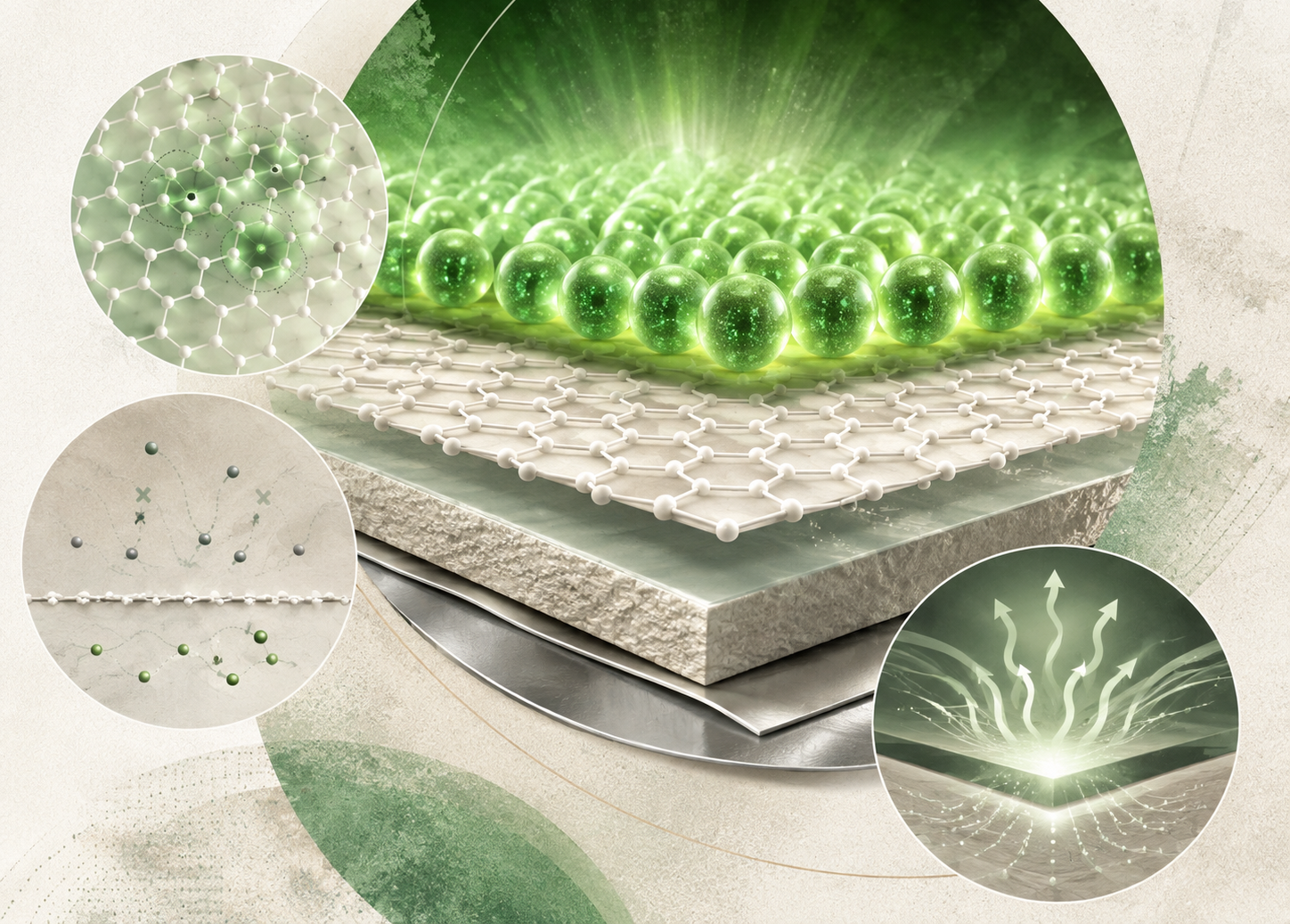
Paper: Ultrathin nano-layered boron nitride stabilizing perovskite quantum dot-based light-emitting diodes. AI-generated abstract conceptual image created using ChatGPT/OpenAI
In a recent research article published in the journal Nature Communications, researchers demonstrated that ultrathin nano-layered boron nitride can significantly enhance the operational stability of perovskite quantum dot-based light-emitting diodes (QLEDs) by serving as a buried interfacial layer that passivates defects, suppresses ion migration, and improves thermal stability.
Perovskite Instability, BN Solution
Perovskite quantum dot-based light-emitting diodes (QLEDs) have emerged as highly promising candidates for next-generation lighting and display technologies, largely due to their exceptional properties, such as strong carrier confinement and tunable emission.
The inherently soft ionic lattice of perovskite materials and the dynamic nature of their ligand binding lead to the formation of ionic defects and severe ion migration, particularly when exposed to operational stressors such as heat and electric fields. While interface engineering has been explored to mitigate these problems, soft organic molecular passivators can desorb during prolonged operation, compromising long-term device performance.
This challenge highlights a critical need for more robust, intrinsically stable interfacial materials, especially those with nanoscale precision, to effectively suppress ion migration and enhance the intrinsic stability of QLEDs.
QLED Fabrication, BN Integration
In this study, scientists integrated ultrathin nano-layered boron nitride (BN) as a buried interfacial layer within green perovskite QLEDs. The specific device architecture was designed as indium tin oxide (ITO)/PEDOT:PSS/PTAA/BN/QDs/TPBi/PO-T2T/LiF/Al, utilizing CsPbBr3 QDs.
The BN, a 2D material, was prepared as a nano-layered ethanol solution and spin-coated onto the hole transport layer (HTL). Its morphology was confirmed, revealing nanosheets approximately 20 nm in size with an ultralow root-mean-square roughness of ~0.34 nm, which is crucial for forming a uniform, highly effective interfacial barrier.
A comprehensive suite of advanced characterization techniques was employed to unravel BN’s multifaceted contributions at the interface. Density functional theory (DFT) calculations were initially used to model the spontaneous adsorption and charge redistribution at the interface between BN and the perovskite surface, predicting strong bonding interactions.
Structural analysis using grazing-incidence wide-angle X-ray scattering (GIWAXS) assessed changes in perovskite crystallinity and preferential orientation following BN incorporation. Experimental confirmation of these bonding interactions was obtained using X-ray photoelectron spectroscopy (XPS) and Fourier transform infrared (FTIR) spectroscopy. XPS detected binding-energy shifts consistent with charge donation from BN to Pb and Br, while FTIR peak shifts provided further evidence of bonding between BN and the perovskite.
To probe the impact on defect passivation and carrier dynamics, steady-state photoluminescence (PL), time-resolved PL (TRPL), and transient absorption (TA) spectroscopy were used, along with space-charge-limited current (SCLC) measurements to quantify trap densities.
The critical role of BN in inhibiting ion migration was investigated through simulations of migration paths and potential barriers, corroborated experimentally by temperature-dependent conductivity measurements to determine activation energies (Ea). Spatial evidence of ion migration suppression was obtained using time-of-flight secondary ion mass spectrometry (ToF-SIMS) depth profiling, which mapped elemental distributions through the device.
BN's Stability, Performance Enhancements
The integration of ultrathin nano-layered boron nitride (BN) substantially enhanced the stability and efficiency of perovskite QLEDs, primarily through nanoscale interface engineering. DFT calculations revealed that BN spontaneously adsorbs onto perovskite surfaces, inducing charge redistribution and forming strong bonding interactions.
This interfacial interaction was experimentally supported by XPS and FTIR. XPS showed characteristic shifts in Pb, Br, and N binding energies consistent with charge donation from BN to Pb and Br, while FTIR shifts supported bonding interactions between BN and the perovskite. This bonding effectively stabilizes the perovskite structure, promoting crystallinity and preferential orientation, as evidenced by GIWAXS patterns.
Crucially, this interaction leads to significant defect passivation, reducing the electron trap density from 3.05 × 1018 cm-3 in control devices to 2.38 × 1018 cm-3 in BN-optimized films. This reduction in defect density minimizes non-radiative recombination pathways, boosting the photoluminescence quantum yield (PLQY) to 87%.
Beyond defect passivation, the ultrathin BN layer acts as a highly effective physical and chemical barrier against ion migration, a major cause of QLED degradation. Simulations demonstrated that BN substantially increases the migration barrier energy for Br- ions from approximately 0.20 eV to 0.36 eV.
This theoretical insight was validated experimentally, with temperature-dependent conductivity measurements showing that the activation energy (Ea) for ion migration increased from 0.41 eV in control devices to 0.58 eV in BN-optimized devices.
ToF-SIMS depth profiling provided compelling spatial evidence, clearly showing a substantial reduction in the migration of Br- ions towards the hole transport layer. This suppression of ion migration helps maintain the perovskite structure during device operation.
The excellent thermal properties of nano-layered BN further contributed to device stability. The authors attribute this enhanced heat dissipation in part to BN’s thermally excited hyperbolic phonon polariton (HPhP) modes, which can provide an efficient channel for heat transport. Experimentally, BN-optimized QD films retained 78% of their original PL intensity at 100 °C, compared with 30% for control films, and also dissipated heat more rapidly after heating.
Interface Engineering: Stable QLEDs
This research demonstrates a practical strategy for improving the operational stability and efficiency of perovskite QLEDs through precise nanoscale interface engineering.
The resulting BN-optimized QLEDs achieved a measured T50 lifetime of 102 hours at an initial luminance of 2,000 cd m−2, with an independent laboratory verifying 99.7 hours. Using accelerated-lifetime measurements, the researchers extrapolated a T50 of 25,263 hours at 100 cd m−2. The devices also achieved an average peak EQE of 30.05%, placing them among the more efficient and stable green perovskite LEDs reported to date.
This work suggests that integrating wide-bandgap 2D materials, such as BN, at perovskite interfaces could help address some of the stability limitations that currently restrict practical applications of halide perovskite optoelectronics.