Researchers examined whether biologically produced nanoparticles can overcome long-standing weaknesses in glass ionomer cements without sacrificing fluoride release, color stability, or material safety.
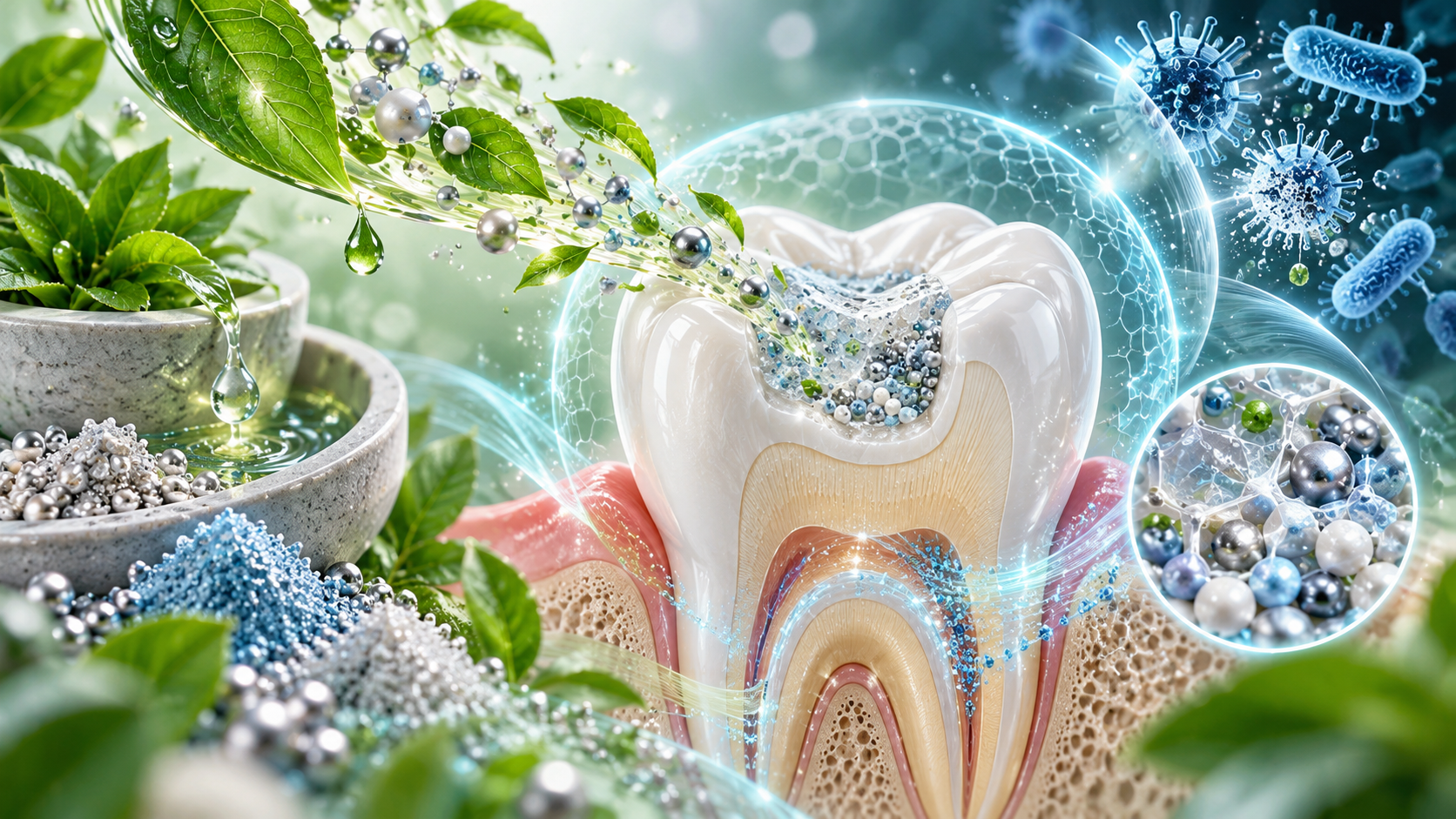
Paper: Green-synthesized nanoparticles for glass ionomer cement reinforcement: a systematic review of their antimicrobial, mechanical, and physicochemical properties. AI-generated abstract conceptual image created using ChatGPT/OpenAI
A systematic review recently published in BMC Oral Health critically evaluated the fluoride release, antimicrobial performance, and mechanical properties of glass ionomer cements (GICs) modified exclusively with green-synthesized nanoparticles (NPs).
Limitations of GICs
GICs are widely used restorative materials because they are thermally compatible with dentin and enamel, biocompatible, release fluoride, and chemically adhere to tooth structure. Yet conventional GICs have limited wear resistance and low mechanical strength, which restrict their use in stress-bearing regions.
Researchers have added various NPs to GICs to address these shortcomings. For example, researchers have incorporated chemically synthesized NPs such as titanium dioxide, gold, silver, and hydroxyapatite into GICs.
These NPs have shown potential to fill micro-voids within the cement matrix and improve antimicrobial activity and compressive strength. GICs modified with conventionally synthesized NPs still raise concerns about long-term biocompatibility and cytotoxicity, inconsistent mechanical performance under different conditions, and poor dispersion that can lead to agglomeration.
Potential of Green-synthesized NPs
Green-synthesized NPs are produced through biological processes that can reduce the use of toxic reagents and harmful by-products. These processes use biological agents such as biocompounds, microorganisms, or plant extracts to reduce metal ions into NPs.
Plant extracts contain a rich mixture of phytochemicals, including organic acids, sugars, alkaloids, terpenoids, flavonoids, and phenolics, that act as reducing and stabilizing agents.
Green-synthesized NPs may have lower cytotoxicity and better biocompatibility than chemically synthesized NPs, but long-term safety in dental applications still requires more toxicological and clinical evidence.
Bioactive compounds from the biological agents used in green synthesis may contribute to antimicrobial activity and infection control, but their effect on clinical outcomes such as postoperative sensitivity has not been established. Green synthesis can also produce variable particle characteristics because plant extracts and processing methods differ between preparations, making results harder to reproduce.
The Review
Many recent investigations have examined incorporating NPs into GICs, but much of this work included chemically synthesized NPs alongside green-synthesized materials or focused on individual NP formulations.
In this review, the authors critically evaluated fluoride release, mechanical properties, and antimicrobial performance in GICs modified exclusively with green-synthesized NPs. The study aimed to examine how green NP production affects material behavior and possible clinical use.
The authors searched several electronic databases for in vitro, animal, and clinical studies of GICs containing green-synthesized NPs.
The authors extracted data, synthesized results, and assessed quality using the Preferred Reporting Items for Systematic Reviews and Meta-Analyses (PRISMA) guidelines.
Inclusion criteria covered NP synthesis methods, material characterization, and measured outcomes. Overall, 25 studies met the inclusion criteria: 24 in vitro (laboratory-based) studies and one animal study. No human clinical studies were included.
A quantitative meta-analysis was not performed because the studies differed substantially in materials, formulations, and testing methods, making statistical pooling inappropriate. Instead, the authors conducted a qualitative systematic synthesis. Of the 24 in vitro studies, 11 were rated low risk of bias and 13 medium risk. The animal study had moderate overall risk.
Fluoride Release and Color Stability
Two studies investigated fluoride release. Both found that adding NPs did not diminish GICs' characteristic fluoride-releasing behavior. In some formulations using hydroxyapatite or chitosan-metal hybrids, fluoride release was modestly higher over longer periods, possibly because the nanoparticles altered cement porosity and ion movement.
Four studies assessed color stability. Low NP concentrations maintained clinically acceptable color-change values (ΔE), but higher loadings sometimes caused noticeable discoloration.
Mechanical Properties
Eleven studies evaluated mechanical properties. Most reported better mechanical performance after incorporating green-synthesized NPs into GICs, but the magnitude of the change varied by NP type and concentration.
For example, formulations containing chitosan-titania-zirconia-hydroxyapatite often had significantly greater compressive strength than unmodified GIC. Several studies reported gains of 20-30%.
Hydroxyapatite-based and zirconia-based NPs also increased microhardness and compressive strength. Biologically synthesized silver NPs produced more variable results: some studies reported reduced microhardness and microcracks, while others found modest gains.
Flexural strength was assessed less often, but the available studies consistently found higher values in GICs modified with multiphase or hybrid NPs. Chitosan-based NP blends produced the highest flexural strength values, typically about twice those of the corresponding control GICs.
The findings suggest that NPs with inorganic-organic hybrid structures may improve flexural resistance.
Antibacterial Activity
Sixteen studies evaluated antibacterial activity, making it the most frequently investigated outcome.
Green-synthesized NPs generally produced stronger antibacterial effects against several common oral pathogens, but the magnitude and range of activity varied with NP composition, concentration, and the microorganisms tested.
Plant-mediated silver NPs showed the most consistent gains among the included studies. Chitosan-, zirconia-, and hydroxyapatite-based NPs also showed favorable antibacterial effects, with results varying by NP concentration and composition.
The review suggests that green-synthesized NPs can improve the mechanical and antimicrobial properties of GICs and may offer sustainability and biocompatibility advantages over chemically synthesized counterparts.
The evidence came almost entirely from laboratory studies, so long-term safety and clinical benefits in patients remain uncertain. Before routine use in restorative dentistry, more precise NP characterization, standardized synthesis, clinical testing, and further toxicological research are needed.
Disclaimer: The views expressed here are those of the author expressed in their private capacity and do not necessarily represent the views of AZoM.com Limited T/A AZoNetwork the owner and operator of this website. This disclaimer forms part of the Terms and conditions of use of this website.
Source:
- Mohamed, M. et al. (2026) Green-synthesized nanoparticles for glass ionomer cement reinforcement: a systematic review of their antimicrobial, mechanical, and physicochemical properties. BMC Oral Health, 26, 1920. DOI: 10.1186/s12903-026-09657-w, https://link.springer.com/article/10.1186/s12903-026-09657-w