A Janus nanofiber dressing mimics skin, cools wounds under light, and uses visible light-triggered antibacterial activity to support faster repair in infected wounds.
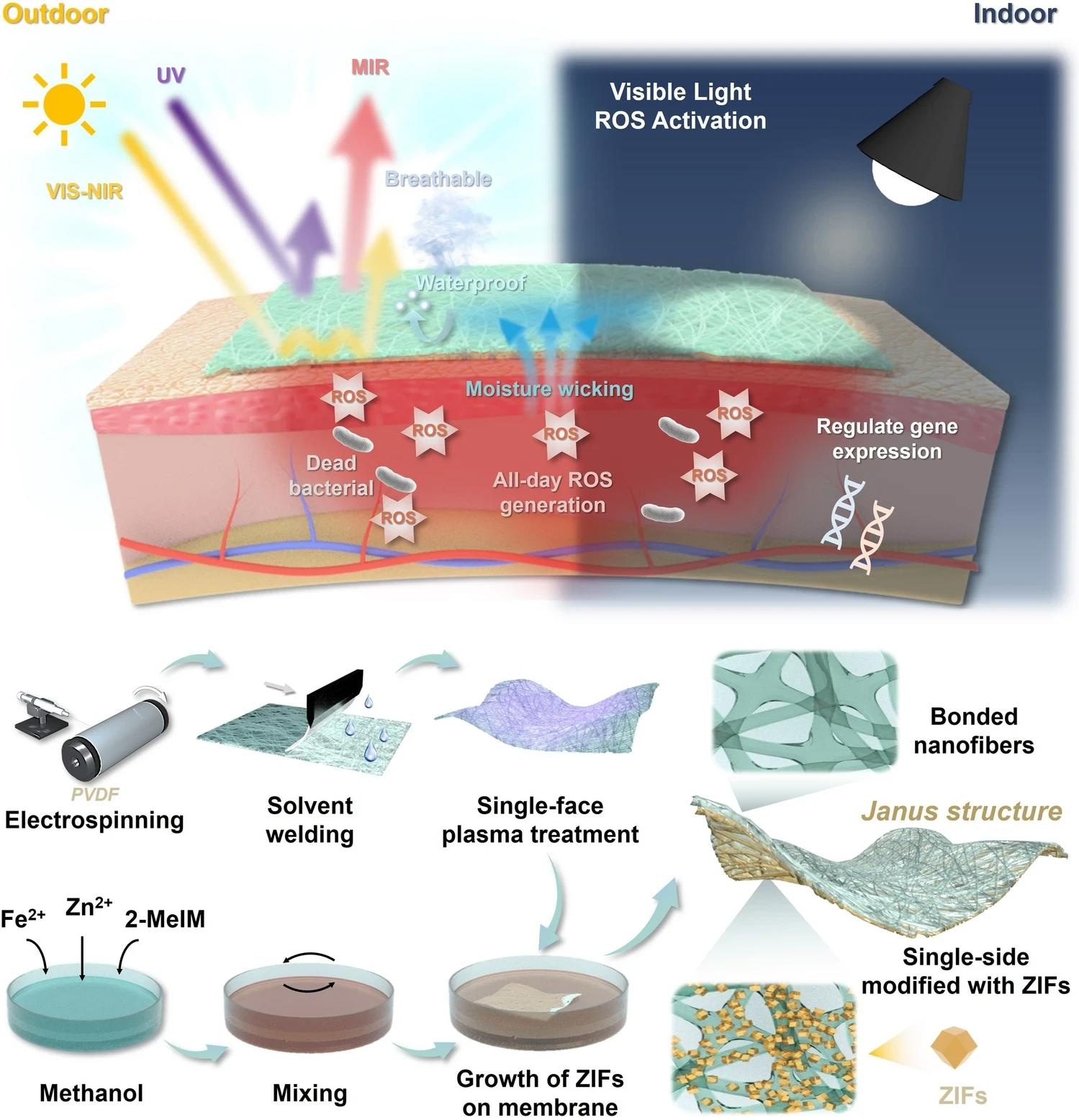
Schematic diagram of the bionic cooling skin design: a Janus structure, good breathability, antibacterial property, and passive cooling performance for accelerating infected wound healing.
A paper recently published in the journal Nano-Micro Letters proposed a “bionic cooling skin” based on hierarchical nanofiber construction for infected wound management. The hierarchical Janus nanofiber dressing was synthesized by integrating solvent-welding technology with visible-light-responsive single-sided metal-organic frameworks (MOFs).
Wound Healing Challenges
Skin wounds are a key health concern, with postoperative wound infections impacting 5%–20% of surgical patients. These skin wounds impair patients' quality of life and impose significant healthcare and economic burdens.
Wound repair is influenced by several aspects, with bacterial infection acting as a major impediment. Infections exacerbate inflammation, damage newly formed tissues, and delay healing.
While conventional wound dressings have played a major role in wound management, they have limitations. For instance, hydrocolloid dressings are generally unsuitable for infected wounds. Similarly, foam dressings are expensive, and gauze dressings cause pain during changes.
Importance of Effective Wound Dressings
Developing effective wound dressings that balance functional efficacy and wear comfort is crucial for the management of infected wounds. For example, nanofiber dressings synthesized by electrospinning offer high breathability and surface area, with growth factors and drugs encapsulated in nanoparticles for controlled release.
Piezoelectric materials can improve cell proliferation and differentiation. The microenvironment around the skin can be controlled by designing a nanofiber structure and diameter, enhancing comfort and managing the humidity and temperature of the wound area, which is useful for wound repair.
Yet new antibacterial materials are critical for combating antibiotic-resistant bacteria and for wound repair, given the overuse of antibiotics. Zeolitic imidazolate frameworks (ZIFs), a category of MOFs, display topological isomorphism with zeolites.
These frameworks can be developed with effective reactive oxygen species (ROS) generation, a controllable structure, and a modest preparation approach to obtain robust antibacterial properties. Yet, designing visible light-responsive antibacterial materials based on ZIFs remains a key challenge.
The Bionic Cooling Skin
In this work, researchers developed a bionic cooling skin with a hierarchical Janus nanofiber structure by combining hierarchical polyvinylidene fluoride (PVDF) nanofibers with functional ZIFs and solvent-welding technology, and single-sided MOFs that generate visible-light-responsive ROS for wound dressing.
Crucial physiological features of skin, such as favorable mechanical compatibility, moisture permeability, and breathability, are mimicked by the proposed bionic design. Solvent welding, single-sided ZIF modification, visible-light-responsive ROS generation, passive cooling, and wound-healing-associated gene regulation were linked to accelerated repair of infected wounds in a preclinical model.
The moisture and air permeability of the bionic skin were ensured by controlling the nanofiber pore size and welding, closely mimicking human skin function. Effective physical bonding points were formed between electrospun nanofibers through solvent welding, imparting exceptional mechanical characteristics to the synthesized membranes.
Additionally, the Janus structure design improved fluid diffusion within the inner layer and provided passive cooling under sunlight, enhancing wearing comfort. Visible-light-responsive ROS antibacterial functionality in the dressing was conferred by the ZIF modification.
The Research Effort
PVDF, zinc nitrate hexahydrate, 2-methylimidazole, dimethylformamide, iron(II) chloride hexahydrate, ethanol, methanol, and lithium chloride were used as the starting materials.
Initially, researchers fabricated a PVDF electrospun membrane and then used solvent welding to weld nanofibers and improve its mechanical properties. This was followed by plasma treatment of the prepared PVDF membrane and subsequent growth of ZIFs on the membrane.
Physical characterization was performed using scanning electron microscopy (SEM), transmission electron microscopy (TEM), X-ray diffraction (XRD), Raman spectroscopy, Fourier transform infrared (FT-IR) spectroscopy, and electron paramagnetic resonance spectroscopy.
Researchers also measured surface temperature and water contact angle, determined the water vapor transmission rate of the wound dressings, and assessed the air permeability of the designed wound dressings.
Additionally, they performed cytotoxicity and proliferation tests of the wound dressing, photoelectrochemical measurements, quantitative reverse transcription polymerase chain reaction (qRT-PCR) for angiogenesis and anti-inflammatory gene expression, infected wound-healing studies, and theoretical band-gap simulations.
The wound-healing experiments were conducted in Staphylococcus aureus-infected mouse wounds under white-light illumination, so the findings remain preclinical.
Viability of the Approach
Researchers successfully prepared a bionic wound dressing using solvent welding technology, achieving excellent mechanical properties with a breaking strength of 21.6 MPa and an elongation at break of 54%, closely mimicking human skin.
Mechanical simulations confirmed that the welded nanofibers maintained a uniform internal stress distribution during stretching. By regulating nanofiber welding and pore architecture, the dressing displayed high moisture and air permeability.
Its Janus structure successfully enabled passive radiative cooling and enhanced moisture transport, resulting in a high mid-infrared emissivity and a 4°C reduction in local skin temperature under sunlight. In outdoor in vivo testing, the Janus dressing also provided an average 1.7°C cooling relative to uncovered wounds.
Iron doping doubled the visible-light-induced ROS response compared with pristine PVDF@ZIF8, achieving a 97.1% antibacterial rate. Gene analysis showed that the dressing promoted wound healing in infected wounds by regulating genes associated with tissue repair, oxidative stress response, antibacterial defense, and skin development.
In conclusion, this study's findings demonstrated the feasibility of this novel bionic wound dressing for improving healing efficiency and comfort in preclinical infected-wound management.
Download your PDF copy by clicking here.
Disclaimer: The views expressed here are those of the author expressed in their private capacity and do not necessarily represent the views of AZoM.com Limited T/A AZoNetwork the owner and operator of this website. This disclaimer forms part of the Terms and conditions of use of this website.