By turning converter ripple into a data carrier, researchers show how batteries could report temperature data through existing power lines, potentially paving the way for nano-enabled internal sensors without extra communication wiring.
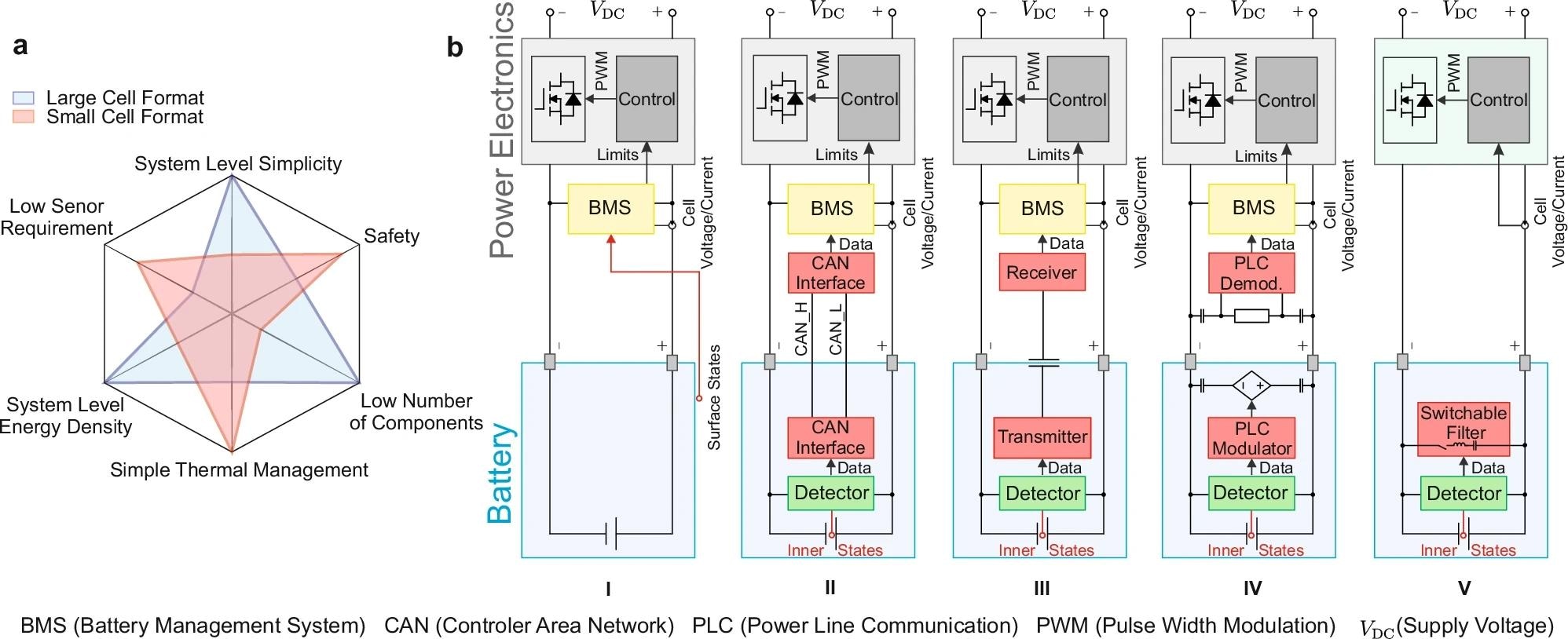
a Aspects of cell integration for large and small cell formats. b Different communication technologies in batteries. (I Simple Battery Management System (BMS) without communication to inside the cell, II Controller Area Network (CAN), III Capacitive coupling communication, IV Power Line Communication (PLC), and V the proposed communication strategy for internal sensing.
In a recent research article published in the journal Communications Engineering, researchers introduced a novel talkative battery concept that employs power-modulation-based communication to enable low-cost, cell-level thermal sensing in large-format lithium-ion battery cells, enhancing battery management for improved safety and performance.
Battery Communication Challenges
Lithium-ion batteries (LIBs) have become the cornerstone of modern energy storage solutions due to their high energy and power density, underpinning technologies such as electric vehicles (EVs) and large grid storage systems. The growing use of large-format lithium-ion batteries poses unique challenges for thermal management. Larger cells exhibit a lower surface-to-volume ratio, leading to significant temperature gradients between the core and the surface.
This gradient complicates thermal monitoring because surface measurements can underestimate core heating or rapid internal temperature changes caused by electrochemical reactions. Hence, internal temperature sensing, including approaches that place sensors closer to electrodes, separators, or the cell core, has gained attention as a route to monitor core temperature more effectively.
However, integrating sensors and communication electronics into the chemically aggressive, confined environment of LIBs requires careful selection for chemical stability, mechanical compatibility, and minimal interference with battery operation.
Conventional communication methods for sensor data transmission, such as Controller Area Network (CAN) or Power Line Communication (PLC), require additional cables or hardware, increasing complexity and cost.
This study leverages the electrical characteristics of battery cells, converters, and power connections to enable communication via load-shift keying (LSK), in which a switchable LC resonant circuit modulates impedance to encode sensor data onto power converter-induced ripple signals.
Impedance Measurement & Demodulation
The study employed Electrochemical Impedance Spectroscopy (EIS) to analyze the impedance characteristics of lithium-ion battery cells. An alternating current (AC) with a variable frequency and a root-mean-square (RMS) amplitude of 0.5 A was applied to the cells, and the resulting voltage response was recorded.
The impedance was calculated as the ratio of the complex voltage phasor to the complex current phasor across a range of angular frequencies. Multiple state-of-charge (SOC) levels were evaluated by alternating EIS measurements with short current pulses to increment the SOC in discrete steps.
For data demodulation, the researchers implemented a phase-sensitive detector (PSD) to extract the sensor signal from the converter-induced ripple. The cell current was monitored, and a high-pass filter with a time constant of 81 ms was used to eliminate low-frequency components, isolating the high-frequency communication signals.
The filtered output was then amplified and processed using a multiplexer controlled via pulse-width modulation (PWM) signals synchronized with the converter’s switching frequency. The multiplexer switched between the inverted and non-inverted amplifier outputs in accordance with the PWM control.
This approach enabled phase-sensitive synchronous detection of the load-modulated signals, facilitating data recovery in the tested configurations from the battery’s power-modulation-based communication pathway. All experimental setups and signal processing algorithms were designed to minimize interference with the battery's normal electrical operation, enabling potential integration of the communication system into large-format lithium-ion cells.
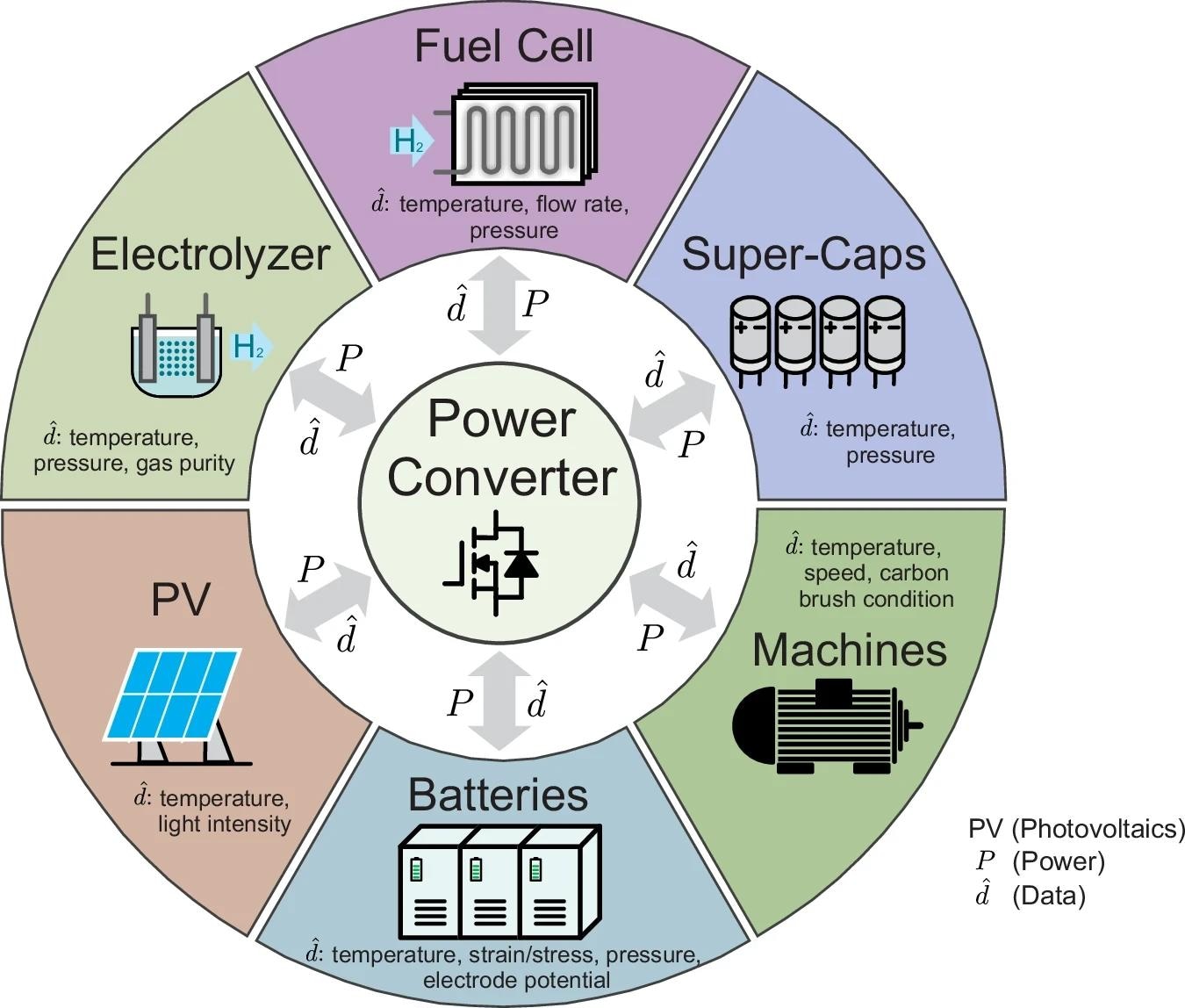
P represents the power flow between a component and the converter, while \widehat{d} is the data transmitted from the component to the converter and back.
Experimental Validation and Analysis
The experiments demonstrated the feasibility of collecting temperature data using the talkative battery concept, achieving a high signal-to-noise ratio, particularly with shorter connection cables. The study validated external sensing on a commercial 100 Ah lithium iron phosphate cell and internal sensing in a customized demonstration cell containing a miniaturized transmitter.
Rather than experimentally testing printed carbon-based sensor inks, the researchers used an NTC temperature sensor read through a voltage divider and converted the signal into a digital bitstream using a microcontroller. This confirmed the feasibility of transmitting temperature data through the proposed LSK-based communication architecture.
Notably, the switchable LC circuits were designed to be connected in parallel with the battery terminals, helping minimize disruption to normal cell operation, an important consideration for practical integration. The internal sensing experiment showed that temperature data could be transmitted from inside a customized cell, rather than a commercial sealed EV-scale cell, including during charging at approximately 10.3 A and at an effective bandwidth of 153 bit s−1, supporting the feasibility of embedded sensing architectures.
Additionally, the power-modulation-based communication eliminated the need for separate wiring or antennas, which are often constrained by metallic battery housings or spatial limitations. However, the results also showed that cable length and system tuning are important practical factors, with longer cables reducing signal quality in some configurations.
The results signify an advancement in low-hardware-cost battery-sensor communication, enabling safer large-format LIB designs by providing improved access to cell-level thermal information without requiring dedicated communication devices for each sensor.
Implications for Battery Safety
This study establishes a systems-level approach to enhance lithium-ion battery safety and management by combining temperature sensing with power-modulation-based data transmission in large cells and leveraging the cell’s electrical characteristics for data transmission via load shift keying.
The integration of an NTC sensor, a microcontroller-based transmitter, and a miniature switchable LC resonant circuit within the battery cell architecture offers a promising method for rapid monitoring of internal or external temperatures, overcoming the shortcomings of traditional external sensing methods.
The talkative battery concept maximizes the use of existing power-line signals for communication, thereby reducing complexity, cost, and potential failure points associated with additional wiring or transceivers.
Overall, the communication approach presented in this research could contribute to safer next-generation lithium-ion battery systems, particularly for electric vehicles and stationary energy storage, where accurate thermal monitoring is paramount. Further work will be needed to optimize tuning, cable-length performance, and integration with different sensor types and commercial battery-pack architectures.
Download your PDF copy by clicking here.
Source:
- Diers J., and Beiranvand H. (2026). Talkative battery: super-safe batteries with power-modulation based internal and external sensor data collection. Communications Engineering. DOI: 10.1038/s44172-026-00698-1, https://www.nature.com/articles/s44172-026-00698-1